[JIFF] A class with cinematographer Kim Woo-hyung
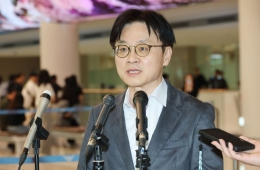
![Cinematographer Kim Woo-hyung speaks at his masterclass session at the Jeonju International Film Festival held in Jeonju, North Jeolla Province on May 3, 2011. [Lee Jin-hyuk/10Asia]](http://www.asiae.co.kr/news/img_view.htm?img=2011050413461450478_1.jpg)
Cinematographer Kim Woo-hyung speaks at his masterclass session at the Jeonju International Film Festival held in Jeonju, North Jeolla Province on May 3, 2011. [Lee Jin-hyuk/10Asia]
People usually remember movies by their directors or cast but what the audience is actually looking at in a dark theater are the eyes of the cinematographer. Their eyes are the final window on the movie as well as the most secretive channel for communicating with the audience.
The final 'master' at the 12th Jeonju International Film Festival (JIFF) following Claire Denis and Noel Burch was cinematographer Kim Woo-hyung. At the masterclass held after the screening for "Late Autumn" on May 3, Kim talked for over two hours on his first experience with the camera to how he entered London Film School, to how he created the behind-the-scenes video for director Jang Sun-woo's 1997 pic "Bad Movie" and then worked on films that followed after including "Empty Lies," "Happy End," "A Good Lawyer's Wife," "The President's Last Bang," "Paju," and most recently "Late Autumn." Below is a sneak peak into the secrets of 'master' Kim's works.
Actors, the director, cinematographer and crew don't come to trust each other after just a few nights of drinking together which you think would solidify teamwork. You check on it everyday through the work you see on the screening monitor. The director, actors and everyone else will trust each other and work hard at their job when each and every scene comes out the way everyone wanted it to.
Regarding the future of films and the digital era there have truly been a lot of discussions. But it has become meaningless to compare strengths, weaknesses and technical data. I really don't think it's that much of a change if you compare it to the moments where we went from black and white to color and no sound to sound. And every film is made under different circumstances and conditions so you can't choose the format it's going to be shot in without taking all of that into consideration as well. Close ups are close ups and full shots are full shots. Whether we're working digitally, with film, or with 16 mm, cinematographers try to work with the same attitude.
Some call me 'filming engineer' or 'filming director' while some just call me by my name. In the U.S. they call me DP (Director of Photography) or cinematographer. But whatever I'm called, I have always communicated and worked in the same way. Not paying attention to the lights when you don't get called a DP? I think that's wrong. The only difference is in the names.
Between a movie's director and cinematographer, having a script is not always a necessity. I think it's simply the best method to use for persuading actors and producers. But everyone expresses their thoughts on paper in different ways and on different levels so it can bring about misunderstandings. The fastest way to figure out what you really want to do is to watch many movies together and look for that tone and vibe you're going for.
The cinematographer is not someone who makes decisions. But instead, the cinematographer makes many suggestions. And those suggestions may or may not be adopted. You only start making suggestions freely and show what you're supposed to do once you start getting in sync with the director. But what I'm rather most concerned with these days is what happens on the set. The director is the one who gets the credit for the two-hour product while for his crew, two or three months of what they do on set will be their life so I believe things should be fun and cheerful on set. I think that's what is more important than there being a good relationship between the director and cinematographer.
On some days, 'happy accidents' occur. When the clouds suddenly clear away and the sun shines radiantly or an accidental fall turns out to be exquisitely beautiful... These are the beautiful moments which cannot be planned nor controlled but will maybe occur once for every movie, if you're lucky. In a way, such unexpected beautiful moments which may be considered technical glitches, are strokes of luck which go beyond the technical aspect of movies.
![[JIFF] Lee Myung-se says will win back male audience with next pic](https://cwcontent.asiae.co.kr/asiaresize/37/2011050215272337940_1.jpg)
Are cinematographers technicians or artists? I think they're both. But we can't be artists before we become technicians. You can only see artistic achievements after seeing technical achievements. You can't film beautiful moments just because you want to. You have to master the technical aspect of your job first and then make sure that you take control of it. If you stopped a clip and looked at a single scene, you'd be able to shoot it beautifully. But that's merely a brief moment. All scenes that have had a lot of effort put into look beautiful. But the moment they're played, the lighting, focus and color disappear and all you'll see is the actor's performance. To us, how pretty Tang Wei's close up looks is not important. It's what's before and after that cut that's more important. Out real role is to decide the overall flow of the movie, show people where to look on that large screen and make what's important look important.
※ Any copying, republication or redistribution of 10Asia's content is expressly prohibited without prior consent of 10Asia. Copyright infringement is subject to criminal and civil penalties.
Photographer : Lee Jin-hyuk eleven@
Editor : Jessica Kim jesskim@
<ⓒ투자가를 위한 경제콘텐츠 플랫폼, 아시아경제(www.asiae.co.kr) 무단전재 배포금지>





![[단독]문신사법 시행 앞두고 엇갈린 법원…‘눈썹문신 무죄’ 대법 심리 착수](https://cwcontent.asiae.co.kr/asiaresize/308/2020013114494834033_1580449788.jpg)


![[시시비비] 과학, 맹신, 사기… 혼돈의 딥테크 주식](https://cwcontent.asiae.co.kr/asiaresize/308/2026051407271078513A.jpg)
![[초동시각]코스피8000 시대, AI투자도 대전환 시급](https://cwcontent.asiae.co.kr/asiaresize/308/2026051409011380770A.jpg)
![[기자수첩]소상공인에겐 너무 먼 일·가정 양립](https://cwcontent.asiae.co.kr/asiaresize/308/2026051409481693494A.jpg)








!["10년 만에 해냈다…이번엔 진짜" 반도체 호황에 1분기 경상흑자 '사상최대'[BOK포커스]](https://cwcontent.asiae.co.kr/asiaresize/309/2026051315410261534_1778654463.png)