[The K-Shaped Consumption Era]② The Disappearance of the Middle... The Collapse of the Middle Class
Wave of Mid-Priced Brands Exiting the Market
Shrinking Middle Class... Diminished Spending Power
Spread of U.S.-Style K-Shaped Consumption in Korea Raises Concerns for Domestic Demand

#The American fast fashion (SPA) brand Gap withdrew from the Korean market last year, marking the end of its 17-year presence since entering Korea in 2017. This was due to the expiration of the licensing agreement with its Korean importer, Shinsegae International. In the domestic market, Gap maintained higher prices through department store-centered operations, which led to it losing ground to cost-effective SPA brands like Uniqlo.
Additionally, Kolon FnC discontinued its lifestyle brand 'Epigram' and menswear brand 'Amofre' after the fall/winter (FW) season last year. At the end of last year, Handsome ended the operations of its women's young casual brand 'SJYP' in department stores and outlets, while Samsung C&T Fashion Division also discontinued its women's brand Cotelo in the summer of last year.
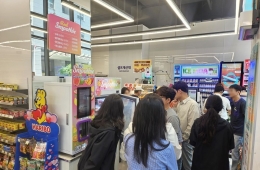
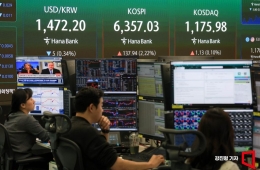
As the Korean consumer market is being reshaped around 'premium' and 'ultra-low price' segments, mid-priced brands are rapidly disappearing. This so-called 'screwflation' phenomenon—where the purchasing power of the middle class is weakened due to declining real wages caused by rising prices—is spreading. When consumption is concentrated in certain groups, it may appear that overall consumption is recovering in economic indicators. However, the decline in middle-class consumption raises concerns that the domestic demand base may be weakened and economic volatility could increase.
According to the Ministry of Economy and Finance's 'Household Trend Survey for Q4 2025' released on April 21, the income quintile share ratio based on equivalized disposable income for the fourth quarter of last year was 5.59, up 0.31 points from 5.28 a year earlier. The income quintile share ratio is calculated by dividing the average income of the top 20% (the fifth quintile) by the average income of the bottom 20% (the first quintile), indicating that the income gap between the highest and lowest groups widened compared to a year ago.
Even within the middle class, income polarization has intensified. According to the Ministry of Data and Statistics' Household Financial and Welfare Survey, the proportion of the middle class (those with 50-150% of median income) stood at about 60% last year, little changed from 59% in 2015. However, during this period, the proportion of the lower middle class (50-75%) expanded from about 21% to around 24%, while the upper middle class (125-150%) shrank from 7-8% to around 6%.
![[The K-Shaped Consumption Era]② The Disappearance of the Middle... The Collapse of the Middle Class](http://www.asiae.co.kr/news/img_view.htm?img=2026041409080524666_1776125286.jpg)
As the proportion of the lower-tier within the middle class has increased, their disposable spending capacity has rapidly weakened. A key indicator of this is the 'surplus amount.' In the fourth quarter of 2024, the average monthly real surplus of households in the third income quintile (the top 40-60%) was 658,000 won, falling below the previous 700,000-won range. This is the first time since 2019 that the surplus amount for middle-class households has dropped below 700,000 won.
The surplus amount refers to the money households can spend freely after covering essential expenses. The decline in this figure not only indicates reduced savings capacity, but also shows that households are inevitably cutting back on discretionary spending, such as dining out, fashion, and leisure. This is the background for the emergence of 'screwflation,' where spending on non-essential items is drastically reduced.
This trend mirrors what first appeared in the United States. Following the COVID-19 pandemic, rising asset prices were concentrated among those holding financial assets, resulting in a rapid expansion of wealth among upper classes and a clear shift to a 'K-shaped structure' where consumption patterns are reorganized around high-income groups. In fact, the top 20% hold about 70% of total assets, intensifying asset concentration and shifting the consumer base toward the upper class. In this process, the spending capacity of the middle class has weakened and the 'middle market' has rapidly shrunk.
![[The K-Shaped Consumption Era]② The Disappearance of the Middle... The Collapse of the Middle Class](http://www.asiae.co.kr/news/img_view.htm?img=2026042109581833961_1776733099.jpg)
In fact, major fashion companies in Korea such as Samsung C&T Fashion Division, Shinsegae International, Kolon FnC, and Handsome have recently experienced both slowing sales growth and deteriorating profitability. Last year, Samsung C&T Fashion Division’s operating profit was 123 billion won, down 28% from the previous year, while Handsome's operating profit fell 17.8% to 52.1 billion won. Shinsegae International saw sales increase by 3.4%, but recorded an operating loss of 11.4 billion won, turning to a deficit. Kolon Industries FnC Division also saw operating profit drop to 3 billion won, a decrease of more than 80%.
These companies, which import and manufacture mid-priced fashion items known as 'contemporary' brands, have been hit hard as consumer polarization accelerates.
Experts warn that while this structure may help sustain consumption in the short term, it can weaken the domestic demand base and increase economic volatility in the long run. In particular, a consumption structure centered on upper-income groups can limit the scalability of consumption.
Hot Picks Today
!["Only the Top 1% Winning Big in Stocks Smile... '300 Million Won Splurges' or '10-Won Wars,' the Middle Disappears [K-Shaped Consumption Era]①"](https://cwcontent.asiae.co.kr/asiaresize/93/2026042114121434484_1776748334.png) "Only the Top 1% Winning Big in Stocks Smile......
"Only the Top 1% Winning Big in Stocks Smile......
- "If Relocated, I'll Resign"?40% of Millennial and Gen Z Employees Threaten to Qu...
- Department Stores Shine with Gourmet Offerings, Discount Marts Rival 1,000-Won S...
- Female Game Caster Makes Bold Move After Criticism Over "Short Skirt" on Broadca...
- Couple Secretly Making Love on Mountain Summit... Broadcast Live on the Internet
Park Mijeong, a research fellow at the International Finance Center, pointed out, "A K-shaped structure can trigger social instability because, even if high-income groups support overall consumption, factors such as employment slowdown and credit risk tend to spread first among low-income groups. In a social structure increasingly dependent on assets, a shock to the financial market could directly lead to a sharp contraction in consumption and an economic downturn."
© The Asia Business Daily(www.asiae.co.kr). All rights reserved.


!["They Said It Was 'Delicious' Milk... Is the 'List of Fake Milk Products in Korea' for Real? [Matjal X-File]"](https://cwcontent.asiae.co.kr/asiaresize/307/2023072413274517286_1690172865.jpg)