"Only the Top 1% Winning Big in Stocks Smile... '300 Million Won Splurges' or '10-Won Wars,' the Middle Disappears [K-Shaped Consumption Era]①"
Polarization in the Consumer Market Becomes Entrenched
Soaring Asset Prices Fuel High-End Spending
Middle Class and Below Flock to Ultra-Value Products
"If you order now, the estimated wait time is about 50 minutes."
On the afternoon of April 13, even though lunchtime had long passed, there was still a long line of people waiting at 'Twelve,' a food and beverage (F&B) brand located in House of Shinsegae Cheongdam in Gangnam, Seoul. The price of a single smoothie, the signature menu item, easily exceeded 20,000 won, but no customers were turning away. People could be seen taking photos of their drinks with their phones or checking their waiting numbers and nodding in acceptance.
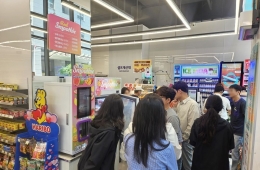
That same day, the CU convenience store located in the BGF Retail headquarters in Samseong-dong, Seoul, was bustling with customers eager to buy a 3,000-won smoothie from the vending machine. This smoothie, made by placing frozen fruit into the vending machine and ready in just one minute, has enjoyed explosive popularity as a cost-effective beverage since its launch in June last year. Yoo, an office worker in his 30s, said, "I tasted delicious smoothies from vending machines in Japan, so I even searched for a map of convenience store smoothie locations in Korea. Twelve is just too expensive, and I don't want to wait in line for it."

Number of people waiting at the CU convenience store smoothie vending machine. Provided by BGF Retail.
View original imageThe domestic consumer market is seeing the entrenchment of so-called 'K-shaped consumption.' Since the second half of last year, as the stock market has continued to perform well, spending by high-net-worth individuals has increased, while demand for ultra-low-priced and discounted products has also surged, making consumption polarization even more pronounced. Analysts point out that the middle class, which has traditionally supported the domestic market, is losing influence as a consumer segment. There are concerns that, combined with increased economic volatility in the future, this could lead to a rapid contraction in overall consumer spending.
Annual '300 Million Won' Splurges... VVIPs Boost Department Store Sales
According to the Ministry of Trade, Industry and Energy's '2025 Key Retail Sales Trends' released on April 21, major domestic department stores showed continuous growth for eight consecutive months from July last year to February this year. Department stores saw a 4.3% annual increase in sales last year, marking the highest growth rate among offline retailers. While concerns had been raised about slowing growth in the department store sector due to the rapid expansion of online markets in recent years, a surge in luxury goods sales led to record-breaking performance.
In fact, the so-called "Erusha" luxury trio—Hermes, Louis Vuitton, and Chanel—posted new records last year. Hermes Korea surpassed 1 trillion won (1.125 trillion won) in annual sales for the first time, up 16.68% from the previous year. During the same period, Louis Vuitton Korea recorded sales of 1.8542 trillion won. After surpassing 1 trillion won in annual sales in 2020, it is now on the verge of joining the "2 trillion won club" within six years. Chanel Korea’s sales also exceeded 2 trillion won (2.0125 trillion won) last year.
These luxury brands operate only within department stores and duty-free shops in Korea. In particular, department stores see their core customer base in VIP clients who spend more than 5 million won annually (according to Shinsegae standards; Lotte 10 million won, Hyundai 30 million won). Despite several luxury price hikes in recent years, demand has remained strong among these customers.
!["Only the Top 1% Winning Big in Stocks Smile... '300 Million Won Splurges' or '10-Won Wars,' the Middle Disappears [K-Shaped Consumption Era]①"](http://www.asiae.co.kr/news/img_view.htm?img=2026041409385424804_1776127134.jpg)
As a result, the proportion of VIP sales at the three major department stores—Lotte, Shinsegae, and Hyundai—has risen sharply. Lotte Department Store’s VIP sales share increased from 31% in 2023 to 45% in 2024, and to 46% last year. During the same period, Shinsegae Department Store’s VIP sales share rose from 44.1% to 47%, and Hyundai Department Store’s from 41% to 46%. For Shinsegae Department Store, the top VIP level, "Trinity," is awarded to only 999 top clients, whose average annual spending last year reportedly reached 200 to 300 million won. This is more than double the 120 million won average annual spending of the next-highest "Black Diamond" tier.
Department stores have continued to post solid results in the first quarter of this year as well. Sales have been particularly strong for luxury jewelry brands. According to Lotte Department Store, luxury jewelry sales in the first quarter surged 55% year-on-year, with foreign luxury brand growth reaching 30%. Shinsegae Department Store and Hyundai Department Store also saw luxury jewelry sales increase by more than 50% each. As a result, Shinsegae Department Store’s first-quarter sales are expected to reach 557.1 billion won, a double-digit (12%) increase.
'Ultra-Low Price Ant Trap'... Discount Brands Set New Sales Records

On the 24th, a customer visiting Daiso Emart Mokdong Store in Yangcheon-gu, Seoul is looking at cosmetics. 2025.2.24. Photo by Kang Jinhyung
View original imageUltra-low-priced products are also flying off the shelves. Daiso, the fixed-price household goods retailer, saw its annual sales exceed 4.5 trillion won last year. Daiso, which sells low-priced products ranging from 500 to 5,000 won, has expanded its product offerings in recent years to include cosmetics and fashion, boasting overwhelming value for money and breaking new sales records every year. Last year, Daiso posted an operating profit of 442.4 billion won and an operating profit margin of 9.7%, roughly three times the average profit margin of 3% seen by traditional retail conglomerates.
Uniqlo, the representative discount brand, is also showing clear growth. Last year, Uniqlo recorded sales of 1.3524 trillion won, an increase of about 27.5% from the previous year (1.0602 trillion won). After a dip during the "No Japan" boycott, Uniqlo’s performance rebounded to over 1 trillion won in 2024, marking two consecutive years of growth.
Industry observers note that these companies have become representative "recession-proof" channels as "value-for-money consumption" has become routine following the COVID-19 pandemic and inflation. The same applies to the rise of C-commerce platforms such as Aliexpress and Temu, which have targeted the Korean market with "ultra-ultra-low price value" in recent years. According to market research firm WiseApp Retail, in March, the number of monthly active users (MAU) for domestic e-commerce was led by Coupang (33.44 million), followed by Aliexpress (8.69 million) and Temu (8.17 million). Since 2023, the user base for these C-commerce platforms has surged, surpassing local e-commerce platforms and maintaining leading positions in the market since last year.
!["Only the Top 1% Winning Big in Stocks Smile... '300 Million Won Splurges' or '10-Won Wars,' the Middle Disappears [K-Shaped Consumption Era]①"](http://www.asiae.co.kr/news/img_view.htm?img=2026041409371024802_1776127030.jpg)
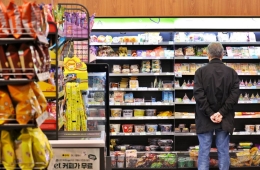
The trend of value-for-money consumption is also clear at large discount stores. Price competition has become routine, with retailers competing to offer even a 100-won discount on products, resulting in concentrated demand for ultra-low-priced goods. Major hypermarkets are engaged in fierce price wars, offering pork belly at 990 won per 100g or undercutting rivals by offering it at 880 won. In the process, consumers are restricting their purchases mainly to promotional items and essential groceries. A representative from a large supermarket commented, "The average purchase per customer is declining, and the focus on discounted items is intensifying. Although competitions over ultra-low-priced promotions are ongoing, the overall spread of consumption is limited."
Asset Market Surge Fuels K-Shaped Consumption... Concerns of a 'Recession Warning'
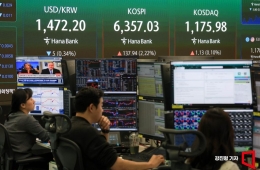
This kind of extreme consumer behavior is attributed to widening gaps between capital and labor, and more recently, the asset polarization brought about by the surging stock market. As the KOSPI sets new record highs and liquidity concentrates in upper-tier assets, the beneficiary class is expanding high-end consumption, while the rest are scaling back spending due to the burden of high living costs.
!["Only the Top 1% Winning Big in Stocks Smile... '300 Million Won Splurges' or '10-Won Wars,' the Middle Disappears [K-Shaped Consumption Era]①"](http://www.asiae.co.kr/news/img_view.htm?img=2026042021175233288_1776687472.jpg)
Jeong Yongtaek, a researcher at IBK Investment & Securities, analyzed, "The current coincidence of a booming asset market and shrinking consumer spending can be traced to widening disparities between capital and labor. As liquidity flows into financial markets rather than the real economy, asset prices rise, but the majority of consumers feel the economy is actually worsening."
Hot Picks Today
!["Only the Top 1% Winning Big in Stocks Smile... '300 Million Won Splurges' or '10-Won Wars,' the Middle Disappears [K-Shaped Consumption Era]①"](https://cwcontent.asiae.co.kr/asiaresize/93/2026041409371024802_1776127030.jpg) "Only the Top 1% Winning Big in Stocks Smile......
"Only the Top 1% Winning Big in Stocks Smile......
- "Despite Price Hike, Buldak Exports Surge... Samyang Foods’ Strong Performance ...
- [Exclusive] Latest Cancer Treatment Costs Rise by 40 Million Won... War Disrupts...
- Prime Minister Minseok Kim Steps Up for Honam: "All Efforts on Stable Launch of ...
- Couple Secretly Making Love on Mountain Summit... Broadcast Live on the Internet
He added, "During periods of deepening polarization, asset prices such as stocks often rise, but the burdens on segments with limited consumption power accumulate, weakening the sustainability of the overall economy. This current pattern of a 'recession amid a boom' could signal an inflection point in the economic cycle." While brisk sales of luxury brands and ultra-value products may give the appearance of a boom, such extreme consumption patterns could be early signs of a recession.
© The Asia Business Daily(www.asiae.co.kr). All rights reserved.

!["They Said It Was 'Delicious' Milk... Is the 'List of Fake Milk Products in Korea' for Real? [Matjal X-File]"](https://cwcontent.asiae.co.kr/asiaresize/307/2023072413274517286_1690172865.jpg)