⑥ Lack of Information and Unsubmitted Data: Government Assessments Fail to Support Patient Choice
Infertility Clinic Assessments Announced in 2020 and 2023
Provincial Infertile Couples Unaware, Rendering It Virtually Useless
Announced Once Every Three Years, Assessment Process Alone Takes Two Years
Criticism That the Information Is Not Up-to-Date
'To encourage voluntary quality improvement of infertility clinics by assessing whether they meet designation criteria and evaluating each procedure, thereby ensuring a safe treatment environment and patient choice.'
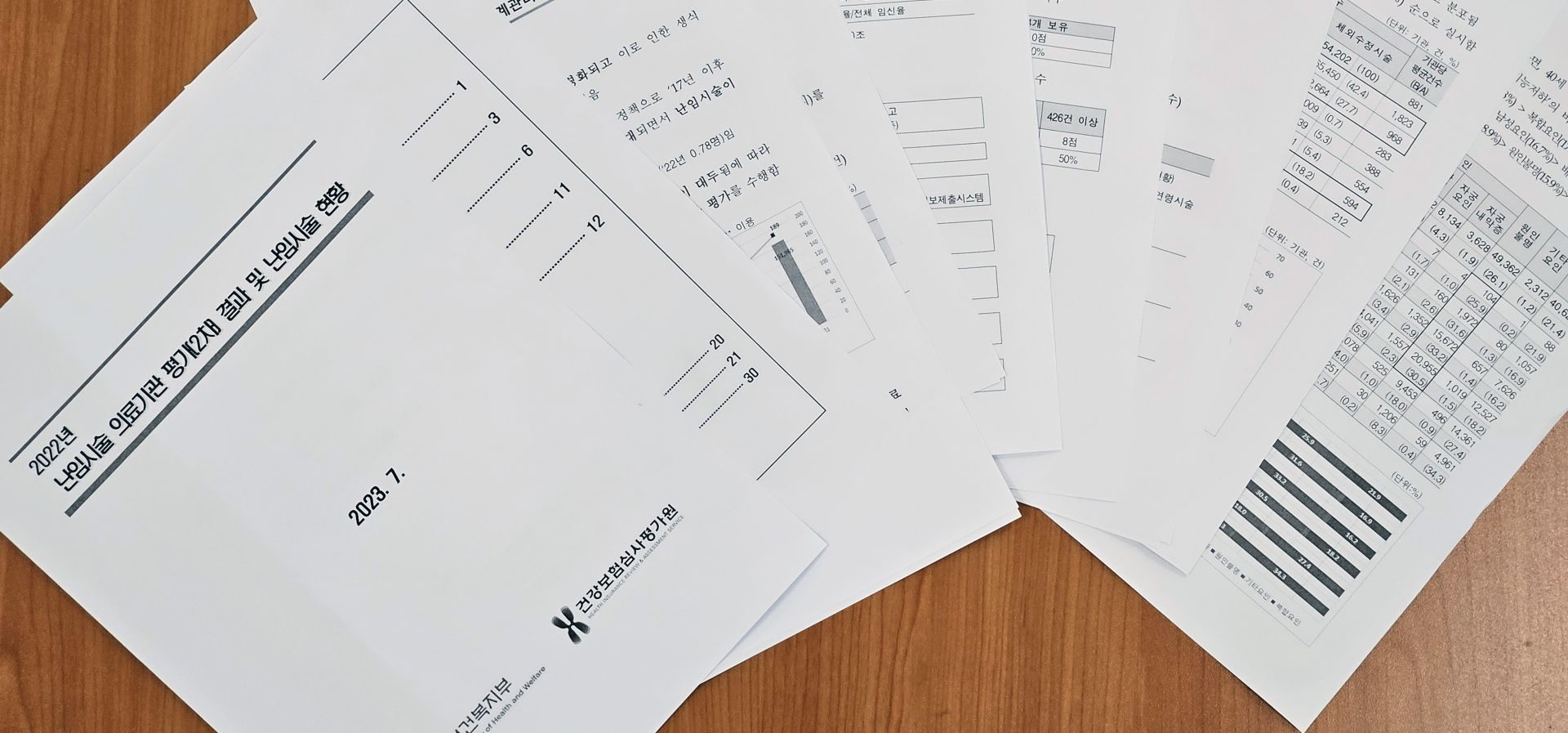
The government conducted two comprehensive assessments of infertility clinics in 2020 and 2023 and announced the results. As infertility patients increased rapidly due to delayed marriage and rising maternal age, the government began providing information and managing clinics offering infertility procedures. The core of the assessment is to check whether clinics have adequate specialists, facilities, and equipment, and whether artificial insemination and in vitro fertilization (IVF) procedures are properly performed. This assessment, conducted every three years, is scheduled for its third round next year. The results can be found on the Health Insurance Review and Assessment Service (HIRA) website.
Although one of the government’s stated purposes for the assessment is to guarantee infertile couples the right to choose their clinic, provincial couples interviewed by the reporter responded, "We didn’t even know such an assessment system existed." Some said, "I saw a banner at the hospital saying it was 'Grade 1,' but I was skeptical about the criteria." Even if most clinics are concentrated in the Seoul metropolitan area, if there is information about suitable local clinics, couples might consider those instead of traveling to Seoul. The problem is that the government’s assessment system is practically not used in the decision-making process for infertile couples.
Patients 'Ignore' Results That Lack Desired Information
The reason couples undergoing infertility procedures do not pay much attention to government assessments when choosing a clinic is that they are unaware of the assessment itself, and the publicly available information is not helpful. Since the assessment is conducted only once every three years and the process alone takes two years, there is criticism that the information is outdated. For example, the 2021 procedure data was assessed throughout 2022 and only made public in July of the following year, meaning couples must decide on a clinic based on results from two years prior.

The reasons for excluding clinics from the assessment are also not clearly stated. Reasons include ▲failure to submit data ▲not meeting the minimum number of procedures (at least 10 artificial inseminations or 30 IVF procedures per year), but only 'excluded from assessment' is indicated without specifying the reason. Regarding this, HIRA told Asia Economy, "The Infertility Clinic Assessment Committee decides how to disclose information, and for the third assessment, we are considering disclosing the reasons for exclusion by institution."
Above all, it is difficult to find the information infertile couples care about most, such as pregnancy success rates, from the public data. According to a 2021 survey by the Korean Women's Development Institute of over 600 women who underwent infertility procedures, the number one consideration when choosing a clinic was 'pregnancy success rate' (41.7%). However, unless individual clinics disclose this, infertile couples cannot check it through the government assessment. The detailed assessment criteria reflect average pregnancy rates for artificial insemination and standardized pregnancy rates (overall pregnancy rates) for IVF, but these are not disclosed externally.
Based on the two previous assessments, the government is supplementing the third assessment to be conducted next year by introducing some new indicators. A HIRA official stated, "We will strengthen the criteria for appropriate procedure volume and multiple pregnancy rates, and introduce assessments for embryo lab infection control and staff expertise in embryo creation."
![Consultation scene at Jamsil Cha Hospital Infertility Center. [Image source=Yonhap News]](http://www.asiae.co.kr/news/img_view.htm?img=2024101515290159364_1728973742.jpg)
Over Half of 'Grade 1' Clinics Concentrated in the Metropolitan Area
The government is cautious about disclosing clinic information. There are concerns that if information such as pregnancy success rates is made public, it could intensify the concentration of patients in the metropolitan area and increase competition among clinics. Lee Soohyeong, a research fellow at the Korea Institute for Health and Social Affairs who published a report last year on improving the quality assessment system for infertility clinics, said, "If results by institution are disclosed, there is a high possibility of data misuse and misinterpretation, leading to side effects such as concentration of patients at certain clinics. Disclosing statistical indicators by region or institution to the general public is premature."
Even the existing government assessment results clearly show the concentration of infertility clinics in the metropolitan area. According to the second assessment, as of 2021, 45% (97 clinics) of the assessed institutions were in Seoul, Gyeonggi, and Incheon, and 68.5% of all 189,373 procedures were performed in the metropolitan area. By city, 40.4% (76,585 procedures) were performed in Seoul alone, and 28.1% (53,236 procedures) in Gyeonggi and Incheon.
Asia Economy’s detailed review of the second assessment results found that among the 233 assessed clinics, those in Seoul, Gyeonggi, and Incheon received the highest grade, Grade 1, most frequently. For artificial insemination, 52% (60 clinics) were Grade 1, and for IVF, 54% (56 clinics) were Grade 1. Artificial insemination was divided into two grades, and IVF into four, with 115 and 104 clinics receiving Grade 1, respectively. Of course, since there are many clinics in the metropolitan area, a significant number were also excluded from the assessment for not submitting data or not meeting the minimum number of procedures?40 for artificial insemination and 49 for IVF.

Clinics with extensive experience in infertility procedures are also concentrated in the metropolitan area. The average annual number of procedures at all infertility clinics was 165.12 for artificial insemination and 1,063.46 for IVF. Of the 67 clinics performing more than 100 artificial inseminations per year, 38 were in Seoul, Gyeonggi, and Incheon; for IVF, 30 of the 53 clinics performing more than 1,000 procedures annually were in the same region. Although a high number of procedures does not directly translate to higher pregnancy success, experts say "experience cannot be ignored," making the preference for Seoul among infertile couples understandable.
44% of Infertility Clinics 'Failed to Submit Data'... "Mandatory Submission Needed"
The fact that many clinics are excluded from assessment due to non-submission of data is another reason why infertile couples find it difficult to rely on government assessments when choosing a clinic. Under the Mother and Child Health Act, the government evaluates the standards and performance of infertility clinics every three years and can revoke their designation based on the results. It also collects, analyzes, and manages relevant statistical data and discloses the results. To date, no infertility clinic has had its designation revoked by the government.
In the second assessment conducted in 2022, 68 out of 283 clinics failed to submit required documents such as the institutional survey and infertility procedure records. Considering that 56 clinics performed fewer than 10 artificial inseminations or 30 IVF procedures per year and were excluded for insufficient procedure volume, 44% of all designated infertility clinics were excluded from the assessment. In the first assessment in 2019, 70 out of 377 clinics failed to submit data. When the government requested data for the assessment, 90 clinics voluntarily gave up their designation.
As a result, the response rate of infertility clinics increased from 40.3% in the first assessment to 56.2% in the second, but the proportion of clinics actually receiving assessment grades remains in the 50% range, which is still low. A Ministry of Health and Welfare official explained, "During the assessment process, we encourage non-submitting clinics to provide data and request supplementary actions. In the process, some clinics return their designation, and various issues arise."
Since the government has committed to designating, assessing, and managing the quality of infertility clinics and providing information, there are calls to make data submission mandatory. Research fellow Lee stated, "To designate and manage infertility clinics, data submission is essential. Separate measures are needed for non-submitting clinics," emphasizing the need for legal amendments to make submission mandatory.
IndexDifficult Business Conditions
- As Marriage and Pregnancy Are Delayed, 1 in 7 Couples Faces Infertility
- "Six Hours of Travel for Just Ten Minutes of Infertility Treatment: Couples Are Growing Weary"
- On the Way to Seoul to Have a Baby... Feels Like the 'Punishment of Sisyphus'
- Why Fertility Doctors Are Boarding Flights to Jeju Island...
- "They Said on Online Forums... You Absolutely Have to Go to a Famous Hospital"
- "Infertility Clinic Evaluation System? I Didn't Even Know That Existed"
- Even the Government Doesn't Know... Flaws in the Infertility Treatment Support Program for Couples
- Local Governments' Infertility Treatment Support Exceeds 100 Billion Won... Gyeonggi Ranks First
- Central Government to Integrate Infertility Policies... Need for Standardized Services Across Regions
-
Reporter Jeong Hyunjin jhj48@asiae.co.kr
-
Edit Choo Myeonghoon chox2mh@asiae.co.kr
© The Asia Business Daily(www.asiae.co.kr). All rights reserved.



![[Reportage]"It Only Leads to Arguments"... Chungnam's True Sentiments Hide Deeper After Martial Law](https://cwcontent.asiae.co.kr/asiaresize/304/2026051223490460082_1778597344.jpg)