Labor Minister: "Must Be Resolved Through Dialogue"... What Is the 'Emergency Arbitration Power' That Could Affect the Samsung Electronics Strike?
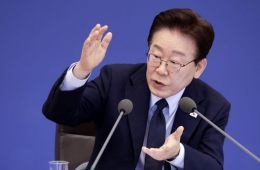
Kim Young-hoon, Minister of Employment and Labor, commented on the breakdown of post-mediation talks between Samsung Electronics labor and management, saying, "It is truly regrettable that a final agreement was not reached," and emphasized, "The issue must be resolved through dialogue, even if it means staying up all night." He drew a clear line regarding the possibility of invoking emergency mediation powers, repeatedly urging both sides to resume dialogue.
Appearing on the YouTube program "Jang Yunseon's News Convenience Store" on the 13th, Minister Kim was asked about the possibility of invoking emergency mediation powers. He responded, "Dialogue is necessary. Dialogue is urgent," and added, "The government's position is that both sides must be persuaded, even if it means splitting every second." He stated, "Whether to strike is the union's choice," but stressed, "The government will once again step in to mediate to prevent the situation from escalating into a strike."
The emergency mediation power is a system that the Minister of Employment and Labor can invoke under Article 76 of the Trade Union and Labor Relations Adjustment Act (the Labor Relations Act). If a labor dispute poses a risk of causing significant harm to the national economy or to daily life due to its scale or nature, or if it is related to essential public services, the government may intervene to restrict strikes.

When emergency mediation powers are invoked, all industrial actions by the union must cease immediately, and workers must return to their workplaces. For the following 30 days, all strikes are prohibited, during which the Central Labor Relations Commission initiates mediation and arbitration procedures. The mediation period is 15 days, and if an agreement is not reached during this period, the process may proceed to compulsory arbitration. Failure to comply is deemed an illegal strike. As this is a strong measure that limits the constitutionally protected right to collective action, it has rarely been invoked in practice.
In fact, emergency mediation powers were invoked in cases such as the 1969 Korea Shipbuilding and Engineering Corporation strike, the 1993 Hyundai Motor strike, and the 2005 Asiana Airlines and Korean Air strikes. In the most recent case involving Asiana Airlines, after last-minute negotiations between labor and management broke down on August 10, 2005, the government invoked emergency mediation powers. At the time, Asiana Airlines accounted for 37% of domestic passenger traffic, 21% of international passenger traffic, and 21% of cargo transport, with annual revenue reaching 2.9921 trillion won (based on 2004 figures).
As a result of the industrial action, from July 17 to August 9, out of a total of 6,936 scheduled flights, 2,208 flights were canceled (a cancellation rate of 31.8%), causing transportation disruptions for 493,000 passengers and 19,000 tons of export cargo. Asiana Airlines suffered direct revenue losses of 164.9 billion won. The total direct and indirect damages amounted to 323.3 billion won, and if the industrial action continued through the end of that week, the losses were expected to reach 423.9 billion won.
At the time, then Minister of Labor Kim Dae-hwan held a press conference at 6 p.m. on August 10 to announce the invocation of emergency mediation powers. He stated, "As the industrial action has continued, not only have the parties directly involved suffered losses, but related industries and the national economy as a whole have accumulated damages. The daily lives of the people are being seriously threatened, and recently, concerns about aviation safety have also been raised. Considering the current situation comprehensively, it is no longer possible to leave the matter solely to autonomous negotiations between labor and management. We have determined that the requirements for invoking emergency mediation under Article 76, Paragraph 1 of the Trade Union and Labor Relations Adjustment Act have been met, and, after consulting with the chairman of the Central Labor Relations Commission, have decided to invoke emergency mediation."
He added, "The labor and management parties at Asiana Airlines must understand that this emergency mediation decision was made not for the benefit of either side, but from the perspective of the public and the national interest. They must immediately return to work, normalize flight operations, and actively work toward a swift resolution of the dispute. If either party continues industrial action despite the emergency mediation decision, the government will respond strictly in accordance with relevant laws and regulations. We expect the labor and management at Asiana Airlines to demonstrate mature judgment and resolve the current situation wisely for the benefit of the public."
Regarding the current labor dispute at Samsung Electronics, Minister Kim stated, "The post-mediation process was by no means a waste of time," and added, "Regardless of formality, the issue must be resolved through dialogue, by any means necessary."
Hot Picks Today
 Even with High Oil Price Relief Payment, Additional 300,000 Won Per Person to Be Provided... Applications Open from the 18th in This Region
- Merck Scores First Invalidation of Halozyme Patent...Positive Signal for Alteogen and Keytruda SC Dispute
- Investment Warnings Surge... "Warning Light" Flashes as KOSPI Nears 8,000 Points
- "Those Who Hesitated at 3,000 Still Haven't Bought" 7 Trillion-Won Asset Manager Says "Opportunities Remain" [Investment Strategies of the Wealthy] ⑦
- "I'm Younger and Fitter Than Your Husband, Get a Divorce"... Suspicious Messages Between Wife and Fitness Trainer
Earlier in the day, the post-mediation process between labor and management at Samsung Electronics concluded without an agreement. The positions of the two sides remained far apart, and the labor union requested a halt to the mediation process. The Central Labor Relations Commission explained, "During the mediation process, we presented a variety of alternatives based on the positions of both labor and management and supported their negotiations, but the differences between the two sides remained significant."
© The Asia Business Daily(www.asiae.co.kr). All rights reserved.