
The employment rate among reclusive youth was 36.9%, which was only half compared to the 72.2% employment rate of non-reclusive youth. It is interpreted that the frustration of employment at the time they should enter the labor market became the key cause of youth reclusion.
Monthly Rent, Utility Bills, Food Expenses... Days of Youth Crushed by Tens of Millions of Won in Debt
#
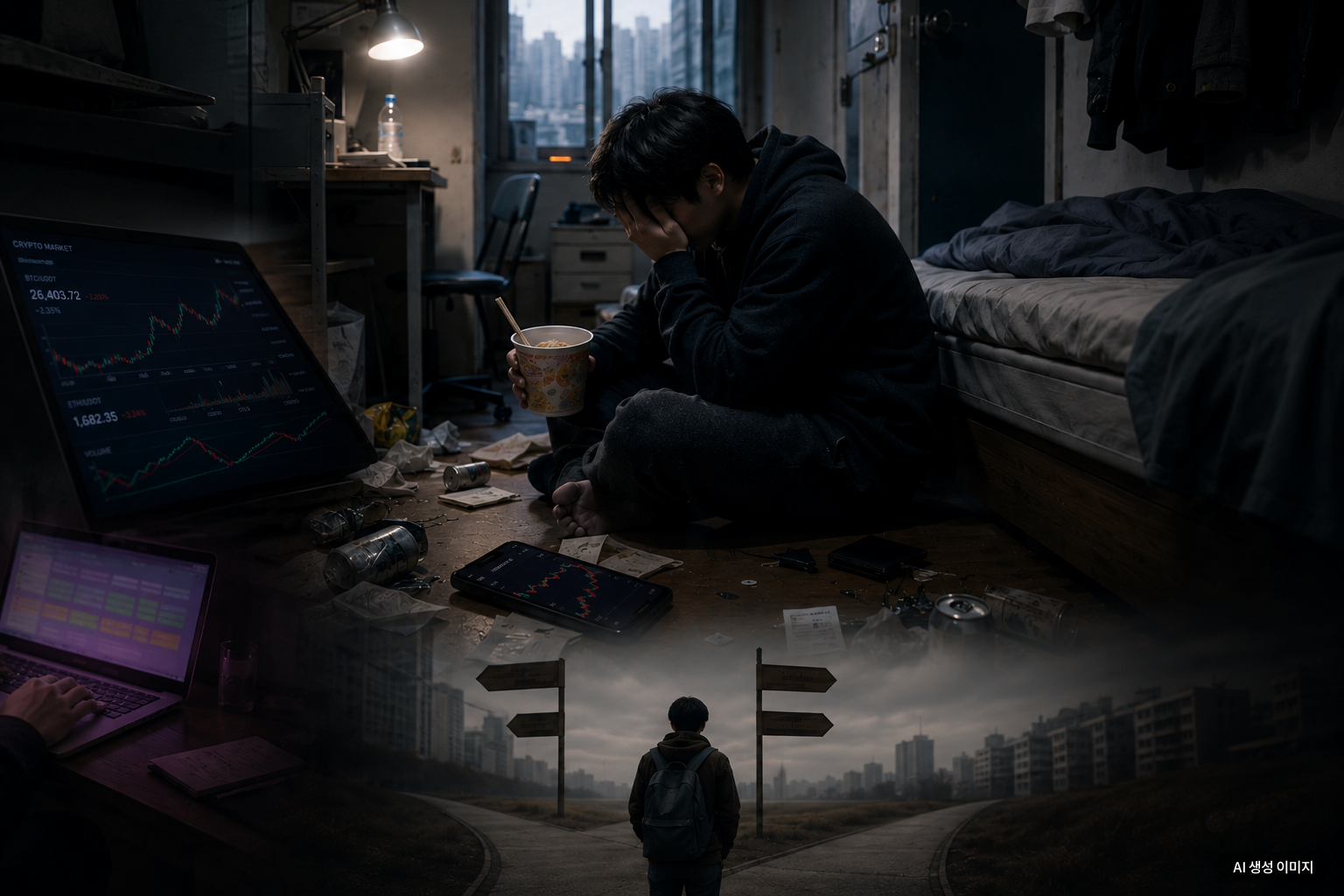
A studio apartment in Sillim-dong, Gwanak-gu, Seoul. For Sohn (27), a current student at Dongguk University, this cramped room is everything. The deposit is 10 million won. Nearly 1 million won leaves his account every month just for rent, management fees, and food expenses. For a job-seeker who has been on leave from school for over two years, this is a massive shackle. Sohn confessed, "I took out a 3 million won personal loan and also borrowed living expenses from the Korea Student Aid Foundation. I thought debt would be my last resort, but it has already stacked up to 30 million won."
Sohn eats only instant noodles in his room every day. At one point, he got into cryptocurrency, dreaming of making quick money. It was during a bull market. He pooled together borrowed money and invested 5 million won. Once, he made 2 million won in just ten days. He said, "When the dopamine rush hit, I lost touch with reality. I realized too late that easy money is spent just as easily, but when things get tough, ads promising '30 million won if you open a shell bank account' start to catch my eye."
Sohn eats only instant noodles in his room every day. At one point, he got into cryptocurrency, dreaming of making quick money. It was during a bull market. He pooled together borrowed money and invested 5 million won. Once, he made 2 million won in just ten days. He said, "When the dopamine rush hit, I lost touch with reality. I realized too late that easy money is spent just as easily, but when things get tough, ads promising '30 million won if you open a shell bank account' start to catch my eye."
#
For Noh (24), a student at Sookmyung Women's University, daily life is filled not with dreams, but with "work for survival." The studio near her school requires a 10 million won deposit and 500,000 won monthly rent. To find a slightly cheaper place, she moved all the way across the Han River to Sillim-dong. The tiny room, less than 13 square meters (4 pyeong), had no sunlight at all. After about a year, when even her emotions felt as dark as the room, she took out a jeonse loan and moved to a Youth Safe Housing apartment.
Her living situation improved, but debt totaling tens of millions of won weighed heavily on Noh. She even used a living expenses loan to cover her deposit. To make ends meet, she works four different part-time jobs, totaling 40 hours a week. After responding to a Korean language teaching job ad, she unwittingly had a burner phone registered in her name and even received debt collection documents. Still, whenever her situation becomes desperate, she feels like she is walking a tightrope. Noh sighed, "I'm scared, but there are many times when I consider high-paying, risky part-time jobs."
Her living situation improved, but debt totaling tens of millions of won weighed heavily on Noh. She even used a living expenses loan to cover her deposit. To make ends meet, she works four different part-time jobs, totaling 40 hours a week. After responding to a Korean language teaching job ad, she unwittingly had a burner phone registered in her name and even received debt collection documents. Still, whenever her situation becomes desperate, she feels like she is walking a tightrope. Noh sighed, "I'm scared, but there are many times when I consider high-paying, risky part-time jobs."
5.2% of Youth Are Reclusive... 'Employment Frustration' Leads to Social Isolation
The mental health of college students pushed to the edge is now showing warning signs. Harsh housing costs and student loan debt are pushing students into isolation even before they take their first steps into society. As finding a job becomes increasingly difficult, feelings of resignation have grown. With despair replacing dreams for the future, students have become more vulnerable to the dangerous temptations of gambling, cryptocurrency speculation, illegal high-paying part-time jobs, and drug addiction.
According to the report "Determinants of Youth Reclusion and Estimation of Socioeconomic Costs," released in February 2026 by the Korea Institute for Health and Social Affairs and the Federation of Korean Industries, there were an estimated 538,000 reclusive youth in Korea in 2024, accounting for 5.2% of all young people. Reclusive youth are defined as those aged 19 to 34 who rarely leave their homes or rooms for reasons other than pregnancy, childbirth, or disability. Considering that Korea's college enrollment rate reached 73.6% in 2024, it is estimated that a significant portion of reclusive youth are either college students or graduates.

This survey result generally aligns with the 4.5% result from 2023 when the Seoul Metropolitan Government conducted the nation's first survey on reclusive youth. At that time, 45.5% cited 'difficulty finding a job' as the reason for isolation and reclusion. In particular, the proportion of those who lived a reclusive life for more than five years was 28.5%.
Side Effects of Capitalism... "Strengthen Practical Economic and Community Education"
If the economic burden leads to accelerated social isolation among young people, the risk of exposure to quick-money schemes and other forms of deviation increases. Experts say that fundamentally, practical economic education is needed to mitigate the side effects of capitalism.
Professor Jo Sangshik of the Department of Education at Dongguk University diagnosed, "Because of uncertainty about the future, quick-money behaviors have become widespread, and the vicious cycle continues." He added, "In our country, education is centered on competition such as entrance exams and private tutoring, but economic education is only provided as an extracurricular subject. We need to make economic education a standard part of university general education, and, even before that, introduce education at the elementary and secondary levels to reduce the side effects of the capitalist system."
There was also an opinion emphasizing a community-based approach to education. Professor Park Seunghee of the Department of Social Welfare at Sungkyunkwan University said, "Youth isolation is not simply an economic issue, but a tragedy involving the destruction of community due to the spread of capitalism." She continued, "Our education system teaches only functional skills, and as we move into the era of artificial intelligence (AI), there needs to be more education that fosters a sense of community."
Information Notice
IndexUniversity Students in Danger
- Breathing Costs a Million Won... The Sighs of Youth Trapped in a Single Room
-
Reporter Jang Heejun junh@asiae.co.kr
-

Reporter Lee Jiye easy@asiae.co.kr
-
Reporter Park Jaehyun now@asiae.co.kr
-

Edit Eo Kangbi uhkb86@asiae.co.kr
© The Asia Business Daily(www.asiae.co.kr). All rights reserved.
!['WHO Declares International Public Health Emergency' Why the Untreatable 'Variant Ebola' Is More Deadly Than COVID-19 [Reading Science]](https://cwcontent.asiae.co.kr/asiaresize/323/2026052110164072055_1779326201.png)
!["Please Help Us": How Much Do Those Bowing 90 Degrees These Days Actually Earn? [Data Pick]](https://cwcontent.asiae.co.kr/asiaresize/323/2026052010120870131_1779239528.png)