[Exclusive] Will Samsung Electronics and Kakao Be Designated as National Critical Infrastructure? Government Moves to Overhaul Management System
Ministry of the Interior and Safety Discusses Overhaul of National Core Infrastructure Designation and Management
Concerns Grow Over Public Impact from Disruptions at Non-Core Facilities
Plans to Add and Subdivide "Industry" Sector within Nation
The government is set to overhaul the management system for national critical infrastructure. This move comes as a result of repeated incidents in which damages at private facilities—those not classified as national critical infrastructure—have affected not only public safety, but also the national economy. As a result, discussions are expected on designating value-added telecommunications services closely linked to people’s daily lives, such as Kakao, and national security resources, such as the semiconductor industry, as national critical infrastructure.
According to government ministries on May 13, the Ministry of the Interior and Safety has recently begun discussions to revise the designation and management system for national critical infrastructure.

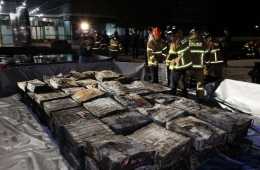
The scene of the fire at the National Information Resources Service in Yuseong District, Daejeon, which occurred in September 2025. Photo by Yonhap News
View original imageNational critical infrastructure refers to facilities, information systems, and assets that can have a significant impact on maintaining key functions of the nation, such as the economy, safety, administration, and health. By law, they are designated by sector—such as energy, information and communications, transportation, and healthcare. Designation is carried out under the Enforcement Decree of the Framework Act on Disaster and Safety Management, which specifies the name, managing institution, and reasons for designation. Dams, power plants, railways, and airports are examples of national critical infrastructure.
However, in recent years, large-scale disruptions have occurred at sites not designated as national critical infrastructure. A prime example is the 2022 fire at the SK C&C Pangyo data center. The fire rendered Kakao services unable to function normally for over five days. Even the National Information Resources Service in Daejeon, despite being designated as critical infrastructure, failed to contain a small spark, causing administrative systems nationwide to be paralyzed.
The purpose of revising the designation and management system for national critical infrastructure is to strengthen the protection system for key national facilities. The goal is to build a national-level protection system by addressing the inadequate classification system and lack of accident prevention measures.
The first step is to reexamine the current 368 facilities designated and managed across 11 sectors as national critical infrastructure. For example, in the energy and information and communications sectors, authorities plan to review the appropriateness and relevance of designations based on the established criteria. The classification system for national critical infrastructure will also be scrutinized, and facilities that may need to be excluded will be considered.
In particular, there are plans to review the possibility of adding and subdividing an “industry” sector within national critical infrastructure. This would involve supplementing the current 11 sectors—energy, information and communications, transportation, finance, healthcare, nuclear power, environment, potable water, key government facilities, joint-use facilities, and cultural heritage—with specific industries.
With these discussions as a starting point, there is potential in the mid- to long-term for relevant private companies in artificial intelligence (AI), semiconductors, and big data to be designated as national critical infrastructure. Kakao, Samsung Electronics, and SK hynix are being mentioned as examples. During the SK C&C Pangyo data center fire, there were calls to designate value-added telecommunications services as national critical infrastructure under disaster safety law. The need for national-level management of semiconductor-related facilities has also been raised.
The designation criteria for industrial sector national critical infrastructure, currently under review by the Ministry of the Interior and Safety, would apply to industries whose functional paralysis would significantly impact the maintenance of key functions in other sectors, or to industries that perform essential manufacturing functions, processes, or supply chain roles that are difficult to replace in the short term. The private companies now under consideration all fit these criteria. The ministry plans to identify candidate industries and prioritize them by evaluating overlap with existing sectors, findings from fact-finding investigations, and assessments of risk and vulnerability. Factors such as industry output, export share, substitutability, and impact on national credit ratings will also be reviewed.
However, the current discussions appear to focus only on “industry groups,” not on specific companies. This is because designating a particular company as national critical infrastructure could cause issues in the company’s business operations.
Once designated as national critical infrastructure, facilities are subject to national-level management. The government must develop protection plans tailored to each facility, region, and industry sector, establishing a disaster management system focused on key risks. Security measures such as network redundancy and dualization, as well as maintenance and security checklists for information systems, must also be followed. Even private facilities will be required to establish systems that maintain the highest level of safety.
Hot Picks Today
!["Those Who Hesitated at 3,000 Still Haven't Bought" 7 Trillion-Won Asset Manager Says "Opportunities Remain" [Investment Strategies of the Wealthy] ⑦](https://cwcontent.asiae.co.kr/asiaresize/93/2026050715101553735_1778134216.jpg) "Those Who Hesitated at 3,000 Still Haven't Bought" 7 Trillion-Won Asset Manager Says "Opportunities Remain" [Investment Strategies of the Wealthy] ⑦
"Those Who Hesitated at 3,000 Still Haven't Bought" 7 Trillion-Won Asset Manager Says "Opportunities Remain" [Investment Strategies of the Wealthy] ⑦
- [Exclusive] Will Samsung Electronics and Kakao Be Designated as National Critical Infrastructure? Government Moves to Overhaul Management System
- "Parents Make 700 Million Won from SK hynix Investment, Will They Buy Me a House?"... Civil Servant's Post Sparks Backlash
- "SK hynix Could Reach 2.8 Million Won; Why Securities Firms Are Confident That the Main Chapter of AI Has Not Even Begun Yet [Click eStock]"
A Ministry of the Interior and Safety official stated, “This is an effort to establish a thorough protection system for key facilities in preparation for social and economic emergencies, in order to minimize damage to the public,” adding, “For now, we will comprehensively review expert opinions on how to approach and categorize the various industrial sectors.”
© The Asia Business Daily(www.asiae.co.kr). All rights reserved.