Investment Warnings Surge... "Warning Light" Flashes as KOSPI Nears 8,000 Points
Samsung Electronics Faces Strike Threat as KOSPI Pauses for Breath
Investment Warnings in Bull Market Surpass 70% of Last Year’s Total in Just Four Months
Concerns Over a 'Correction Leading to Forced Selling' Cycle May Be Overstated
The KOSPI, which had climbed close to the 8,000-point threshold, has entered a period of consolidation. Downward pressure is mounting on the market, driven by concerns over a possible strike following failed labor negotiations at Samsung Electronics, as well as a surge in investment warnings due to market overheating. While worries about excessive volatility and leveraged investments—so-called "Bittu" (investing with borrowed money)—are emerging, analysts believe that the risk of a major market crash caused by large-scale forced selling, as seen in the past, is relatively low.

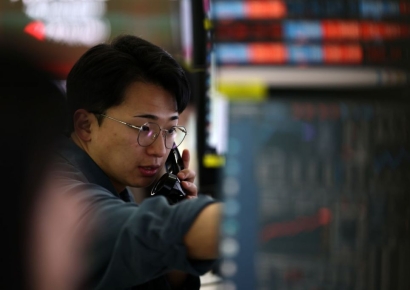
A dealer is working in the dealing room at the headquarters of Hana Bank. Photo by Yonhap News Agency
View original imageOn May 13, the KOSPI opened at 7,513.65, down 1.69% from the previous trading day, and as of 9:50 a.m., it was trading at 7,485.17, down 2.07%. In particular, Samsung Electronics saw a sharp decline as the failure of labor-management negotiations over performance bonuses heightened the possibility of a general strike. Samsung Electronics was trading at 2,675,000 won, down 4.12% (115,000 won) from the previous session. At the same time, the KOSDAQ was trading at 1,158.58, down 1.76%. The won-dollar exchange rate opened at 1,493.8 won, up 3.9 won from the previous session, and was trading at 1,495.4 won.
Overnight, the New York stock market showed mixed results due to inflation concerns and profit-taking in semiconductor stocks. On May 12 (local time), the Dow Jones Industrial Average closed at 49,760.56, up 56.09 points (0.11%) from the previous session. The S&P 500 Index fell by 11.88 points (-0.16%) to 7,400.96, while the tech-heavy Nasdaq Composite closed at 26,088.20, down 185.92 points (-0.71%). Semiconductor stocks, which had recently led the market rally, drove the indices lower. Micron (-3.61%), Qualcomm (-11.46%), Intel (-6.82%), SanDisk (-6.17%), and Western Digital (-5.25%) all declined.

Meanwhile, the number of stocks designated for investment warning this year is expected to reach the highest level in a decade. According to the Korea Exchange, between January and May 11, a total of 250 investment warnings were issued for KOSPI and KOSDAQ stocks. This figure surpasses 70% of the annual totals for both 2020 (352 cases) and last year (348 cases)—years marked by the "Donghak Ant Movement" retail investment boom—in just over four months. On a monthly basis this year, there were 55 warnings in January, 47 in February, and 49 in March, followed by a sharp increase to 80 in April. So far this month, 19 warnings have been issued over five trading days.
By market, Daewon Cable and LS Eco Energy were designated as investment warning stocks on the KOSPI this month. This was due to speculative demand pouring into power equipment stocks, driven by the simultaneous expansion of global artificial intelligence (AI) data centers and the replacement cycle of aging power grids. On the KOSDAQ, optical communication-related stocks such as Lycom and Wooriro were designated. This can be interpreted as growing market interest in next-generation transmission technologies that can overcome the limitations of traditional copper lines, amid a surge in data processing volume resulting from the spread of AI.
The market alert system is a mechanism by which the exchange issues investment risk warnings for stocks that may be subject to unfair trading practices, such as trades concentrated in a small number of accounts or rapid price surges over a certain period. Alerts are categorized into three levels based on severity: investment attention, investment warning, and investment risk. If the price continues to soar after a stock is designated as an investment warning, trading can be suspended. For investment risk stocks, trading is suspended for one day on the date of designation.

The surge in investment warning stocks is the result of large-scale capital inflows into the stock market. After the KOSPI surpassed 6,000 points at the end of February, both funds on standby and leveraged investment increased. According to the Korea Financial Investment Association, as of May 11, investor deposits stood at 13.40987 trillion won, a 22.49% increase from 10.94676 trillion won on February 25. During the same period, the balance of margin loans rose by 12.03%, from 3.21340 trillion won to 3.59985 trillion won.
However, since the increase in margin loan balances trails the rise in KOSPI stock prices, the actual risk from leveraged investment is considered low. According to Kiwoom Securities, from April to May 8, KOSPI stock prices rose 48%, while margin loan balances increased by only 10%. In the case of semiconductors, which are leading the market, stock prices skyrocketed by 78%, while the margin loan increase rate remained at just 1%, indicating a very stable trend. Major stocks in the AI value chain, such as IT hardware and power equipment, also show low leverage, suggesting that the risk of a broad-based index decline due to credit concerns is limited.
Hot Picks Today
 Investment Warnings Surge... "Warning Light" Flashes as KOSPI Nears 8,000 Points
- "Those Who Hesitated at 3,000 Still Haven't Bought" 7 Trillion-Won Asset Manager Says "Opportunities Remain" [Investment Strategies of the Wealthy] ⑦
- Snapping a Careless 'V' Pose... "All Your Personal Data Could Be Stolen" Warning Spreads on SNS
- "SK hynix to Soar to 2.8 Million Won, 'Main Chapter of AI Hasn't Even Begun Yet'—Why KB Securities Is Confident [Click e-Stock]"
- 'Drugs to Prevent Aging' Enter Their First Target Year... First Patient Dosed in the US [New Path for Bio, Anti-Aging] ①
Han Ji-young, a researcher at Kiwoom Securities, said, "The absolute increase in margin loans may create an environment of surface-level anxiety about speculative overheating," but added, "Even during this record-breaking rally, the actual surge in margin loans has been limited." She continued, "There have been supply-side constraints such as brokerage firms' limits on margin lending and management of margin requirements, and in a large-cap bull market, individual investors have shown a preference for cash purchases or exchange-traded funds (ETFs), reducing reliance on leverage. As a result, the so-called vicious cycle of 'market correction → liquidation of leverage → additional index decline due to forced selling' is not as severe as feared."
© The Asia Business Daily(www.asiae.co.kr). All rights reserved.