"Semiconductor Boom Outweighs Middle East Risks" KDI Sharply Raises This Year's Economic Growth Forecast from 1.9% to 2.5%
KDI: "Korean Economy Entering Expansionary Phase"
Forecasts Astounding $240 Billion Current Account Surplus
The Korea Development Institute (KDI), a state-run think tank, has sharply raised its economic growth forecast for this year from the previous 1.9% to 2.5%, an increase of 0.6 percentage points. The institute analyzed that the semiconductor export boom driven by surging demand for artificial intelligence (AI) is boosting the scale of the Korean economy and is expected to lead to an unprecedented current account surplus.

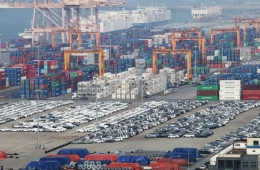
Containers piled up at Pyeongtaek Port, Gyeonggi Province. Photo by Yonhap News.
View original imageAccording to the 'First Half 2026 Economic Outlook' released by KDI on May 13, the gross domestic product (GDP) growth rate for this year is projected at 2.5%. This figure is 0.6 percentage points higher than the revised economic outlook in February, which was 1.9%, reflecting the fact that the recent increase in exports, especially semiconductors, has been much stronger than previously expected. Compared to the projection at the end of last year (1.8%), the figure has risen vertically by as much as 0.7 percentage points.
Jung Kyuchul, Director of the Macroeconomic and Financial Policy Research Department at KDI, stated, "Of the 0.6 percentage point upward adjustment in the growth rate forecast from 1.9% to 2.5%, the contribution from semiconductor exports far exceeds half, or more than 0.3 percentage points."
KDI also stated, "With a simultaneous surge in semiconductor prices and export volumes, the current account surplus, especially in goods, is expanding significantly." The institute analyzed, "The 2.5% growth rate expected for this year exceeds our estimated potential growth rate (mid-1% range), indicating that the Korean economy is currently in an expansion phase."
In particular, KDI projected an extraordinary current account surplus of $240 billion this year and $210 billion next year. The institute explained that the explosive increase in semiconductor exports is improving income conditions, which in turn is creating a virtuous cycle leading to increased investment and consumption. Director Jung added, "The positive effects of semiconductors have more than offset the negative impact of the Middle East war (-0.5 percentage points)."
Hot Picks Today
 Even with High Oil Price Relief Payment, Additional 300,000 Won Per Person to Be Provided... Applications Open from the 18th in This Region
- Is the Union Still Aiming for the 45 Trillion Won Bonus?... Samsung Union Rejects Government Mediation as Countdown to May 21 General Strike Begins
- Grabbing Wrists, "Miss, Anyang 60,000 Won"... Late-Night Illegal Taxis Turn Seoul into a Lawless Zone
- Investment Warnings Surge... "Warning Light" Flashes as KOSPI Nears 8,000 Points
- "I'm Younger and Fitter Than Your Husband, Get a Divorce"... Suspicious Messages Between Wife and Fitness Trainer
Domestic demand is also expected to recover gradually. Private consumption is forecast to grow by 2.2% this year, while facility investment is expected to increase by 3.3%, thanks to investment demand in the semiconductor sector. However, KDI recommended that, given the persistent risk of rising oil prices due to the Middle East conflict, a flexible monetary policy and more efficient fiscal spending are necessary for price stability.
© The Asia Business Daily(www.asiae.co.kr). All rights reserved.