Labor Minister Kim Younghoon: "The Essence of the Jinju Accident Lies in the Multi-Level Structure... Tragedy Caused by Failure of the Yellow Envelope Act"
Kim Younghoon, Minister of Employment and Labor, stated on the 23rd that the fundamental issue behind the death of a Cargo Solidarity union member at the CU logistics center in Jinju, Gyeongnam, was the "multi-tiered subcontracting structure" that has built up over time, even before the so-called Yellow Envelope Act.
In an interview on "Kim Taehyun's Political Show" on SBS that day, Minister Kim countered some claims that the Yellow Envelope Act was to blame for the incident, saying, "On the contrary, this tragedy occurred because the intent of the law was not properly implemented on the ground." He explained, "The Yellow Envelope Act is a mechanism to institutionalize dialogue, but in this case, negotiations were rejected and even a lawsuit for damages was filed, which escalated the conflict. A tragedy occurred as the union was pushed into extreme struggle."

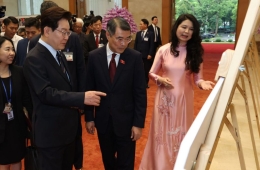
Kim Younghoon, Minister of Employment and Labor, is attending the Labor Safety Ministers' Meeting held at the Government Seoul Office in Jongno-gu, Seoul on the 16th, and speaking about improvement plans for subcontract operations in the public sector. 2026.4.16 Photo by Jo Yongjun
View original imageMinister Kim especially pointed to the multi-tiered subcontracting system as the structural cause of this incident. He noted that BGF Retail operates through a multi-layered structure involving its logistics subsidiary, regional logistics centers, subcontracted transportation companies, and delivery workers. Conflict has accumulated because there has been no negotiation with the principal contractor, which holds the real controlling power.
He said, "Conflict was inevitable in a structure where transportation companies contract with the lowest-level freight workers. Ultimately, in order to improve working conditions, negotiation with the principal contractor is unavoidable, but failing to resolve this through dialogue led to confrontation." He further emphasized, "It is necessary to simplify the multi-tiered structure to reduce unnecessary costs and conflicts."
When asked whether BGF Retail is the principal contractor, Minister Kim confirmed, "BGF Retail is correct." Regarding the legal status of special employment workers such as truck drivers, he added, "Even if they are formally classified as self-employed, there are precedents that recognize them as workers if they are in a relationship of economic dependence. Judgments should be made based on substantive criteria."
Minister Kim dismissed concerns that the implementation of the Yellow Envelope Act would lead to a surge in springtime labor disputes (Chuntu). He explained, "About 1,100 subcontracted unions have requested negotiations with 390 principal contractors, which means an average of two to three unions per principal contractor. This is within a manageable range, and contrary to concerns, what we are seeing is not 'Chuntu' (spring labor struggles) but 'Chundam' (spring dialogue) centered on negotiations."
Hot Picks Today
 Thailand and India Surpass 50%, but Korea Only ...
- "Why Is My Chanel Wallet on Danggeun?"...High School Students Steal Luxury Goods...
- "Why Are They Doing This?" Bizarre 'Streetlight Challenge' Involving Leg-Wrappin...
- "Doctors Never Eat This": Foods Warned Against by Asan Medical Center Professor
- Chilling Timing "Did They Know Again?"... $640 Million Suspicious Bet Just 15 Mi...
Regarding discussions on amendments to the Fixed-Term Employment Act, he said, "Business circles are calling for an extension of the period, while labor groups are demanding restrictions on reasons for use. We plan to find a solution after sufficient deliberation."
© The Asia Business Daily(www.asiae.co.kr). All rights reserved.