First Quarter GDP Posts Surprise Growth... This Year's Battle Between Semiconductor Boom and Middle East Shock (Comprehensive)
Real GDP Grows 1.7%, Highest in 5 Years and 6 Months
Private Consumption Provides Support as Exports—Powered by Semiconductors—Surge
Construction and Facility Investment Rebound from Slump to Positive Growth
Real GDI Jumps 7.5%, Marking the Highest Growth in 38 Years
Impact of Middle East War to Intensify in Second Quarter... Annual Growth Path Remains Uncertain
In the first quarter of this year, South Korea's economy achieved a "surprise growth" that exceeded market expectations. While private consumption served as a pillar of support, strong export performance led by semiconductors and investments to expand production capacity combined to drive economic growth. However, there are concerns that the annual growth rate for this year may fall below the previous forecast of 2.0% due to the aftermath of the Middle East war that broke out at the end of February. The growth trajectory for the year will likely depend on whether the impact of the war, which is expected to intensify from the second quarter onward, outweighs the unexpectedly strong semiconductor market, or vice versa.

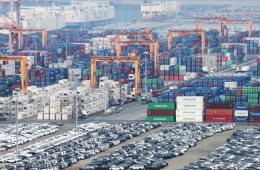
Containers are piled up at Pyeongtaek Port in Gyeonggi Province. Photo by Yonhap News.
View original imageFirst Quarter Growth Rate Hits Highest in 5 Years and 6 Months... Private Consumption, Exports, and Investment Surge
The Bank of Korea announced on April 23 that the preliminary real gross domestic product (GDP) growth rate for the first quarter of this year was 1.7% compared to the previous quarter. This is the largest growth since the third quarter of 2020 (2.2%), marking a five-and-a-half-year high. It is also nearly twice the Bank of Korea's earlier forecast (0.9%) presented in its economic outlook in February. Lee Dongwon, Director General of Economic Statistics Department 2 at the Bank of Korea, explained, "If you consider the results of the two leading semiconductor companies, their first quarter performance either surpassed or nearly matched their annual earnings from last year. The stronger-than-expected semiconductor market at the start of the year is the main reason for exceeding the forecast."
The South Korean economy entered negative territory in the first quarter of last year with a -0.2% growth rate, but rebounded to 0.7% in the second quarter and 1.3% in the third quarter, raising hopes for recovery. However, the fourth quarter saw another contraction at -0.2%, bringing the annual growth rate to barely 1%.
This surprise jump in growth was driven by simultaneous improvements in exports, private consumption, and investment indicators. In particular, strong export growth centered on semiconductors, the improvement in private consumption, and a positive turnaround in construction and facility investment all contributed to the higher growth rate. Lee pointed out, "Private consumption continued to grow in both the fourth quarter of last year and the first quarter of this year, even after the issuance of consumption coupons last year. Semiconductor exports also performed much better than expected, and these two areas significantly contributed to growth."
Exports increased by 5.1% compared to the previous quarter, mainly in IT products such as semiconductors. This marks a significant improvement from the negative growth in the fourth quarter of last year. Imports rose by 3.0% as machinery, equipment, and automobiles increased. Domestic demand continued to recover, especially in the private sector, and both construction and facility investment returned to growth. Private consumption grew by 0.5% from the previous quarter, led by an increase in goods such as apparel. Government consumption rose by 0.1%, mainly due to increased spending on goods. Construction investment also increased by 2.8% during the same period as building and civil engineering works grew. Facility investment rose by 4.8%, with increases in both machinery and transportation equipment. Both sectors shifted to growth after having declined by -3.5% and -1.7%, respectively, in the fourth quarter of last year.
Lee explained, "Facility investment rebounded mainly due to increased investments in semiconductor and display manufacturing equipment. Construction investment also turned positive, driven by the expansion of semiconductor plants and an increase in new housing starts. These factors contributed to the surprise growth in the first quarter." However, he cautioned that construction investment could still face challenges due to soaring raw material prices, which could lead to cost issues.

The 'Semiconductor Supercycle' Leads as Construction Sector Recovery Pushes Ahead
Looking at the contribution by expenditure category in the first quarter, the export rebound was particularly pronounced. The growth contribution of net exports (exports minus imports) was 1.1%, a turnaround from -0.2 percentage points in the previous quarter. Although imports rose by 1.2 percentage points, exports surged by 2.4 percentage points, thereby increasing their contribution. The contribution of domestic demand to growth rebounded from 0 percentage points in the fourth quarter of last year to 0.6 percentage points in the first quarter. Notably, the contributions from construction and facilities each rose by 0.3 and 0.4 percentage points, respectively, boosting the overall domestic demand contribution. By economic agent, the private sector contributed 1.7 percentage points, higher than the government’s 0 percentage points.
By industry, clear improvements were seen in both the manufacturing and construction sectors. Manufacturing grew by 3.9% from the previous quarter, led by computers, electronics, and optical devices. Construction also grew by 3.9% as both building and civil engineering works increased. The electricity, gas, and water supply sector saw a 4.5% increase, mainly due to water supply and raw material recycling. All these sectors reversed from negative growth in the fourth quarter of last year to positive growth in just one quarter. The service sector grew by 0.4%, centered on finance and insurance, culture, and other miscellaneous areas.
In the first quarter, real gross domestic income (GDI) increased by 7.5% from the previous quarter, far outpacing GDP growth. This is the highest growth rate in 38 years, since the first quarter of 1988 (8.0%). Lee explained, "This result stems from a significant rise in export prices, especially semiconductors, which improved the terms of trade."
Middle East War to Fully Impact Second Quarter... "Annual Growth Rate Hinges on Key Factors"
The downward pressure on growth from the Middle East war is expected to be fully reflected in the indicators starting in the second quarter. Going forward, the key point will be how much the positive factor of strong semiconductor exports can offset the negative shock of the war. Lee noted, "The impact of the Middle East war was not significant in the first quarter. Up until late March, domestic vessels continued to pass through the Strait of Hormuz before and after the start of the conflict. To put it simply, the war only affected about 10 out of 90 days in the first quarter, so the full impact will begin from April."
Hot Picks Today
 Chilling Timing "Did They Know Again?"... $640 ...
- "They Said It Was Safe, Even Seniors Invested... But ETFs Can Also Be Delisted [...
- If It Stops, 1 Trillion Won Lost Per Day... "We Want More Bonuses" ? 30,000 Gath...
- "Doctors Never Eat This": Foods Warned Against by Asan Medical Center Professor
- "I Can't Believe They're Real": Cockroaches Squirm Inside Transparent Jacket in ...
Forecasts for South Korea's economic growth rate this year vary by institution. The Organisation for Economic Co-operation and Development (OECD) lowered its forecast from 2.1% last December to 1.7% in March, while the International Monetary Fund (IMF) has maintained its forecast at 1.9%. Lee explained, "It is true that the Middle East war has had an increasingly negative effect on economic growth, but even the OECD and IMF projections differ in direction. Despite the war, exports—especially semiconductors—remain strong, and although consumer sentiment weakened in April, monitoring tools such as credit card usage through last week have not yet shown any impact. This is another variable to consider." He added that it is also important to observe how much impact government policies will have from the second quarter onward.
© The Asia Business Daily(www.asiae.co.kr). All rights reserved.