DeepX and Hyundai Motor Robotics Lab Join Forces to Develop Next-Generation Physical AI Computing Platform
Building a Robot Physical AI Infrastructure
Based on the DX-M2 Using Samsung's 2nm Process
Low-power artificial intelligence (AI) semiconductor company DeepX and Hyundai Motor Group Robotics Lab are ramping up their collaboration to develop a physical AI computing platform for next-generation robots.
On April 21, the two companies announced plans to jointly develop a next-generation AI computing architecture capable of running large-scale generative AI models in real time within robots. Based on this, they aim to build a physical AI platform for robotics applications.

Recently, in the field of robot AI, technologies such as Vision-Language Action (VLA) and Vision-Language Model (VLM), which enable robots to perceive their surroundings through cameras, understand human language commands, and then make autonomous decisions, are emerging as core innovations. These technologies are regarded as essential for evolving robots from simple automated machines into “intelligent systems that can see, understand, and make decisions to act.”
The two companies will collaborate to ensure that these next-generation robot AI technologies can be stably run in real-world robotic environments, specifically in areas such as ▲ultra-low-power AI semiconductor architecture ▲AI computing hardware systems for robots ▲physical AI software stack ▲robot application AI libraries.
This collaboration will leverage DeepX’s next-generation AI semiconductor, the ‘DX-M2’, as a core technology. The DX-M2, which will be produced with Samsung Electronics’ 2-nanometer (nm; one-billionth of a meter) foundry process, is designed to run large-scale AI models in ultra-low-power environments. Its ultra-low-power, high-performance AI computing architecture, which enables direct AI computation within the robot, is expected to greatly enhance both the autonomy and response speed of robots.
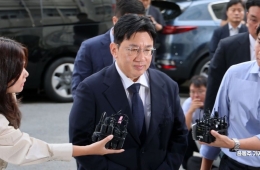
DeepX CEO Kim Nokwon stated, “The AI industry is rapidly transitioning from a data center-centric era to a physical AI era, where real-world systems are at the forefront. The next five years will be crucial for the industry’s reorganization. In the physical AI era, ultra-low-power computing technologies that can run AI in real-world systems such as robots, automobiles, and industrial devices will become key infrastructure.”
Hot Picks Today
!["Only the Top 1% Winning Big in Stocks Smile... '300 Million Won Splurges' or '10-Won Wars,' the Middle Disappears [K-Shaped Consumption Era]①"](https://cwcontent.asiae.co.kr/asiaresize/93/2026041409371024802_1776127030.jpg) "Only the Top 1% Winning Big in Stocks Smile......
"Only the Top 1% Winning Big in Stocks Smile......
- "Despite Price Hike, Buldak Exports Surge... Samyang Foods’ Strong Performance ...
- [Exclusive] Latest Cancer Treatment Costs Rise by 40 Million Won... War Disrupts...
- Female Game Caster Makes Bold Move After Criticism Over "Short Skirt" on Broadca...
- Couple Secretly Making Love on Mountain Summit... Broadcast Live on the Internet
Hyun Dongjin, Executive Vice President and Head of Hyundai Motor Group Robotics Lab, commented, “In the physical AI era, robots represent the closest point of contact between AI technology and people. At the Robotics Lab, our goal is to create robots that can naturally be by people’s side—robots that are worth living with and worth using. To that end, we are strategically building a core technology ecosystem, including on-device AI computing, together with expert partners in various fields both domestically and internationally.”
© The Asia Business Daily(www.asiae.co.kr). All rights reserved.



!["They Said It Was 'Delicious' Milk... Is the 'List of Fake Milk Products in Korea' for Real? [Matjal X-File]"](https://cwcontent.asiae.co.kr/asiaresize/307/2023072413274517286_1690172865.jpg)