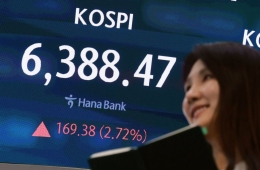
[Issue Interview] Dong Jeongsin, Head of KB Management Research Institute: "Korean Economy Faces Supply Shock... Depends on Energy and Oil Prices"
Slowing Growth and Rising Inflation... Korean Economy Enters a Complex Crisis
Productive Finance: Ensuring Policy Effectiveness Is Key
Real Estate: Price Adjustments Likely in Gangnam, Firm Prices in Outlying Areas... Tax System Normalizatio
"The Korean economy is currently facing a typical supply-shock-driven challenge, with growth slowing while inflation and exchange rate instability are intensifying."
Dong Jeongsin, Managing Director and Head of Management Research Institute at KB Financial Group, stated this in an interview with The Asia Business Daily on April 16. He diagnosed that "the fundamentals of the Korean economy remain intact, but it has entered a phase of 'low growth and high volatility,' making it extremely vulnerable to external shocks."
This is because geopolitical risks and trade issues are simultaneously impacting the Korean economy, worsening conditions across growth, inflation, and the financial markets. Dong explained, "Exports, driven mainly by semiconductors, have remained relatively solid, and consumer spending showed signs of recovery until the beginning of the year. However, since March, downward pressure on growth and volatility in the financial and foreign exchange markets have increased significantly. This is due to energy supply disruptions and surging oil prices caused by the Middle East war, as well as uncertainty surrounding U.S. tariff policies."

Dong Jeongsin, Managing Director and Head of Management Research Institute at KB Financial Group
View original imageDouble Burden of High Exchange Rates and Oil Prices... Korean Economy Enters Low Growth, High Volatility Phase
He identified 'high exchange rates' and 'high oil prices' as the biggest burden factors for the Korean economy at present. After the outbreak of the Middle East war, the won-dollar exchange rate at times exceeded the 1,500-won level, and in March, the consumer price index turned upward again, recording a 2.2% year-on-year increase, largely due to higher oil prices.
The problem is if this situation becomes prolonged. In the short term, a recovery in semiconductor exports and the implementation of a supplementary budget may partially cushion the downward pressure on the economy. However, if Middle East risks and U.S. trade pressure persist, business sentiment, investment, and real income could all weaken at the same time, potentially resulting in a greater-than-expected slowdown in growth.
Dong warned, "If the rise in oil prices is prolonged, it could lead to a complex shock that spreads beyond inflation to growth and the entire financial market," adding, "There is a possibility that the slowdown in our economic growth could be deeper and longer than anticipated."
He referred to the next six months as a 'golden time' that will determine the course of the Korean economy, stressing, "It will be crucial to see how much domestic demand and investment can recover, moving away from a structure that relies on a single pillar of exports, and how quickly the economy can absorb the shocks from exchange rates and energy."
However, he predicted that the current geopolitical risk originating in the Middle East is unlikely to lead to an 'oil shock' similar to those in the past. Dong said, "Korea's energy efficiency has improved compared to the past, and there has been some diversification of supply routes, such as liquefied natural gas (LNG), so the shock is unlikely to be as direct as in previous times." He added, "From a policy perspective, it is important to manage inflation to prevent it from spreading to expected inflation, and to respond selectively to vulnerable groups and industries sensitive to energy."

Expanding Productive Finance... Need for RWA Easing and Risk Diversification
Regarding the 'productive finance' policy emphasized by the Lee Jaemyung administration, Dong assessed it as an essential prescription for the Korean economy, which has entered a low-growth phase, and as a meaningful policy for restoring the fundamental intermediary function of finance.
However, he pointed out that even with sound policy intentions, if conservative investment practices and heavy regulations persist, such measures could end up being mere slogans or supply for the sake of filling quotas. He thus stressed the need for: ▲enhancing the professional capabilities of the financial sector to assess and manage investment targets and risks with sophistication ▲institutional support such as easing risk-weighted assets (RWA) requirements for financial companies ▲expanding private sector participation through the development of secondary markets, activation of funds, and tax benefits. In addition, he emphasized the importance of strengthening 'loss-absorbing safety nets,' such as expanding joint responsibility and guarantees by the government and policy financial institutions.
Dong, who has served on the Basel Committee on Banking Supervision (BCBS), stated that in order to expand productive finance, it is necessary to consider adjusting the risk weights of corporate loans within the scope allowed by international standards. He especially pointed out that it is difficult to expand lending to small and innovative companies that lack credit ratings and tangible collateral, as high risk weights are applied to such loans.
To expand investment in growth-oriented companies, it is inevitable to accept a certain level of risk, such as potential principal loss; thus, there is a trade-off between soundness and expanded investment. In this regard, Dong stated, "As an institutional supplement, it is more desirable to disperse risk through policy finance or guarantees rather than having banks supply funds to high-risk companies on their own, or for capital investment subsidiaries of financial groups, such as venture capital (VC) or private equity (PE), to take on this role."

Real Estate: Need for Consistent 'Supply' Policies... Some Areas, Including Gangnam 3 Districts, May See Price Adjustments
On the real estate market, he highlighted the importance of consistently implementing supply policies in the long term, while emphasizing that, in the short term, normalizing the tax system is key. However, he stressed that this should be approached from the perspective of 'tax normalization' for the medium to long term, rather than simply aiming for price stability.
He said, "It is reasonable to gradually raise the holding tax, which is lower than in advanced countries, while adjusting the capital gains tax to induce more properties to come onto the market. The criteria for high-priced homes and the structure of the tax system also need to be reviewed."
Regarding future home prices, he forecasted that some areas, including the Gangnam 3 districts, could experience price adjustments. The 'KB Leading Apartment 50 Index,' calculated by KB Real Estate based on the nation's top 50 apartment complexes by market capitalization, recorded 132.4 this month, down 0.73% from the previous month. This is the first decline in the Leading Apartment 50 Index in 2 years and 1 month, since February 2024 (-0.06%).
Hot Picks Today
 "Even Luxury Cars Drive Off Without Paying"... ...
- "Only the Top 1% Winning Big in Stocks Smile... '300 Million Won Splurges' or '1...
- Applied Just for Skin Soothing...Study Finds It Suppresses Antibiotic Resistance
- "Is the Starting Salary Really 4 Million Won?"... Surprise as Navy Salary and Sa...
- “Nothing Left to Protect” as Japan Drops Its “Peace State” Banner... Lifts B...
Dong noted, "As the possibility of holding tax hikes is being discussed, concerns about a short-term surge have increased, and some areas subject to regulation, such as the Gangnam 3 districts, are highly likely to see price adjustments. On the other hand, outlying areas of Seoul may continue to show a firm trend, considering factors such as resolving price gaps and lending conditions."
© The Asia Business Daily(www.asiae.co.kr). All rights reserved.




![Is This a Boom or a Recession? Queues for Both Luxury and Bargain Goods [K-Shaped Consumption Era]](https://cwcontent.asiae.co.kr/asiaresize/307/2026042114133834494_1776748418.png)