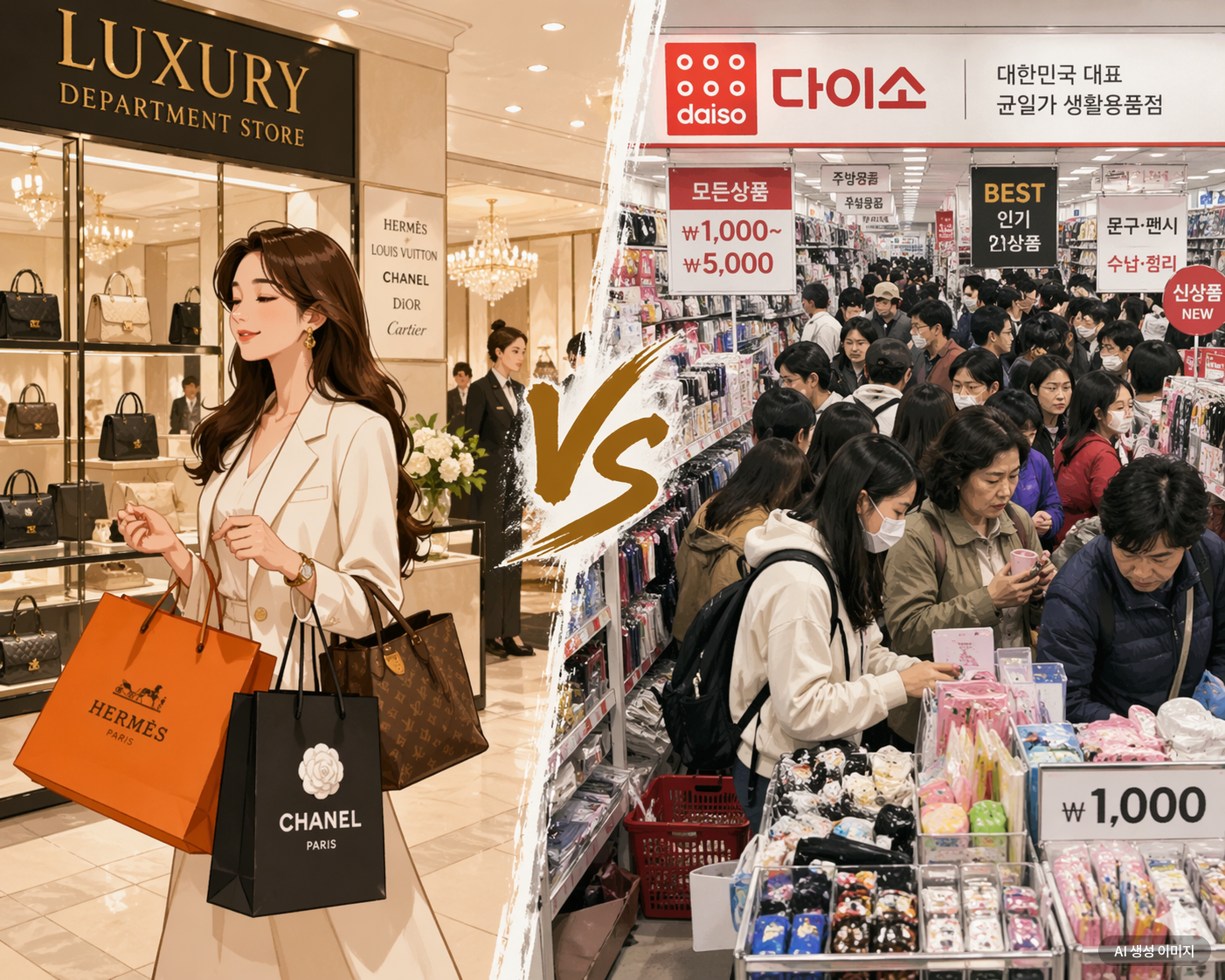
VVIPs Queue for Billion-Won Shopping at Luxury Stores
Billion-Won Shopping vs. 1,000-Won Wars ... [The K-Shaped Consumption Era]
"If you order now, the estimated waiting time is about 50 minutes."
On the afternoon of April 13, even well past the lunchtime peak at 'Twelve', a food and beverage (F&B) brand located in the House of Shinsegae Cheongdam in Gangnam, Seoul, dozens of people were still waiting in line. Although the price of a single smoothie, the signature menu item, easily exceeded 20,000 won, not a single customer turned away. Customers took photos with their drinks or checked their queue numbers on their phones, visibly accepting the wait.
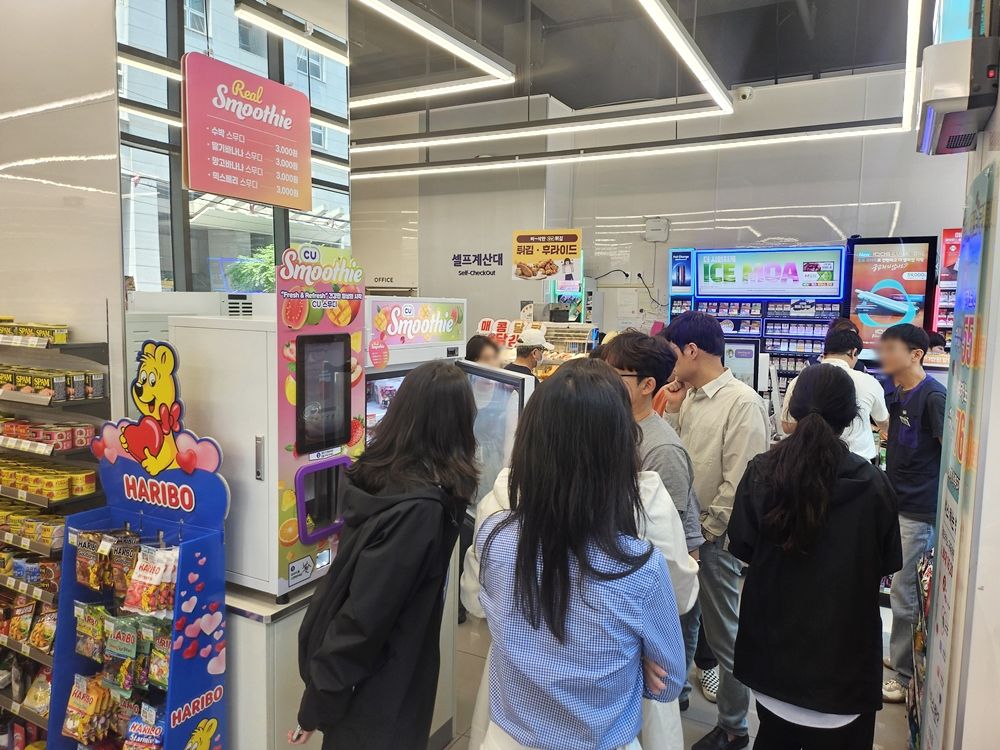
Thousand-Won War Waiting Lines at Ultra-Low Price Stores
Middle-Income Consumers Shut Wallets and Disappear
Department Store Sales Driven by Luxury Sector
On the same day, the CU convenience store at the BGF Retail headquarters in Samseong-dong, Seoul, was packed with customers hoping to buy a 3,000-won smoothie from a vending machine. This smoothie, which is ready in a minute after frozen fruit is inserted into the machine, has been a sensational hit since its launch in June last year as a value-for-money beverage. A 30-something office worker surnamed Yoo said, "After enjoying smoothie vending machines in Japan, I even searched for convenience stores with smoothies here in Korea," adding, "Twelve is just too expensive-it's not worth waiting in line for."
The "K-shaped consumption" trend is becoming entrenched in Korea's domestic market. Since the second half of last year, a bull run in the stock market has further boosted the spending power of high-asset individuals, while demand for ultra-low-cost and discount products has surged, making consumption polarization even more pronounced. Analysts point out that the middle class, which has traditionally supported the domestic market, is losing its influence as a consumer group. There are growing concerns that this could lead to a sharp contraction in consumption, especially as economic volatility increases.
Annual "300 Million Won Flex"... VVIPs Drive Department Store Sales
According to the Ministry of Trade, Industry and Energy's "2025 Major Retailer Sales Trends" released on April 21, major department stores in Korea posted year-on-year growth for eight consecutive months from July last year through February this year. Department stores recorded a 4.3% annual increase in sales last year, the highest growth rate among offline retailers. Although there were concerns about sluggish growth in the department store sector due to the rapid expansion of the online market in recent years, a surge in luxury goods sales has led to record-high results.

The so-called "EruSha" brands-Hermes, Louis Vuitton, and Chanel-set new records last year. Hermes Korea surpassed the 1 trillion won mark in annual sales for the first time, recording 1.125 trillion won, up 16.68% from the previous year. During the same period, Louis Vuitton Korea achieved sales of 1.8542 trillion won, positioning itself to join the "2 trillion won club" just six years after surpassing 1 trillion won in 2020. Chanel Korea also exceeded 2 trillion won in sales last year, reaching 2.0125 trillion won.
These luxury brands only operate out of department stores and duty-free shops in Korea. In particular, department stores rely on VIP customers who spend over 5 million won annually (Shinsegae standard; Lotte 10 million won; Hyundai 30 million won) as their core clientele. Despite multiple luxury price hikes in recent years, demand has remained robust.

As a result, the proportion of VIP sales at Lotte, Shinsegae, and Hyundai Department Stores has risen sharply. At Lotte Department Store, the share of sales to VIPs expanded from 31% in 2023 to 45% in 2024 and reached 46% last year. Over the same period, Shinsegae Department Store saw its VIP sales ratio rise from 44.1% to 47%, and Hyundai Department Store from 41% to 46%. At Shinsegae Department Store, only the top 999 customers receive the highest VIP status, "Trinity", and their average annual spend reportedly ranges from 200 million to 300 million won-more than double that of the "Black Diamond" tier below, which averages 120 million won per year.
The department store industry has continued to post solid results in the first quarter of this year. Especially robust growth was seen among luxury jewelry brands. According to Lotte Department Store, sales of luxury jewelry in the first quarter soared by 55% compared to the same period last year, with foreign luxury goods growth rates reaching 30%. Both Shinsegae and Hyundai Department Stores also saw luxury jewelry sales jump by more than 50%. As a result, Shinsegae Department Store is expected to post first-quarter sales of 557.1 billion won, up 12% year-on-year.
'Ultra-Low-Price Ant Hell'... Low-Cost Brands Set New Sales Records
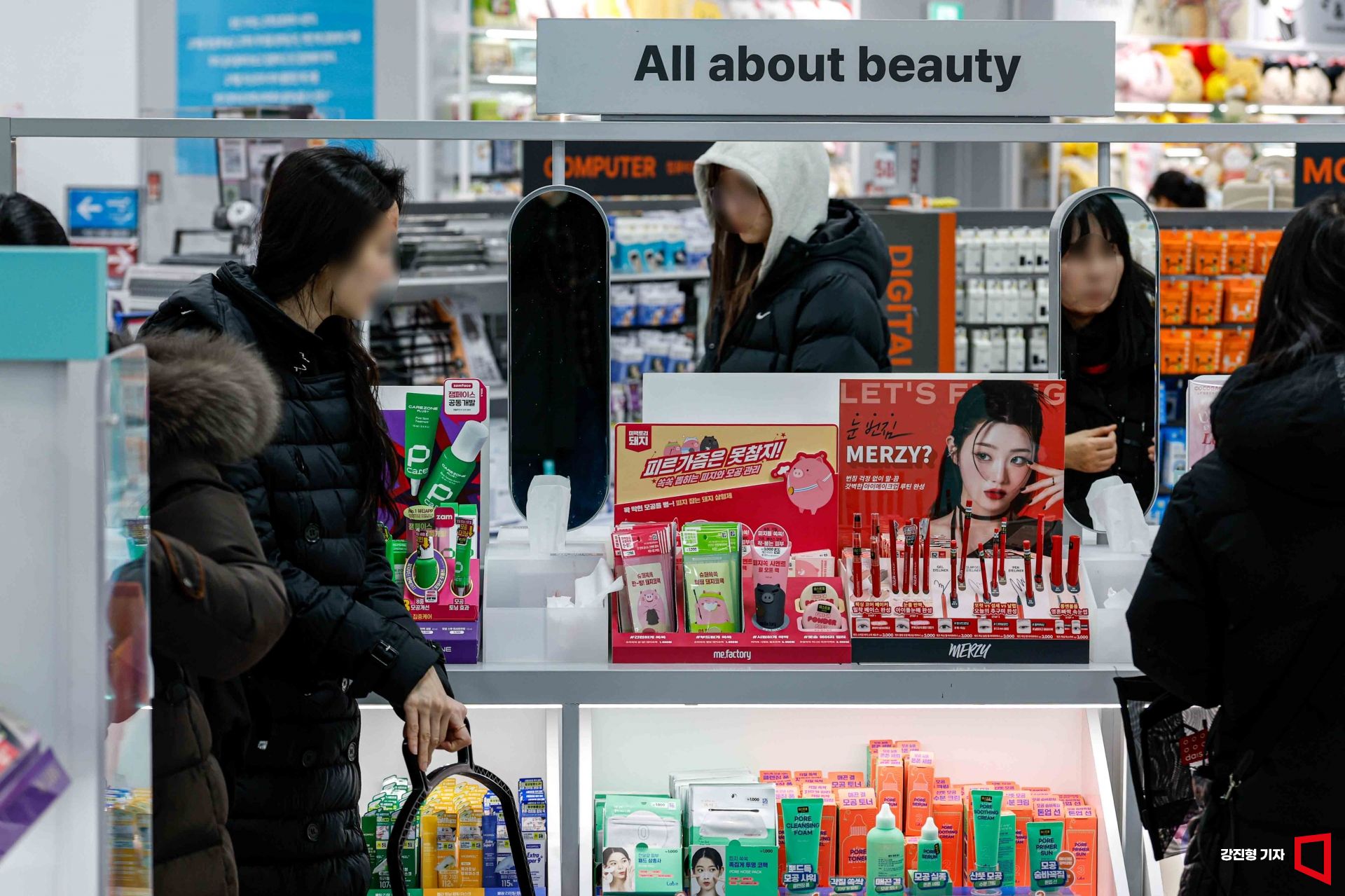
Daiso and Low-Cost Brands Achieve Record High Performance
Asset Gap Widened by Stock Market Boom
Consumer Perception of Economy Actually 'Worsens'
Extreme Consumption Raises Concerns of Recession Signs
Ultra-low-price products are also selling rapidly. Daiso, a fixed-price general merchandise retailer, surpassed 4.5 trillion won in sales last year. Daiso, which sells low-cost items from 500 to 5,000 won, has expanded its product range in recent years to include highly cost-effective cosmetics and fashion items, posting record-breaking sales every year. Last year, Daiso posted an operating profit of 442.4 billion won and an operating margin of 9.7%-about three times higher than the 3% average margin among traditional retail conglomerates.

Uniqlo, another leading low-cost brand, also showed clear growth. Uniqlo's sales reached 1.3524 trillion won last year, up about 27.5% from the previous year (1.0602 trillion won). This marks the second consecutive year of growth after rebounding to over 1 trillion won in 2024, recovering from the "No Japan" movement slump.
These companies have become well-known recession beneficiaries as "value-for-money consumption" has become routine amid inflation since the COVID-19 pandemic. This trend is mirrored by the rapid rise of C-commerce platforms such as Aliexpress and Temu, which have targeted the Korean market with "ultra-ultra-low-price" strategies in recent years. According to market analysis firm WiseApp Retail, in March the top three e-commerce platforms in Korea by monthly active users (MAU) were Coupang (33.44 million), followed by Aliexpress (8.69 million), and Temu (8.17 million). These C-commerce players have seen a surge in users since 2023, overtaking domestic e-commerce platforms for the first time since the pandemic.

Value-driven consumption is also evident at major hypermarkets. Fierce price competition has become the norm, with demand focused on ultra-low-cost products. Leading hypermarkets have introduced pork belly at 990 won per 100 grams, while competitors have countered with prices as low as 880 won, 100 won less, resulting in a price war. In this environment, consumers are limiting their purchases mostly to promotional items and essential groceries. A hypermarket representative said, "The average basket size is shrinking, and the focus on discounted products is intensifying. Despite repeated ultra-low-price promotions, overall consumption is not spreading widely."
Asset Market Surge Fuels K-Shaped Consumption ... Concerns of "Recession Signs"
Such extreme consumption patterns are being fueled by widening gaps between capital and labor, as well as the recent surge in the stock market, which has intensified asset polarization. As the KOSPI hits all-time highs and liquidity concentrates in upper-tier assets, beneficiaries are ramping up high-end consumption, while others are cutting spending due to the burden of high living costs.

Jung Yongtaek, a researcher at IBK Investment & Securities, stated, "The simultaneous occurrence of a booming asset market and shrinking consumption is rooted in the widening gap between capital and labor. As liquidity flows into the asset market rather than the real economy, asset prices rise, but most consumers are actually feeling worse off."
He added, "During periods of deepening polarization, it's common for asset prices such as stocks to rise, but at the same time, the burden grows for those with limited spending power, undermining the sustainability of the broader economy. This 'recession amid boom' could be a signal of a turning point in the economic cycle." In other words, while luxury brands and ultra-cost-effective products are selling briskly and the market may appear to be booming, these extreme consumption patterns could be early warning signs of a recession.
-

Reporter Kwon Jaehee jayful@asiae.co.kr
-
Edit Kang Dongwon kangdw76@asiae.co.kr
© The Asia Business Daily(www.asiae.co.kr). All rights reserved.



![[Report] "A Culinary Destination with a View of Gyeongbokgung"... Kim Dong-sun's High-End Dining Takes Over Gwanghwamun](https://cwcontent.asiae.co.kr/asiaresize/304/2026042114562634571_1776750985.jpg)

![[Gallery Stroll] Red Robe, Black Lines... Danjong Returns with the Face of Wounds](https://cwcontent.asiae.co.kr/asiaresize/304/2026042014183532691_1776662315.jpg)