IAEA Chief: "South Korean Nuclear Submarines Must Ensure No Contribution to Nuclear Proliferation"
Raphael Grossi, Director General of the International Atomic Energy Agency (IAEA), commented on South Korea's introduction of nuclear-powered submarines (nuclear submarines), stating that "this is something that must be considered from the perspective of inspection teams" and stressing the need to "ensure that this does not contribute to nuclear weapons proliferation in any way."

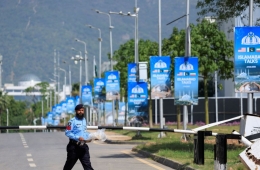
Raphael Grossi, Director General of the International Atomic Energy Agency (IAEA), is speaking at a press conference held on the 15th at the Four Seasons Hotel in Jongno-gu, Seoul. Photo by Yonhap News
View original imageAt a press conference held on the 15th at the Four Seasons Hotel in Jongno-gu, Seoul, Director General Grossi said, "We plan to continue dialogue with stakeholders, including the government, military, and shipbuilding companies, to establish thorough safeguards."
He explained, "Due to the characteristics of vessels that operate for extended periods, the materials used in submarines can fall outside the scope of what inspection teams can monitor or inspect. The amount of enriched uranium used on vessels is substantial, and depending on the technology adopted, there is also the possibility that highly enriched uranium could be used."
Director General Grossi stated, "As a signatory to the Treaty on the Non-Proliferation of Nuclear Weapons (NPT), various nuclear-related activities carried out by nuclear researchers in South Korea are subject to IAEA inspections. Special procedures or coordination with the IAEA will be required." He added, "A different technical method is needed to ensure that the materials present at the outset are not diverted and remain unchanged." While nuclear-powered submarines themselves are not subject to IAEA inspection, the nuclear fuel used in these submarines must undergo IAEA inspection.
Regarding the direction of consultations between South Korea and the United States on nuclear energy and nuclear-powered submarines, he noted, "The South Korean government has made its intention to pursue nuclear submarines clear through cooperation with the United States, but there are still unresolved aspects regarding actual construction and fuel."
Director General Grossi also expressed concern about the activation of North Korea's Yongbyon nuclear facility and North Korea's increased capacity to produce nuclear weapons. He said, "We have confirmed that a new uranium enrichment facility, similar to the existing ones, has been built in Yongbyon, North Korea," adding, "North Korea's uranium enrichment capacity has increased significantly."
Hot Picks Today
 Applied Just for Skin Soothing...Study Finds It...
- "Only the Top 1% Winning Big in Stocks Smile... '300 Million Won Splurges' or '1...
- 46 Voice Phishing Ring Members Repatriated from Cambodia Sentenced to Prison in ...
- "If You Pay, I'll Close the Case"... Former Korea Customs SJPO Who Took 145 Mill...
- "Please Launch It in Korea!" After All the Hype... This Coffee Finally Arrives i...
Having arrived in South Korea the previous day, Director General Grossi is scheduled to meet with Foreign Minister Cho Hyun to discuss various issues, including nuclear safety and technical cooperation related to nuclear-powered submarines, the situation in the Middle East, and the North Korean nuclear issue.
© The Asia Business Daily(www.asiae.co.kr). All rights reserved.





![Is This a Boom or a Recession? Queues for Both Luxury and Bargain Goods [K-Shaped Consumption Era]](https://cwcontent.asiae.co.kr/asiaresize/307/2026042114133834494_1776748418.png)