Stricter Penalties for Drugged Driving: Police to Launch Special Crackdown Starting in April
Refusal to Undergo Testing Will Be Penalized the Same as Drugged Driving
The police are launching a special crackdown to prevent a series of drug-impaired driving accidents.
On March 31, the National Police Agency announced that an amendment to the Road Traffic Act, which strengthens the penalties for drug-impaired driving, will go into effect on April 2. Under the revised law, anyone found driving a vehicle while under the influence of drugs to the extent that it impairs their ability to drive safely will face harsher penalties: imprisonment of up to five years or a fine of up to 20 million won, increased from the previous maximum of three years' imprisonment or a fine of up to 10 million won. Refusing to submit to drug testing will also be punished in the same way as drug-impaired driving.

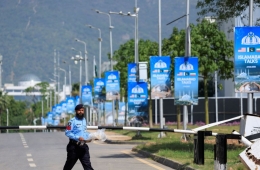
Driver A, who caused an accident in February this year by driving an SUV under the influence of drugs and crashing into the Han River embankment from Banpo Bridge, is attending the pre-trial detention hearing at the Seoul Western District Court. Photo by Yonhap News
View original imageAccordingly, the police will conduct a special crackdown on drug-impaired driving for two months until May 31, in conjunction with their annual spring crackdown on drunk driving. This special operation will target not only nightclubs and entertainment districts but also areas near large hospitals.
Unlike drunk driving checkpoints, which detect only alcohol, drug-impaired driving checks require screening for as many as 490 different substances. Furthermore, because there are no standardized measurements, more detailed procedures such as assessing the driver’s ability to operate a vehicle are required.
If officers spot a vehicle exhibiting signs of drug-impaired driving, such as zigzag driving, they will first assess the driver’s driving behavior, appearance, speech, and attitude. If deemed necessary, the officer will ask the driver to step out of the vehicle and conduct an initial roadside assessment, which includes walking in a straight line, turning, and standing on one foot. Next, a field drug test will be administered to check for the presence of drugs. If the result is positive, the officer will request a urine or blood test. Even if the field drug test is negative, if the officer believes—based on the driver’s condition or the results of the roadside assessment—that the driver may have taken substances not detected by the field test, the officer may still request a urine or blood test.

A police official explained, "Drug-impaired driving is now subject to the same penalties as drunk driving, and refusing to be tested is also punishable. Therefore, we have strengthened the procedures for collecting objective indicators and evidence necessary for enforcement." The official added that police officers have received additional training and guidance to prevent human rights violations during the relatively complex enforcement process.
Hot Picks Today
 "Paying More Than the Listed Price?"... Academi...
- "Only the Top 1% Winning Big in Stocks Smile... '300 Million Won Splurges' or '1...
- "I Used It for 10 Years, But I'm Leaving"... Natural Cosmetics Brand Faces Backl...
- Couple Secretly Making Love on Mountain Summit... Broadcast Live on the Internet
- "Please Launch It in Korea!" After All the Hype... This Coffee Finally Arrives i...
Ho Seung Kim, Director of the Traffic Bureau at the National Police Agency, stated, "We ask for your cooperation with the procedures, even if they may be inconvenient," and pledged, "We will do our utmost to ensure that no innocent citizen is harmed as a result of drug-impaired driving."
© The Asia Business Daily(www.asiae.co.kr). All rights reserved.




![Is This a Boom or a Recession? Queues for Both Luxury and Bargain Goods [K-Shaped Consumption Era]](https://cwcontent.asiae.co.kr/asiaresize/307/2026042114133834494_1776748418.png)