Koo Yoon-chul Tells S&P: "Korea Has Sufficient Capacity to Respond to Middle East Energy Risks... U.S. Investments Positive for Our Economy"
Meeting with S&P Annual Consultation Delegation to Discuss Policy Directions
"Overcoming Challenges with Oil Reserves and Diversified Natural Gas Imports"
Regarding the Special Act on Investments in the United States: "An Opportunity Instead

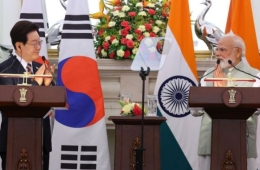
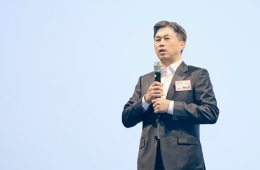
Deputy Prime Minister and Minister of Strategy and Finance Koo Yoon-chul is greeting with a handshake Kim Eng Tan, Regional Head of Sovereign Ratings for Asia Pacific at Standard & Poor's (S&P), who visited Seoul Government Complex in Jongno-gu, Seoul on the 11th for an annual consultation. Ministry of Strategy and Finance - Greeting with a handshake Kim Eng Tan, Regional Head of Sovereign Ratings for Asia Pacific - Taking a commemorative photo shaking hands with Kim Eng Tan, Regional Head of Sovereign Ratings for Asia Pacific.
View original imageDeputy Prime Minister and Minister of Strategy and Finance Koo Yoon-chul stated on March 11 that concerns about a potential economic crisis originating from the Middle East can be addressed, emphasizing, "We have sufficient capacity to respond thanks to ample oil reserves and diversification of natural gas import routes."
Deputy Prime Minister Koo made these remarks during a meeting with the annual consultation delegation from international credit rating agency Standard & Poor's (S&P) at the Seoul Government Complex on the same day. In response to S&P's inquiry regarding Korea's energy sector response to the Middle East situation, Koo explained, "Korea has secured more than 200 days' worth of oil reserves in accordance with International Energy Agency (IEA) standards," and added, "We already have diversified import routes for natural gas, which ensures strong response capability." He also noted that efforts are being made to not only strengthen short-term supply management but also to fundamentally shift the fossil energy-dependent economic structure.
When asked by S&P about investment projects in the United States, Deputy Prime Minister Koo expressed confidence that such projects would have a positive impact on the Korean economy. He explained, "Investments are made based on project progress (disbursement of funds according to project milestones), and the annual investment cap of 20 billion dollars and other funding burdens are distributed over the medium to long term, with safeguards in place for the foreign exchange market." He added, "Investments are being made in sectors closely related to domestic industries, such as nuclear power and shipbuilding, which can positively impact the Korean economy. The government will actively work to turn U.S.-bound investments into opportunities. If the Special Act on Investment in the United States passes the National Assembly this week, we will promptly proceed with follow-up measures such as enacting subordinate legislation and establishing funds."
Deputy Prime Minister Koo further explained that, in addition to the booming semiconductor sector, Korea's economy is advancing in a variety of industries such as defense, automobiles, and nuclear power. The government has also selected and is swiftly supporting 15 leading projects for the ultra-innovative economy to help boost the potential growth rate. He emphasized that tangible results are being seen, such as the stock market index reaching an all-time high, thanks in part to efforts to advance the capital market.
Hot Picks Today
 "With This Certificate, Even Those in Their 60s...
- Popcorn Container Craze at Theaters Sparks Sell-Out Frenzy, Emerges as New Reven...
- Jung Wono Camp’s Lee Haesik: "Oh Sehoon Blames Others and the Past... Repeating...
- "Six Months After 'Mom's Touch Troublesome Woman' Incident... Franchise Says, 'S...
- "Quit Office Job to Earn Over 200 Million Won a Year"… Chinese Woman in Her 30s...
From March 9 to 11, the annual consultation delegation held meetings not only with Deputy Prime Minister Koo Yoon-chul, but also with various government agencies including the Ministry of Strategy and Finance, the Bank of Korea, and the Korea Institute for International Economic Policy (KIEP).
© The Asia Business Daily(www.asiae.co.kr). All rights reserved.


!["They Said It Was 'Delicious' Milk... Is the 'List of Fake Milk Products in Korea' for Real? [Matjal X-File]"](https://cwcontent.asiae.co.kr/asiaresize/307/2023072413274517286_1690172865.jpg)