Government Holds Korea Economy IR for Institutions in Hong Kong... "Capacity to Respond to Middle East Crisis"
Senior Executives from Goldman Sachs and JP Morgan Attend
"Early Stage of Advancing Toward the Korea Premium"
Ji-young Choi, Director General for International Economic Affairs (Vice Minister) at the Ministry of Strategy and Finance, stated, "Based on ongoing institutional reform efforts such as improvements in corporate governance, we are currently in the early stages of moving toward a 'Korea Premium.'" Regarding the situation in the Middle East, she added, "We have sufficient capacity to respond, including stable macroeconomic conditions and energy reserves."
On March 6, the Ministry of Strategy and Finance announced that Vice Minister Choi had held an investor relations (IR) session in Hong Kong the previous day, targeting major global institutional investors along with the Financial Services Commission and other related agencies. The IR event was attended by senior executives, including Asia regional representatives from leading global investment banks such as Citibank, Goldman Sachs, and HSBC, as well as top asset management firms such as JP Morgan, Morgan Stanley, Prudential, and Wellington. For substantive discussion, the session was limited to 16 participants from 10 institutions.

Choi Ji-young, Director of International Economic Affairs at the Ministry of Finance and Economy. Photo by Yonhap News Agency
View original imageRegarding the heightened tensions in the Middle East, Vice Minister Choi explained, "Despite the current expansion of global uncertainty, the Korean economy has sufficient capacity to respond, including stable macroeconomic conditions and energy reserves. As we have demonstrated resilience and rapid recovery from past challenges, Korea is equipped to deal with a variety of shocks."
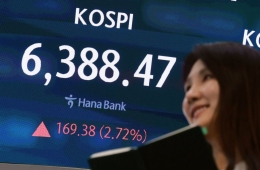
On foreign exchange and capital market advancement policies, she evaluated, "The recent upward trend in the KOSPI reflects the early stage of moving toward a 'Korea Premium,' based on ongoing institutional reform efforts such as improvements in corporate governance." She further introduced plans to "broaden and deepen the foreign exchange market by significantly improving accessibility to the Korean won through groundbreaking reforms in the foreign exchange market."
In response to questions about the potential for industrial development centered on the artificial intelligence (AI) industry and the semiconductor sector, she explained, "Driven by growing global AI demand, Korea's semiconductor industry is performing strongly." She continued, "We will continue to strengthen our AI industry competitiveness based on world-class semiconductor technology and information and communication infrastructure, while also securing new growth engines across diverse sectors such as bio and K-content to enhance the overall competitiveness of Korean industries."

During the IR session, the government also provided a detailed assessment of the Korean economy. It was diagnosed that the Korean economy has shown a recovery trend since the second half of last year, maintaining robust macroeconomic fundamentals such as a low unemployment rate and stable price trends.
The government also highlighted Korea's strong export competitiveness, innovative capabilities in advanced sectors such as semiconductors, and the global spread of K-content as the main growth drivers for the Korean economy. Additionally, it emphasized Korea's solid external soundness, including ample foreign exchange reserves and a high level of net external assets.
As a policy direction to enhance Korea's growth potential, the government introduced plans to substantially expand the budget for artificial intelligence (AI), fostering AI as a core future growth industry to strengthen Korea's global competitiveness in the AI sector.
Hot Picks Today
 “Nothing Left to Protect” as Japan Drops Its ...
- "Only the Top 1% Winning Big in Stocks Smile... '300 Million Won Splurges' or '1...
- "Paying More Than the Listed Price?"... Academies Caught in the Act of Illicit T...
- Applied Just for Skin Soothing...Study Finds It Suppresses Antibiotic Resistance
- "Please Launch It in Korea!" After All the Hype... This Coffee Finally Arrives i...
To improve foreign investors' access to the Korean market, the government announced capital market advancement efforts, such as extending foreign exchange market trading hours to 24 hours and establishing offshore won settlement infrastructure, as previously outlined in the MSCI roadmap released in January. It also noted initiatives to improve payment convenience and to simplify real-name and customer identification (KYC) procedures.
© The Asia Business Daily(www.asiae.co.kr). All rights reserved.





![Is This a Boom or a Recession? Queues for Both Luxury and Bargain Goods [K-Shaped Consumption Era]](https://cwcontent.asiae.co.kr/asiaresize/307/2026042114133834494_1776748418.png)