"If the War Doesn't End Within a Month, Real Hell Could Break Loose"...Worst-Case Scenario Warns of Threat to 5,000 Points
KOSPI Plunges for Second Day Amid US-Iran War
Securities Firms Warn of Worst-Case Scenario if Conflict Lasts Over a Month
If War Ends Within a Month, 5,500 Level Could Serve as Support

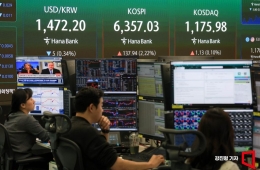
The KOSPI index plunged over 4% at the opening, directly hit by Middle East geopolitical risks including concerns over a full-scale war between the U.S. and Iran, as the index was displayed on the trading room status board at Hana Bank in Jung-gu, Seoul on the 4th. The KOSPI index activated sell-sidecars for two consecutive days. March 4, 2026 Photo by Yoon Dongjoo
View original imageAs military clashes between the United States and Iran have intensified, the KOSPI has plunged for two consecutive days. Experts predict that if the war ends within a month, the KOSPI will see a short-term correction of around 10% before attempting a rebound. However, they warned that in a worst-case scenario—such as escalation of the war or a prolonged blockade of the Strait of Hormuz—the KOSPI could plummet by more than 30%, potentially threatening the 5,000-point level.

Large-cap Stocks Plunge in the Wake of War
On March 4, the KOSPI opened at 5,592.59, down 3.44% from the previous trading day, and dropped as low as 5,438.97, a 6.09% decrease during the session. Due to the sharp decline, a sell-sidecar (a temporary suspension of program sell orders) was triggered at around 9:06 a.m. The sell-sidecar is activated when the KOSPI 200 futures index falls by more than 5% and remains at that level for one minute. This marks the second consecutive day that the sell-sidecar has been triggered, following its activation the previous day.
Major large-cap stocks, including Samsung Electronics, SK Hynix, and Hyundai Motor, saw significant declines. As of 9:31 a.m., Samsung Electronics was trading at 188,300 won, down 3.49% from the previous trading day. This is the first time Samsung Electronics' share price has fallen below 190,000 won since February 19. Other large-cap stocks, such as SK Hynix (-1.06%), Hyundai Motor (-4.20%), LG Energy Solution (-3.31%), and Hanwha Aerospace (-4.19%), were also on a downward trend.
The Korean stock market was also affected by the overnight decline in the New York Stock Exchange, which was influenced by the ongoing war between the U.S. and Iran. On March 3 (U.S. Eastern Time), the Dow Jones Industrial Average closed at 48,501.27, down 0.83% from the previous session. The Nasdaq Composite Index closed at 22,516.69, down 1.02%. The Philadelphia Semiconductor Index plunged 4.58%.
Concerns about inflation and a slowdown in the global economy have grown as international oil prices surged for two consecutive days due to Iran's blockade of the Strait of Hormuz. April West Texas Intermediate (WTI) crude oil rose by $3.33 (4.67%) from the previous session, trading at $74.56 per barrel. Over the past two days, international oil prices have jumped more than 10%.
Experts believe that the future trajectory of the KOSPI depends on whether the war is prolonged. If the conflict between the U.S. and Iran is resolved within a month, the KOSPI is expected to undergo a correction of around 10% before attempting a rebound. However, if the war drags on and leads to a full-scale blockade of the Strait of Hormuz, the KOSPI's decline could deepen significantly.
Hana Securities predicted that, assuming the military conflict between the U.S. and Iran ends in the short term, the KOSPI will experience a correction of less than 10% before rebounding. Jaeman Lee, Head of Global Investment Analysis at Hana Securities, forecast, "If the military conflict between the U.S. and Iran continues for about one to two months and oil supply disruptions occur during that period, the KOSPI's short-term bottom could be a 10% decline."
Daishin Securities also projected a roughly 10% correction for the KOSPI if the war is resolved within a month. IBK Investment & Securities similarly predicted that if the war ends within a month, the KOSPI would rebound from the mid-5,000-point range as its bottom.
If the War Lasts More Than a Month, the 5,000 Level Could Be Breached
However, in a scenario where the war lasts more than a month, it is expected that the KOSPI will correct by at least 20%. In particular, if the blockade of the Strait of Hormuz continues and Korea's oil supply becomes unstable, a correction of more than 30% is possible, threatening the 5,000-point level. The Strait of Hormuz is a narrow maritime passage connecting the Persian Gulf and the Gulf of Oman, serving as a strategic chokepoint and a major global oil transportation route. Korea imports about 70% of its oil through the Strait of Hormuz.
Kyungmin Lee, Head of FICC Research at Daishin Securities, stated, "In the past, when geopolitical risks in the Middle East became prolonged and oil prices remained high, it eventually led to a global economic recession with a time lag, and the stock market entered a phase of bubble collapse and major decline. If the war becomes prolonged, the correction in the KOSPI could deepen."

However, there are also forecasts that in the best-case scenario, where the war ends within one to two weeks, the correction in the KOSPI will not be severe. Junho Byun, a researcher at IBK Investment & Securities, analyzed, "In early March, the KOSPI may correct to the mid-to-high 5,000-point range as the conflict escalates, but if the situation is resolved quickly and the market undergoes only a short-term correction, this could serve as an opportunity to relieve technical overheating, potentially leading to renewed market momentum."
Hot Picks Today
!["Only the Top 1% Winning Big in Stocks Smile... '300 Million Won Splurges' or '10-Won Wars,' the Middle Disappears [K-Shaped Consumption Era]①"](https://cwcontent.asiae.co.kr/asiaresize/93/2026042114121434484_1776748334.png) "Only the Top 1% Winning Big in Stocks Smile......
"Only the Top 1% Winning Big in Stocks Smile......
- "If Relocated, I'll Resign"?40% of Millennial and Gen Z Employees Threaten to Qu...
- Department Stores Shine with Gourmet Offerings, Discount Marts Rival 1,000-Won S...
- Female Game Caster Makes Bold Move After Criticism Over "Short Skirt" on Broadca...
- Couple Secretly Making Love on Mountain Summit... Broadcast Live on the Internet
Some experts also note that the magnitude of the correction is significant because the KOSPI has risen much more than other global markets this year. Jiyoung Han, a researcher at Kiwoom Securities, commented, "While major overseas stock markets, such as the Nasdaq in the U.S., have not posted high gains—with the Nasdaq down 2.5% since the beginning of the year—the KOSPI has surged 48%. This has made the Korean market particularly vulnerable to the Middle East crisis. However, considering the accelerating earnings momentum of KOSPI-listed companies and the government's market support policies, it is premature to speak of a long-term downward trend in the index."
© The Asia Business Daily(www.asiae.co.kr). All rights reserved.


!["They Said It Was 'Delicious' Milk... Is the 'List of Fake Milk Products in Korea' for Real? [Matjal X-File]"](https://cwcontent.asiae.co.kr/asiaresize/307/2023072413274517286_1690172865.jpg)