Economic Uncertainty at Its Worst... "Yoon Must Step Down for Economic Stability"
Exchange Rates Soar and Stock Market Plummets After Martial Law Incident
Foreigners View Martial Law Incident Very Negatively, Withdraw Funds from Korea
Uncertainty Must Be Removed Quickly with Either Presidential Impeachment or Resignation

President Yoon Suk-yeol's emergency martial law situation has pushed our already struggling economy to the brink. With both domestic demand and exports declining, there is a high possibility that next year's economic growth rate will fall to the 1% range, and political instability is expected to further accelerate the downward trend of our economy.
Many experts believe that just President Yoon Suk-yeol remaining in office is already acting as a direct threat to our economy, causing the won's value and the stock market to plummet. They assessed that the impact on our economy is greater than during the impeachment crises of former Presidents Roh Moo-hyun and Park Geun-hye. It is anticipated that a swift decision on President Yoon's resignation or impeachment is necessary to remove the uncertainties in our politics and economy and to move to the next phase.
Concerns Over Prolonged Impeachment Drive Exchange Rate Up and KOSPI Down Sharply
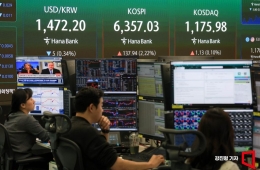
On the 9th, in the Seoul foreign exchange market, the won-dollar exchange rate opened at 1,426.0 won, up 6.8 won from the previous trading day. The won's value has sharply declined since the emergency martial law situation on the 3rd. The won-dollar exchange rate jumped 24.5 won just last week, showing the weakest performance among major world currencies. Last week, the won depreciated by 1.86% against the dollar, while the euro (+0.03%), yen (+0.10%), and pound (+0.26%) strengthened.
On the same day, the KOSPI index also opened down 1.47% at 2,392.37 points. Concerns over a prolonged impeachment crisis grew, causing the index to fall for four consecutive trading days and break below the 2,400 level. During the day, the KOSPI dropped to 2,383.82, marking its lowest point since November 3 last year (2,351.83).
Experts unanimously evaluated that President Yoon Suk-yeol's martial law situation and concerns over a prolonged impeachment have hindered our economy. They argued that unless the president's status is resolved quickly, concerns about our economy will not disappear.
Professor Shin Yul of Myongji University's Department of Political Science and Diplomacy said, "Foreign capital is rapidly withdrawing from our country due to this martial law situation," adding, "Considering the uncertain state of our economy, President Yoon's impeachment must be decided quickly for the economy to stabilize promptly."
Choi Byung-chun, director of the New Growth Economy Research Institute, also emphasized, "Foreigners currently view our country as being in an anarchy-like situation and are withdrawing funds," warning, "If impeachment is not carried out swiftly, the Korean economy will regress to 10 or 20 years ago, with continued declines in the stock market and won value."
Lee Joo-won, economist at Daishin Securities, pointed out, "The exchange rate is showing a sharp rise amid domestic political instability," and added, "Because political uncertainty has damaged investment sentiment toward Korea, the exchange rate will exhibit high volatility until the political issues ease."
Many experts also view the current economic situation as more severe than during the impeachment crises of former President Park Geun-hye in 2016 or even former President Roh Moo-hyun in 2004.
Professor Heo Jun-young of Sogang University's Department of Economics said, "During Park Geun-hye's impeachment, the economy was recovering from a low point, and the impeachment was carried out quickly, so the economic shock was less severe," adding, "But now, with the economy in a very difficult state and the martial law situation occurring, the shock is expected to be greater than in the past."
Professor Ha Joon-kyung of Hanyang University's Department of Economics explained, "Unlike in the past, the fact that impeachment has not been carried out now itself creates a very difficult-to-understand uncertainty for foreigners," and said, "The president remaining in office while not exercising executive power lacks clear legal grounds, and if this situation continues for a long time, it will inevitably have negative effects on society, the economy, and external credibility."
During the recent case of former President Park Geun-hye's impeachment, the exchange rate and stock market experienced short-term volatility but quickly stabilized after the impeachment decision. Han Ji-young, a researcher at Kiwoom Securities, noted, "Park's impeachment occurred after a prolonged period of political turmoil, so the possibility of impeachment was somewhat predictable within the financial market, limiting the market shock," but also pointed out, "The longer this impeachment crisis drags on, the more it could cause not only political uncertainty but also policy gaps, potentially triggering short-term fluctuations in stock prices and foreign investor flows."

Speaker Woo Won-shik declared the impeachment motion against President Yoon Seok-yeol as 'vote invalid' due to insufficient quorum at the National Assembly plenary session on the 7th. Photo by Kim Hyun-min
View original imageAfter Impeachment Fails, Foreign Views on Our Economy Turn More Pessimistic
In fact, after the impeachment failed on the 7th, foreign perspectives on our economy have become more pessimistic.
Foreign investment bank (IB) Morgan Stanley stated, "(Despite the martial law situation) the basic outlook for Korea's export weakness and delayed consumption recovery remains unchanged," and evaluated, "The possibility of impeachment and presidential replacement could amplify household and investor concerns about the economic outlook, increasing downside risks to domestic demand and investment activities." They also added, "Many investors expressed concerns about Korean stocks if political instability continues."
Hong Kong-based CLSA also said, "Unwelcome political risks have been added to Korean stocks, which have shown disappointing movements since July," and argued, "Not only should the investment proportion in Korea be reduced next year, but the timing of reducing the proportion should be brought forward."
Barclays likewise stated, "Due to strong opposition to the incumbent president, political uncertainty is likely to persist," and warned, "There is a risk of delays in next year's budget approval, and if this delay prolongs, there could be potential downside risks to domestic demand recovery."
Hot Picks Today
!["Only the Top 1% Winning Big in Stocks Smile... '300 Million Won Splurges' or '10-Won Wars,' the Middle Disappears [K-Shaped Consumption Era]①"](https://cwcontent.asiae.co.kr/asiaresize/93/2026041409371024802_1776127030.jpg) "Only the Top 1% Winning Big in Stocks Smile......
"Only the Top 1% Winning Big in Stocks Smile......
- "If Relocated, I'll Resign"?40% of Millennial and Gen Z Employees Threaten to Qu...
- "Finally Coming"... Samsung Electronics, SK hynix 2x Leveraged ETF to Be Listed ...
- Female Game Caster Makes Bold Move After Criticism Over "Short Skirt" on Broadca...
- Couple Secretly Making Love on Mountain Summit... Broadcast Live on the Internet
Kim Jung-sik, emeritus professor at Yonsei University's Department of Economics, diagnosed, "The martial law situation has caused extreme volatility in the foreign exchange market and concerns about domestic demand stagnation, raising worries about financial instability," and said, "Political issues must be resolved quickly to reduce the economic impact."
© The Asia Business Daily(www.asiae.co.kr). All rights reserved.



!["They Said It Was 'Delicious' Milk... Is the 'List of Fake Milk Products in Korea' for Real? [Matjal X-File]"](https://cwcontent.asiae.co.kr/asiaresize/307/2023072413274517286_1690172865.jpg)