Hyundai Research Institute "Economic Growth Rate Forecast for This Year at 2.7%"... Up 0.5%P from Early Year
Export Boom and Domestic Recession Type Surplus Structure
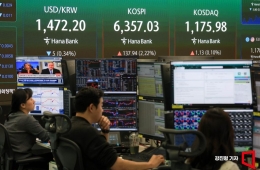
The Hyundai Research Institute announced on the 6th that it has revised South Korea's economic growth forecast for this year to 2.7%. Earlier, the institute had projected 2.2% in January, but raised it by 0.5 percentage points as the first half of the year passed. If the forecast holds true, it will significantly surpass last year's growth rate of 1.4%.
The reason for raising the forecast is the judgment that the export market recovery is solid. In the economic weekly report released that day, the institute explained, "The first quarter economic growth rate showed unexpectedly strong performance," adding, "With the export market recovery strength being solid, and imports falling short of expectations due to sluggish domestic demand, the trade and current account surplus structure of 'overseas boom-domestic recession' is being reinforced."
While both exports and domestic demand were sluggish last year, resulting in a complex recession, this year is expected to improve led by exports. Domestic demand indicators are not expected to improve much. The forecast for private consumption growth rate is 1.7%, and facility investment growth rate is expected to be around 3.8%. Construction investment growth rate is expected to drop sharply to 0.1%. However, exports, which had decreased by more than 7% last year, are expected to increase by 9.3% this year, with the trade balance projected to reach $43.4 billion.

The institute explained, "Going forward, the Korean economy will show a typical export-led growth structure where exports drive economic recovery," adding, "As the export recovery strengthens, economic vitality centered on manufacturing will increase, and the part that had responded to market demand expansion through inventory adjustments has reached its limit, leading to expanded facility investment to increase production capacity."
However, since raising the forecast is based on improved external conditions, unexpected shocks or intensified geopolitical risks could result in growth in the low 2% range. Furthermore, to achieve a trickle-down effect where the export recovery leads to the domestic sector, the government needs a 'bridge strategy' that clearly communicates economic policy messages to stabilize economic sentiment. It also emphasized the need to flexibly conduct monetary policy while focusing on expanding real purchasing power and alternative consumer markets.
Hot Picks Today
!["Only the Top 1% Winning Big in Stocks Smile... '300 Million Won Splurges' or '10-Won Wars,' the Middle Disappears [K-Shaped Consumption Era]①"](https://cwcontent.asiae.co.kr/asiaresize/93/2026041409371024802_1776127030.jpg) "Only the Top 1% Winning Big in Stocks Smile......
"Only the Top 1% Winning Big in Stocks Smile......
- "If Relocated, I'll Resign"?40% of Millennial and Gen Z Employees Threaten to Qu...
- Department Stores Shine with Gourmet Offerings, Discount Marts Rival 1,000-Won S...
- Female Game Caster Makes Bold Move After Criticism Over "Short Skirt" on Broadca...
- Couple Secretly Making Love on Mountain Summit... Broadcast Live on the Internet
The institute proposed, "Active market stabilization efforts such as creating a business-friendly investment environment and expanding construction investment are necessary," and "The share of risk management-focused trade policies should be increased to accelerate the pace of export market recovery."
© The Asia Business Daily(www.asiae.co.kr). All rights reserved.


!["They Said It Was 'Delicious' Milk... Is the 'List of Fake Milk Products in Korea' for Real? [Matjal X-File]"](https://cwcontent.asiae.co.kr/asiaresize/307/2023072413274517286_1690172865.jpg)