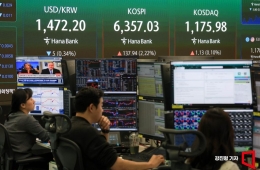
Surplus in Current Account for 10 Consecutive Months Amid Semiconductor Boom (Comprehensive)
Semiconductor Exports Surge 63% in February
Current Account Surplus Expected to Continue for the Time Being

As the semiconductor market recovers, South Korea's current account surplus continued for the 10th consecutive month in February. With the global IT industry improving, semiconductor demand is expected to keep rising, leading to a continued current account surplus.
According to the preliminary balance of payments statistics released by the Bank of Korea on the 5th, South Korea's current account surplus in February recorded $6.86 billion. This surplus increased compared to the $3.05 billion recorded the previous month. The current account surplus has continued for 10 consecutive months since May last year. The surplus amount was also the third highest ever recorded for February.

On the morning of the 5th, the 2024 February Balance of Payments (provisional) briefing was held at the Bank of Korea in Jung-gu, Seoul. From the left in the photo: Kim Tae-ho, Manager of the International Balance of Payments Team at the Bank of Korea; Song Jae-chang, Head of the Financial Statistics Department; Moon Hye-jung, Head of the International Balance of Payments Team; and Ahn Yong-bi, Manager of the International Balance of Payments Team. Photo by Bank of Korea.
View original imageExports Increase, Imports Decrease... "Recent Oil Price Rise is a Burden"
The current account surplus was driven by exports. February exports amounted to $52.16 billion, an increase of about 3% compared to the same period last year. By item, semiconductor exports surged 63% year-on-year, leading the overall export improvement. Song Jae-chang, head of the Financial Statistics Department at the Bank of Korea, said, "Semiconductors have been continuously driving the current account surplus," adding, "Demand for artificial intelligence (AI) and data centers is increasing, leading to improvements in semiconductor front industries such as servers, mobile devices, and PCs."
On the other hand, passenger car exports declined by 8.2%, steel products by 8.8%, and chemical products by 8.9% compared to the previous year, showing weakness. In particular, passenger cars, which had driven our exports until last year, have recently been sluggish. Seok Byung-hoon, a professor of economics at Ewha Womans University, evaluated, "Due to the global high interest rate impact, consumption is depressed, so the decline in passenger car exports may continue," and added, "Electric vehicles are also struggling as they are losing ground to China."
By export region, Southeast Asia increased by 20.1% year-on-year, the United States by 9.1%, and Japan by 1%. In contrast, China decreased by 2.4%, and the European Union (EU) by 8.4%.
February imports were $45.55 billion, down 12.2% year-on-year. The decline in energy prices led to a continued decrease centered on raw materials. Raw material imports in February fell 19.1% compared to the previous year. Most major items saw reduced imports: gas by 48.6%, chemical products by 23.2%, coal by 17.5%, and petroleum products by 15.1%. Capital goods imports also decreased by 5.3%, mainly due to information and communication devices (-31.4%), and consumer goods imports shrank by 6.6%, including passenger cars (-19.7%) and grains (-17.2%).
With exports rising and imports falling, the February goods balance surplus reached $6.61 billion, successfully turning to a surplus compared to the previous year. The surplus also expanded compared to the $4.24 billion recorded the previous month. The current account surplus is expected to continue for the time being due to export improvements. Director Song stated, "We expect the current account surplus to continue for the time being due to the improvement in the semiconductor industry."
However, the rise in international oil prices is expected to increase raw material import prices, negatively affecting the current account surplus. Director Song predicted, "International oil prices have been rising recently, but so far, this will affect crude oil import prices with a time lag."

The duty-free area of Incheon International Airport Terminal 1 is bustling with travelers. Photo by Jinhyung Kang aymsdream@
View original imageService Account Deficit Shrinks as Departures Decrease
The service account recorded a deficit of $1.77 billion in February, mainly due to travel and processing services. However, the deficit amount was smaller than January's $2.66 billion. The travel account deficit ($1.36 billion) slightly narrowed compared to January ($1.47 billion). The Bank of Korea explained this was due to a decrease in departures. The intellectual property account deficit (-$40 million) also shrank compared to January (-$520 million) as income from patent and trademark royalties increased.
The primary income account showed a surplus of $1.82 billion, mainly from dividend income. The surplus widened as dividend income from domestic companies' overseas subsidiaries increased. The secondary income account recorded a deficit of $420 million.
Hot Picks Today
!["Only the Top 1% Winning Big in Stocks Smile... '300 Million Won Splurges' or '10-Won Wars,' the Middle Disappears [K-Shaped Consumption Era]①"](https://cwcontent.asiae.co.kr/asiaresize/93/2026041409371024802_1776127030.jpg) "Only the Top 1% Winning Big in Stocks Smile......
"Only the Top 1% Winning Big in Stocks Smile......
- [Exclusive] Latest Cancer Treatment Costs Rise by 40 Million Won... War Disrupts...
- "Finally Coming"... Samsung Electronics, SK hynix 2x Leveraged ETF to Be Listed ...
- Female Game Caster Makes Bold Move After Criticism Over "Short Skirt" on Broadca...
- Couple Secretly Making Love on Mountain Summit... Broadcast Live on the Internet
The net financial account, which is assets minus liabilities, increased significantly to $6.85 billion compared to $2.81 billion the previous month. Direct investment saw domestic investors' overseas investments increase by $3.3 billion, mainly in the secondary battery sector, while foreign investors' domestic investments decreased by $710 million. Securities investment showed domestic investors' overseas investments increased by $9.05 billion, mainly in stocks, and foreign investors' domestic investments also rose by $10.65 billion, mainly in stocks.
© The Asia Business Daily(www.asiae.co.kr). All rights reserved.


!["They Said It Was 'Delicious' Milk... Is the 'List of Fake Milk Products in Korea' for Real? [Matjal X-File]"](https://cwcontent.asiae.co.kr/asiaresize/307/2023072413274517286_1690172865.jpg)