Government to Submit CPTPP Membership Application This Month... What Are the Remaining Procedures?
![[Image source=Yonhap News]](http://www.asiae.co.kr/news/img_view.htm?img=2022040213591313557_1648875553.jpg)
[Asia Economy Sejong=Reporter Dongwoo Lee] As the government plans to submit its application for membership in the Comprehensive and Progressive Agreement for Trans-Pacific Partnership (CPTPP) to the depositary country New Zealand within this month, interest in the subsequent procedures is growing.
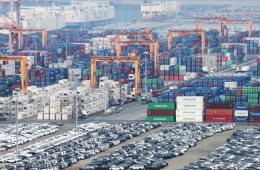
The CPTPP is a coalition launched on December 30, 2018, by the remaining 11 countries including Japan, Australia, and Mexico after the United States withdrew from the Trans-Pacific Partnership (TPP), which was originally led by the U.S. It is a massive economic bloc accounting for about 15% of global trade and 13% of GDP. It represents about 23% of South Korea’s exports, and the member countries generally adhere to a principle of tariff-free trade among themselves.
Unanimous Approval from 11 Member Countries Required... Takes at Least One Year
According to the Ministry of Trade, Industry and Energy on the 2nd, the CPTPP member countries are Japan, Canada, Australia, Brunei, Singapore, Mexico, Vietnam, New Zealand, Chile, Peru, and Malaysia, totaling 11 countries. The United Kingdom applied for CPTPP membership in February last year, and China and Taiwan applied in September of the same year.
The CPTPP is expected to promote diversification of export markets through enhanced trade liberalization. Key provisions of the agreement include the elimination of tariffs on agricultural, fishery, and industrial products within the region, activation of data transactions, and relaxation of regulations on finance and foreign investment.
For the South Korean government to join the CPTPP, it must hold public hearings to gather expert opinions in accordance with the "Act on Procedures for Concluding and Implementing Trade Agreements (Trade Procedures Act)." A public hearing to collect citizens’ opinions was held at the Government Complex Sejong on the 25th of last month. Afterward, the government will establish a negotiation plan through the Ministerial Meeting on External Economic Affairs, report the prepared plan to the National Assembly, and then submit the application directly to the depositary country New Zealand.
New membership in the CPTPP requires unanimous consent among member countries. To this end, it is essential to engage in individual consultations with CPTPP member countries concurrently with domestic procedures. Subsequently, discussions on South Korea’s accession will be held among existing member countries. The CPTPP member countries will then submit a report on the meeting results, and if this report passes by unanimous consensus, South Korea’s membership will be confirmed. Once membership is finalized, the National Assembly must complete the ratification approval.
Challenges Include Risk Consultations in Domestic Agriculture and Livestock Sectors
If the South Korean government joins the CPTPP, some risks in the agriculture and livestock sectors are expected to be unavoidable.
The tariff elimination rate for agricultural products among CPTPP member countries is 96%, known as a highly open agreement. It is analyzed that South Korea’s accession may inevitably require additional opening of agricultural and fishery products at a higher level than before.
In the agriculture and fisheries sectors, there is strong opposition to the unilateral promotion of the agreement, which threatens not only competitiveness but also public health rights.
Hot Picks Today
 Chilling Timing "Did They Know Again?"... $640 ...
- Thailand and India Surpass 50%, but Korea Only at 37%... Falling Behind in the A...
- "Why Is My Chanel Wallet on Danggeun?"...High School Students Steal Luxury Goods...
- "Woke Up to a Strange Smell"...Both Feet Placed on KTX Front Armrest
- "I Can't Believe They're Real": Cockroaches Squirm Inside Transparent Jacket in ...
Members of the Democratic Party of Korea anticipate strong demands for tariff elimination on Mexican beef and pork, New Zealand whole and skim milk powder, and Mexican and Peruvian oranges and grapes. They also foresee serious damage to the livestock and fruit sectors due to the relaxation of sanitary and phytosanitary (SPS) barriers, leading to imports of fresh fruits and fresh livestock products.
![[Image source=Yonhap News]](http://www.asiae.co.kr/news/img_view.htm?img=2022040213585613556_1648875536.jpg)
© The Asia Business Daily(www.asiae.co.kr). All rights reserved.