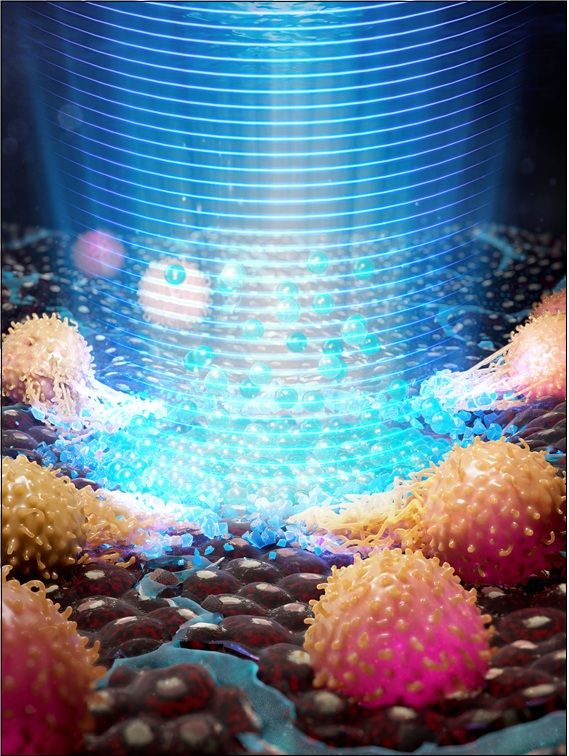
Cancer immunotherapy was a breakthrough, but it has been ineffective against many cancers. This is because so-called "immune deserts" form, in which immune cells cannot penetrate the tumor tissue. Although drugs circulate throughout the entire body, a structural limitation in which immune responses do not occur inside the tumor itself has blocked therapeutic efficacy.
A new approach that directly targets this limitation has now been proposed by a Korean research team. The technology selectively activates immunity only inside tumor tissue, turning areas where immunity was barely functioning into an "immune oasis."
The Korea Institute of Science and Technology (KIST) announced that a research team led by Dr. Youngmin Kim of the Center for Biomaterials and Dr. Sungmin Han of the Bionics Research Center has developed a new cancer immunotherapy technology that induces immune responses only inside tumors using ultrasound.
Waking up immunity only inside the tumor with ultrasound
The research team devised a method in which they directly inject an implantable gel containing immune-activating substances into the tumor tissue and then apply ultrasound from outside the body. The tumor tissue is physically disrupted only in the region reached by the ultrasound, releasing tumor antigens, and at the same time, the gel is designed to convert into nanoscale immune-stimulating particles that immune cells can readily absorb.
As a result, immune stimulation is precisely focused only at the tumor site. This structure reduces the likelihood that immune adjuvants will spread systemically and cause side effects, while enabling a strong immune response inside the tumor. The research team described this concept as a therapeutic strategy that creates a small "Immunoasis" inside the tumor.

It is a therapy that alters the immune microenvironment around solid tumors to induce anticancer immune responses. Using a thermoresponsive hydrogel and high-intensity ultrasound, it stimulates local immune responses around the tumor and reactivates immune cells. Provided by the research team.
원본보기 아이콘Twice as many immune cells...enhanced efficacy of existing immunotherapy
In animal experiments, tumor tissues treated with this technology showed a marked increase in immune cells that attack cancer. The number of T cells, which are central to immune responses, more than doubled compared with existing treatments, and tumors that previously exhibited almost no immune response were observed to convert into an immune-activated microenvironment.
As a result, tumor growth was suppressed, and survival increased by about 30%. When combined with existing cancer immunotherapies, the treatment effect was further enhanced, indicating potential as an adjuvant therapeutic strategy to increase response rates even in cancers that respond poorly to current immunotherapies.
This technology is also significant in that treatment can be delivered using only injections and ultrasound. It can be applied in a relatively simple manner even for patients for whom surgery is highly burdensome or treatment access is limited, and once the gel is injected, clinicians can adjust the intensity and timing of the ultrasound to tailor therapy to the patient's condition. The research team expects that this technology could evolve into a new cancer treatment platform integrated with ultrasound equipment in the future.
Dr. Youngmin Kim of the Korea Institute of Science and Technology said, "The core of this study is transforming the interior of tumors, where immunity was barely functioning, into a space where immune activity is revived," adding, "We hope this will lead to a new cancer immunotherapy strategy that reduces the burden on patients while enhancing the efficacy of existing cancer immunotherapies."
This research was conducted with support from the Ministry of Science and ICT, and the findings have been published in the international journal Advanced Materials.
IndexReading Science
- After AI, Now AR: Meta Scores Two Wins While Apple Struggles
- There Is Water That Can Turn Into Ice Even at Room Temperature
- "It Was Supposed to Rain, but It Was Sunny"... Is the Forecast Wrong, or Are We Misinterpreting It?
- When AI Has Nothing Left to Learn: Will Humans Become Unnecessary?
- Planting Immunity Inside Tumors...How Immune Oases Kill Cancer
-

Reporter Kim Jonghwa justin@asiae.co.kr
-
Edit Choi Yujeong yjchoi@asiae.co.kr
© The Asia Business Daily(www.asiae.co.kr). All rights reserved.

![[Reportage]"It Only Leads to Arguments"... Chungnam's True Sentiments Hide Deeper After Martial Law](https://cwcontent.asiae.co.kr/asiaresize/304/2026051223490460082_1778597344.jpg)