'Unbelievable source' weather app
In reality, the forecast was not wrong,
but users interpreted the meaning differently
In reality, the forecast was not wrong,
but users interpreted the meaning differently
by Kim Jonghwa
by Choi Yujeong
Published 10 Nov.2025 14:03(KST)
Updated 10 Nov.2025 14:07(KST)
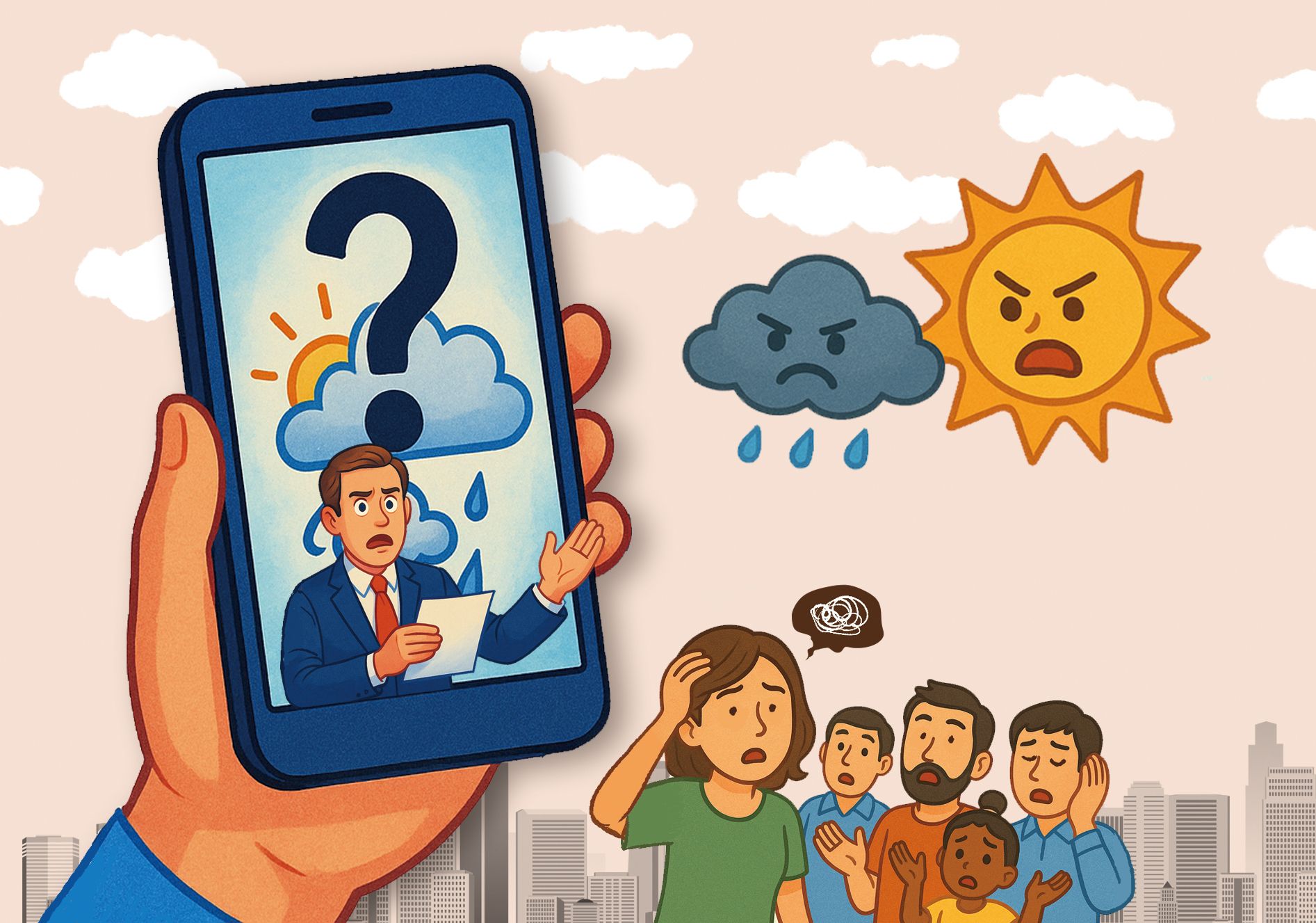
Recently, despite frequent "autumn rainy seasons," weather apps have failed to fulfill their role. Rain was forecast, but the sky remained clear; on days predicted to be sunny, sudden showers poured down. Among citizens who brought umbrellas to work only to see sunshine all day, the complaint, "The Korea Meteorological Administration got it wrong again," is repeated.
At some point, smartphone weather apps became an "unbelievable source" of information. In reality, however, it is far more common for users to interpret the language of forecasts differently, rather than the forecasts themselves being wrong. Meteorologists say, "It's not that the forecasts are inaccurate, but that users interpret their meaning differently."

According to statistics from the Korea Meteorological Administration, the average accuracy of 24-hour forecasts last year was 86.7%. For the past three months (June to August 2025), which saw heavy rainfall, the accuracy (ACC) of precipitation occurrence was 88.5%, a clear improvement over 2024 (84.5%) and 2023 (83.8%). In numbers, this means that 9 out of 10 forecasts were correct.
Yet, citizens still feel that forecasts are "often wrong." The reason lies in the language of "probabilistic forecasts." A "60% chance of precipitation" does not mean "there is a 60% chance it will rain," but rather that "under similar weather conditions, it rained 6 out of 10 times in the past."
Most users intuitively interpret this as "it will rain." Ultimately, the gap between the mathematical language of forecasts and the intuition of citizens makes the perceived error much greater than the actual error.
The Korea Meteorological Administration has recently begun full-scale operation of an artificial intelligence (AI)-based forecasting system. The ultra-short-term precipitation prediction model "NowAlpha" receives precipitation data observed over two hours from 12 weather radars nationwide and predicts precipitation intensity up to six hours ahead at 10-minute intervals. The calculation takes less than 40 seconds, more than ten times faster than traditional numerical forecasting models.
For medium-range forecasts, the latest AI models such as "WISDOM," "FourCastNet2," "Pangu-Weather," and "GraphCast" are used to produce 12-day forecasts at six-hour intervals.
Yoon Seyoung, Professor at the School of Computing and Kim Jaechul AI Graduate School at KAIST, explained, "AI forecasting models do not directly solve physical equations but operate in a data-driven manner by learning patterns from observational data." He added, "While training takes time, once completed, the model can generate new forecasts in just a few seconds."
However, this approach is structurally limited in explaining "why a forecast was made that way." Professor Yoon pointed out, "Deep learning is a black-box structure with more than millions of weights, so it is difficult to clearly identify which input variables influenced the result," adding, "This creates a structural limitation in explaining the causes behind forecasts."
The Korea Meteorological Administration also acknowledges this issue. "AI forecasts are excellent in terms of speed, but their stability may be lacking in extreme weather events such as storms or heavy rainfall." The reason is that AI forecasts use a deterministic structure that provides only a "single result."
To address this, the Korea Meteorological Administration is introducing "explainable AI (XAI)" technology, which visualizes the basis of forecasts to allow for logical explanations. In addition, an ensemble approach that trains multiple models simultaneously and integrates their results is also being pursued.
In particular, the Korea Meteorological Administration has recently begun developing a medium-range AI model capable of 14-day forecasts using a "Bayesian neural network-based ensemble structure." This model is designed to move beyond the traditional deterministic structure and consider both the uncertainty of initial conditions and the variability of data.
An official from the Korea Meteorological Administration explained, "While AI is fast at calculations, it does not always satisfy physical consistency, such as the law of energy conservation," adding, "We are developing in a direction that includes physical constraints in the training process to ensure both accuracy and stability."
The performance of AI forecasts ultimately depends on the quality of input data. According to analysis by the Korea Meteorological Administration, the factors that determine forecast accuracy are: quality of observational data (32%), numerical forecasting models (40%), and forecaster expertise (28%). In other words, one-third of the forecast is determined by "data quality management."
Jo Jeonghun, Researcher at the Artificial Intelligence Meteorology Research Division of the National Institute of Meteorological Sciences, stated, "The accuracy of AI forecasts is directly proportional to the reliability of input data," adding, "If even a portion of the observational data accumulates errors, the bias of the forecast model can increase." He emphasized, "Ultimately, the performance of AI depends more on the consistency and integrity of input data than on the algorithm itself."
Woo Jingyu, Forecaster at the Korea Meteorological Administration, also stressed, "The observational data used in forecasts are combined with numerical model backgrounds from various sources such as radar, satellites, and ocean data," adding, "Rather than minor errors in individual data, the overall system's coordination and quality management process are more important."
Weather alerts on smartphones change several times a day. This is not evidence that the forecasts are wrong, but rather a real-time adjustment process to improve accuracy.
Forecaster Woo Jingyu explained, "AI forecasting models can be recalculated at short intervals, so whereas forecasts used to be updated twice a day, now they are refreshed dozens of times," adding, "A changing forecast actually means the system is responding sensitively to weather conditions."
An official from a private weather app company also commented, "From the user's perspective, frequent forecast changes can be unsettling, but it doesn't mean the forecast has failed; rather, it signals that the forecast is being continuously updated," adding, "In the era of AI forecasting, timeliness has become a more important evaluation criterion than accuracy."
Weather forecasting is, by nature, a science that deals with uncertainty. While AI is becoming a tool to reduce that uncertainty, an "infallible forecast" still does not exist. However, by uncovering patterns that humans cannot see, AI enables us to be better prepared for each day. The science of reading the sky is now evolving into the realm of "wisdom in understanding error."

Kim Jonghwa justin@asiae.co.kr
Choi Yujeong yjchoi@asiae.co.kr
© The Asia Business Daily(www.asiae.co.kr). All rights reserved.




![[Reportage]"It Only Leads to Arguments"... Chungnam's True Sentiments Hide Deeper After Martial Law](https://cwcontent.asiae.co.kr/asiaresize/304/2026051223490460082_1778597344.jpg)