Yoonhee Lee, Principal Researcher of the Space Extreme Measurement Group at KRISS, explained, "The density of Ice XXI is similar to the ultra-high-pressure ice layers predicted to exist inside the icy moons of Jupiter and Saturn," adding, "This research will provide important clues for exploring the internal structure of celestial planets and the possibility of life."
Korea Research Institute of Standards and Science captures the moment water transforms into ice under ultra-high pressure
World's first discovery of a new crystal structure 'Ice XXI' at over 20,000 atmospheres
Reveals the structural essence of water and its changes under extreme conditions
Establishes foundational technology for precise measurement of materials in space environments
World's first discovery of a new crystal structure 'Ice XXI' at over 20,000 atmospheres
Reveals the structural essence of water and its changes under extreme conditions
Establishes foundational technology for precise measurement of materials in space environments
The Korea Research Institute of Standards and Science (KRISS) has captured the moment when water at room temperature and under ultra-high pressure exceeding 20,000 atmospheres transforms into ice.
On October 27, KRISS researchers announced that they had observed the crystallization process of water at the microsecond (μs, one-millionth of a second) scale, leading to the world’s first discovery of a previously unknown crystalline phase of ice, named 'Ice XXI'.

Phase diagram of various states of water and ice existing over a wide range of temperatures and pressures. The area marked in blue indicates the location of the newly discovered room-temperature ultra-high-pressure ice, "Ice XXI." Provided by KRISS
원본보기 아이콘'Room-Temperature Ice' Created by Pressure
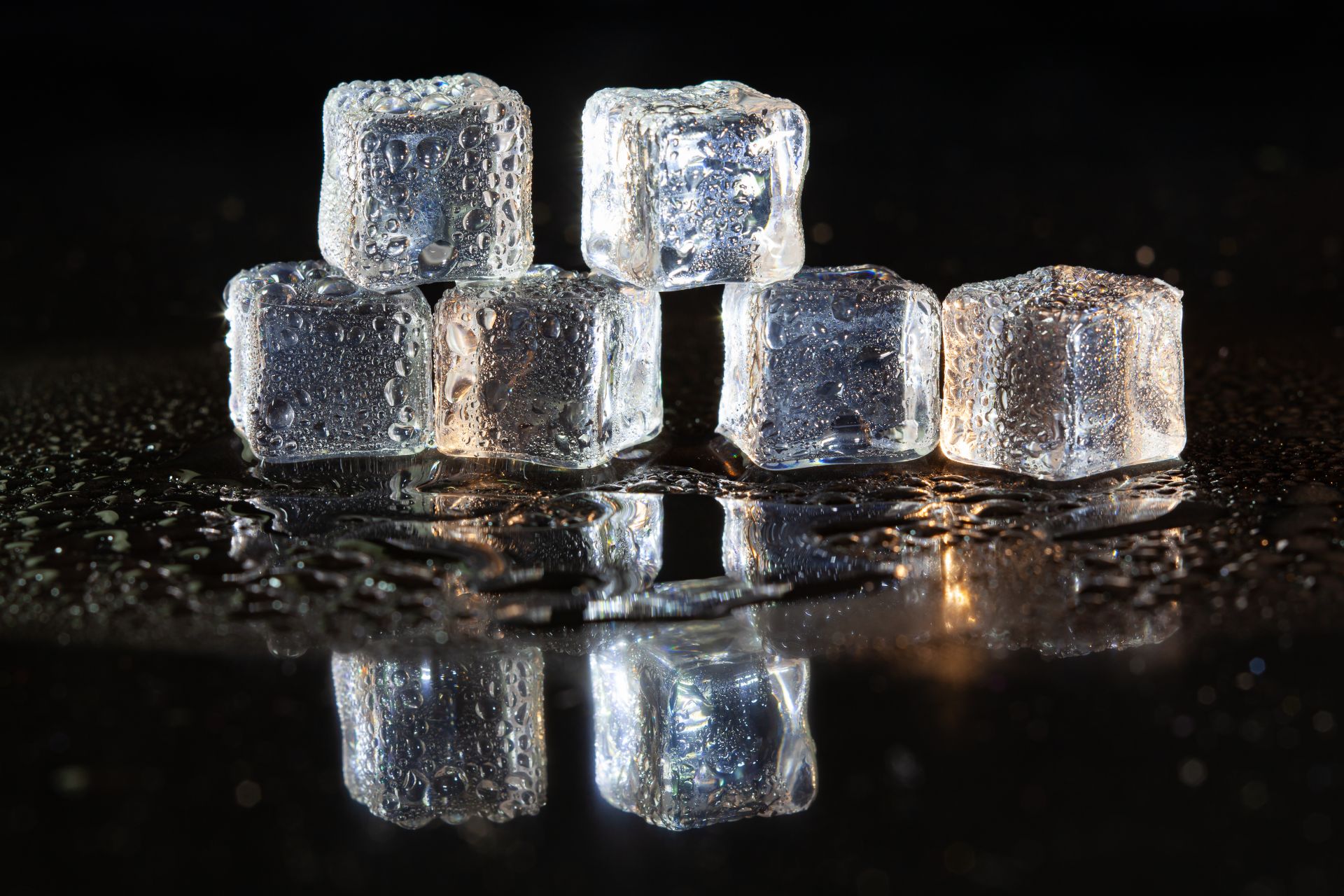
While water typically freezes below 0°C, its state is determined not only by temperature but also by pressure. When pressure is sufficiently high, water can turn into solid ice even at room temperature.
At room temperature, water transforms into 'Ice VI' at pressures above approximately 9,600 atmospheres (0.96 GPa). In this study, the researchers directly observed the process in which water remains liquid under much higher pressure-20,000 atmospheres (2 GPa)-before eventually crystallizing into ice.
Under such extreme pressure, the hydrogen bond structure between water molecules becomes intricately twisted and rearranged, resulting in the formation of various types of ice.
Until now, scientists worldwide have discovered 20 types of crystalline ice under different temperature and pressure conditions. However, the intermediate pressure range of 0 to 20,000 atmospheres is considered a 'complex region' where multiple phase transitions overlap, making it difficult to elucidate the internal structure.

Dr. Minju Kim, a postdoctoral researcher at KRISS (left), and Eunhee Lee, a senior researcher (right), are observing the crystallization process of overpressure ice implemented through a dynamic diamond anvil cell device. Provided by KRISS
원본보기 아이콘Technology That Creates 20,000 Atmospheres in a Space as Thin as a Hair
This discovery was made possible by KRISS's independently developed ultra-precision compression device, the 'dynamic diamond anvil cell (dDAC)'.
This device places water in a microscopic metal gap thinner than a strand of hair and compresses it using two diamonds to generate ultra-high pressure. Traditional equipment required researchers to manually adjust the pressure over several tens of seconds, but KRISS designed their device to apply pressure within just 10 milliseconds (one-thousandth of a second) using a piezo actuator.
This enabled the researchers to realize the 'supercompression' state-where water remains in a metastable liquid form at pressures far exceeding those at which it would normally freeze. This region had rarely been experimentally observed until now.

The world's largest X-ray free-electron laser facility, the European XFEL. European XFEL Facebook
원본보기 아이콘The research team exposed this state of water to the world’s largest X-ray free-electron laser facility, the European XFEL, firing millions of X-ray pulses per second to capture structural changes in the water molecules. As a result, they discovered more than five new crystallization pathways at room temperature, confirming that one of them was a previously unreported crystalline phase, 'Ice XXI'.
A Larger Crystal Structure Than Conventional Ice... Similar to Planetary Interiors
The newly discovered Ice XXI exhibited a unique structure distinct from previously known ice phases. The 'unit cell', the smallest repeating unit of the crystal structure, was exceptionally large and formed a flattened rectangular prism shape.
The KRISS research team analyzed the precise positions of the water molecules using X-ray diffraction data and fully elucidated the structure of the new Ice XXI.
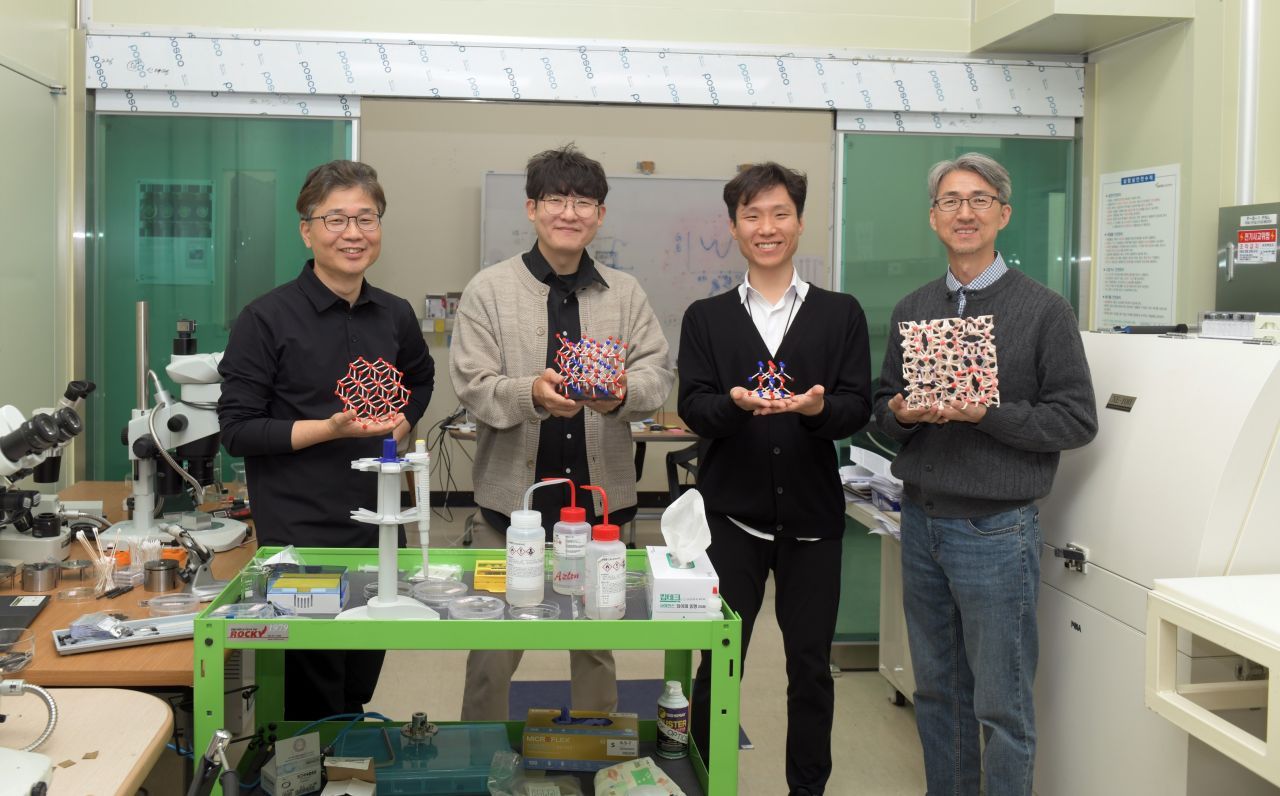
Geunwoo Lee, Principal Researcher of the same group, stated, "By combining the self-developed dDAC technology with the ultrafast imaging technology of XFEL, we captured a 'fleeting moment' that was previously inaccessible with existing equipment," emphasizing, "Research on material behavior under extreme conditions will open new chapters in the development of advanced materials and extreme environment science."
KRISS Space Extreme Measurement Group High-Pressure Research Team. From left: Yoonhee Lee, Principal Researcher; Minju Kim, Postdoctoral Researcher; Jingyun Kim, Postdoctoral Researcher; Geunwoo Lee, Principal Researcher. Photo by KRISS
'Ice Research' Expands Beyond Physics to Space Science
This achievement is significant not only for discovering a new form of ice, but also for experimentally demonstrating the structural essence of water and how materials change under extreme conditions. The research was supported by the National Research Council of Science & Technology’s project for developing ultra-high-temperature materials and property measurement technology for 4,000 K-class rocket engines.
The results were published in the October issue of the international journal 'Nature Materials' (impact factor 38.5). The paper, titled "Multiple Freezing-Melting Pathways of High-Density Ice through Ice XXI Phase at Room Temperature," lists Yoonhee Lee as the first author and Geunwoo Lee as the corresponding author.
KRISS is now recognized for establishing foundational technology to precisely measure material behavior under ultra-high-pressure and ultra-high-temperature conditions found in extreme space environments, as a result of this study.
IndexReading Science
- After AI, Now AR: Meta Scores Two Wins While Apple Struggles
- There Is Water That Can Turn Into Ice Even at Room Temperature
- "It Was Supposed to Rain, but It Was Sunny"... Is the Forecast Wrong, or Are We Misinterpreting It?
- When AI Has Nothing Left to Learn: Will Humans Become Unnecessary?
- Planting Immunity Inside Tumors...How Immune Oases Kill Cancer
-

Reporter Kim Jonghwa justin@asiae.co.kr
-
Edit Choo Myeonghoon chox2mh@asiae.co.kr
© The Asia Business Daily(www.asiae.co.kr). All rights reserved.
!['WHO Declares International Public Health Emergency' Why the Untreatable 'Variant Ebola' Is More Deadly Than COVID-19 [Reading Science]](https://cwcontent.asiae.co.kr/asiaresize/323/2026052110164072055_1779326201.png)
!["Please Help Us": How Much Do Those Bowing 90 Degrees These Days Actually Earn? [Data Pick]](https://cwcontent.asiae.co.kr/asiaresize/323/2026052010120870131_1779239528.png)