
However, the atmosphere changed when CEO Huang announced at a White House press conference at the end of April that Nvidia would invest $500 billion in U.S. manufacturing. Promoting U.S. manufacturing is one of President Trump's core policies. CEO Huang also accompanied him on a Middle East tour, achieving sales of semiconductors worth over $200 billion to Saudi Arabia and the United Arab Emirates. Since then, President Trump reportedly began calling CEO Huang 'my friend,' according to The New York Times. President Trump also praised CEO Huang in his speech at the Asia-Pacific Economic Cooperation (APEC) CEO Summit in Gyeongju last October.
Jensen Huang's actions have become increasingly prominent under the second Trump administration.
He began to stand out during the Middle East tour in May... Also accompanied the UK visit in September.
Apple's Tim Cook and Tesla's Elon Musk have grown distant.
Trump is using AI as a negotiation card.
He began to stand out during the Middle East tour in May... Also accompanied the UK visit in September.
Apple's Tim Cook and Tesla's Elon Musk have grown distant.
Trump is using AI as a negotiation card.

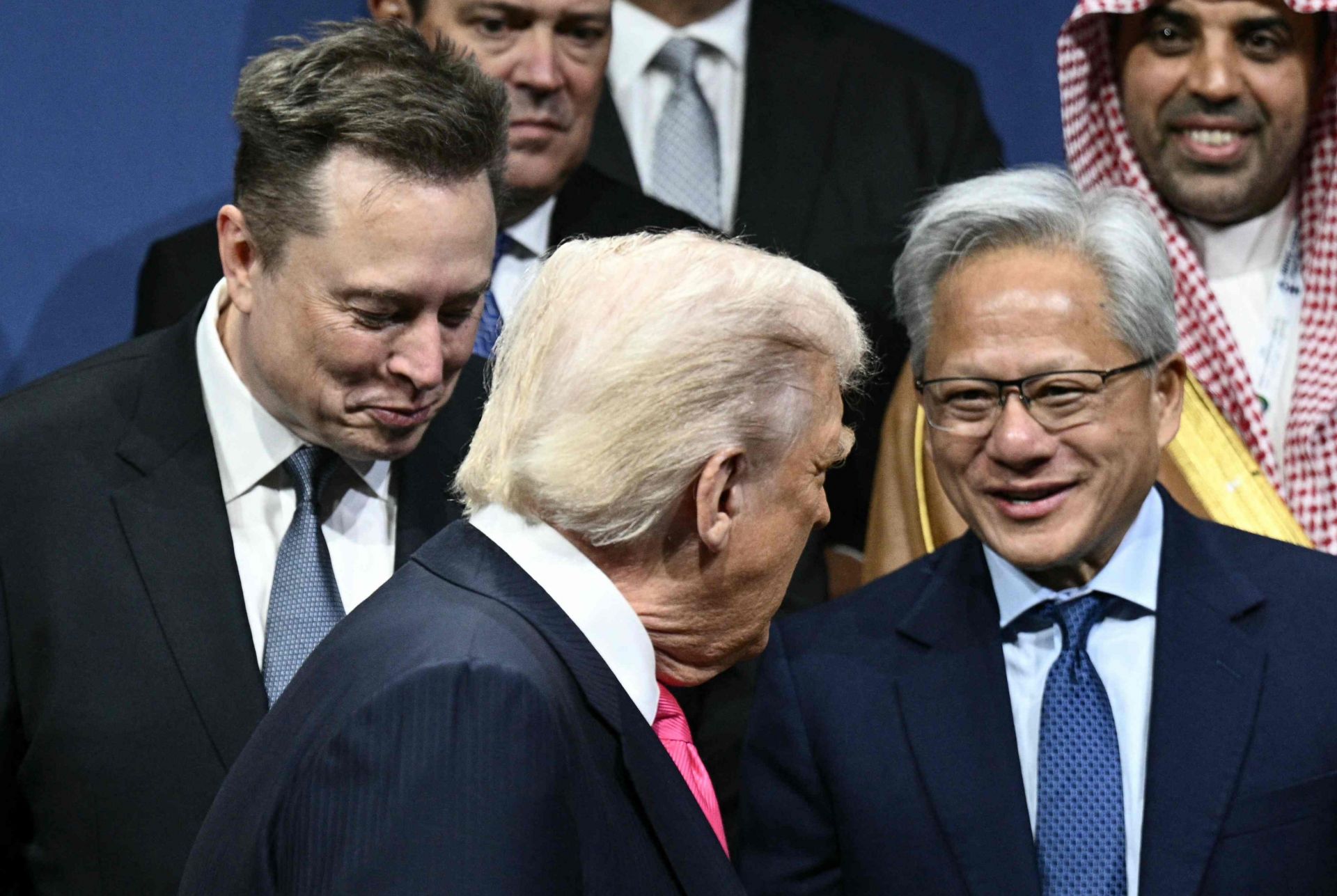
U.S. President Donald Trump is taking a commemorative photo with Jensen Huang, CEO of Nvidia, and Elon Musk, CEO of Tesla, at the U.S.-Saudi Arabia Investment Forum held on the 19th of last month (local time) at the Kennedy Center in Washington D.C. Photo by AFP Yonhap News
원본보기 아이콘Jensen Huang, CEO of Nvidia, has been drawing attention under the second administration of US President Donald Trump. While Tim Cook, CEO of Apple, wielded political influence during the first Trump administration, and Elon Musk, CEO of Tesla, was in the spotlight at the beginning of the second term, it is now CEO Huang who stands out. Given Nvidia's overwhelming dominance in the AI chip market and Huang's growing rapport with President Trump, some analysts suggest he is emerging as a central figure in the US government's AI industry strategy.
In an interview released on the 3rd (local time) with popular podcaster Joe Rogan, CEO Huang stated that he regularly communicates with senior officials in the Trump administration. He demonstrated his close ties by saying, "Whenever I need something or want to share my thoughts, I just call them." Meeting with reporters at the US Congress that day, he also confirmed having met with President Trump and discussed issues regarding export controls on AI semiconductors.
As of the 5th of this month, Nvidia's stock price has risen by approximately 31.9% this year.
Jensen Huang Did Not Attend the Inauguration-How Did He Become 'My Friend' to Trump?
CEO Huang began to gain prominence during President Trump's first overseas trip, the Middle East tour in May. Tim Cook, who had maintained a close relationship with President Trump during the first term, was absent, while CEO Huang's presence drew attention. Huang also accompanied Trump on the UK visit in September.
Their relationship was not smooth from the start. CEO Huang was one of the few big tech CEOs who did not attend President Trump's inauguration in January this year. Instead, he chose to travel to China. According to The New York Times, citing three sources, their first meeting in the Oval Office two weeks after the inauguration was also challenging, as they struggled to communicate effectively.
Another reason CEO Huang gained President Trump's trust is believed to be his support for Trump's interventionist corporate policies. In August, when President Trump announced a plan for the US government to collect a portion of the profits from semiconductor sales to China, CEO Huang agreed with the policy.
Did He Benchmark Tim Cook in the First Term? Cook and Musk's Influence Has Waned
According to US business media CNBC, CEO Huang surpassed the influence of both Cook during Trump's first term and Musk in the early days of the second term. Huang's recent actions appear to be modeled after Cook's approach during the first Trump administration. Cook preferred direct communication with business leaders and valued his political image, often calling or dining with President Trump to build a good relationship. Despite the US-China trade war reaching its peak during Trump's first term, Cook maintained close ties with Trump while also preserving good relations with China, ensuring that the iPhone was exempted from US tariffs on Chinese goods and thus avoiding the fallout from the trade war.
However, the relationship between Cook and President Trump appears to have soured since the beginning of this year. In May, President Trump expressed dissatisfaction, saying, "There are some issues with Tim Cook," criticizing Apple for not expanding production in the US. According to a New York Times report in May, Cook also refused to accompany President Trump on his Middle East tour, which reportedly drew Trump's ire.
At one point, there were expectations that Elon Musk, CEO of Tesla-once considered one of Trump's closest confidants-would become the tech industry CEO closest to the president during the second Trump administration, much like Cook in the first. Musk even headed the Department of Government Efficiency (DOGE), a key department in the Trump administration. However, after he publicly criticized President Trump's large-scale tax cut bill, their relationship soured. Since then, Musk has distanced himself from the Trump administration to focus on his business.
On the other hand, Nvidia is reaping significant benefits from aligning with the Trump administration's policies. According to Bloomberg on the 3rd, the 'GAIN AI Act,' which Nvidia has been lobbying for across the company, was excluded from the U.S. National Defense Authorization Act. The GAIN AI Act stipulates that semiconductor companies must prioritize meeting domestic demand before exporting high-performance artificial intelligence (AI) chips to countries of concern such as China. Nvidia has strongly opposed this regulation, arguing that it would promote China's AI technological independence and weaken U.S. leadership in the AI industry. To prevent this, CEO Huang personally met with President Trump and key members of the U.S. Congress. Earlier, the U.S. online media Axios reported that the White House pressured Congress to exclude the GAIN AI Act from the National Defense Authorization Act.
On the 8th, the Trump administration allowed Nvidia's cutting-edge H200 AI semiconductor to be exported to China. On the 4th, a bipartisan bill was introduced in Congress to block exports of the H200 to China, and CEO Huang publicly opposed the bill. The H200, released in 2023, is the highest-performing chip among those using the previous-generation Hopper architecture. While it does not match the latest Blackwell-based B200, it outperforms the lower-spec H20 chip of the same generation, which is currently permitted for export to China.
President Trump announced on his social network, Truth Social, that he informed Chinese President Xi Jinping that the US would allow Nvidia to ship the H200 to China and other countries, provided the US maintains strong national security.
Is Nvidia the Only Beneficiary? "Trump Uses AI Chips as a Negotiation Card"
By building close relationships with corporate CEOs, President Trump is also reaping political benefits. Nvidia, in particular, has been at the forefront of fulfilling one of the second Trump administration's core promises: bringing manufacturing back to the US. As Nvidia semiconductors have become indispensable to AI development, the Trump administration is reportedly using them as diplomatic and trade negotiation leverage, according to The New York Times. Just as the US in the 1950s offered nuclear technology to countries that pledged peaceful use, the Trump administration is now offering AI technology to countries that help resolve conflicts.

Last April, Jensen Huang, CEO of Nvidia, announced the US investment plan together with US President Donald Trump at the White House in Washington D.C. Photo by AFP Yonhap News
원본보기 아이콘For example, a $2 billion deal was recently announced to build an AI data center in Kazakhstan using Nvidia semiconductors, following the country's accession to the Abraham Accords. Nvidia semiconductors have also served as a powerful bargaining chip in US negotiations with Saudi Arabia, the UK, China, and others.
While US government officials say Nvidia played only a minor role in Kazakhstan's accession to the accords, The New York Times pointed out that the mere inclusion of Nvidia in such discussions demonstrates how President Trump is leveraging AI and Nvidia.
IndexGlobal Focus
- AI Talent War... Like a 'Second Operation Paperclip'
- 'Average Age 73': Old Boys Lead the US, China, and Russia
- Imported Rice on Japanese Tables, Easter Eggs Disappear in the US
- Crossing the Line with 'Third-Term Push and Pull'... Three Different Interpretations Drawn
- Trump's 'First Buddy' Is Changing
-
Reporter Oh Suyon syoh@asiae.co.kr
-
Edit Choo Myeonghoon chox2mh@asiae.co.kr
© The Asia Business Daily(www.asiae.co.kr). All rights reserved.

![[Culture Interview] "Unifying the Fragmented Music Market... Super Fans Are the Next Competitive Edge"](https://cwcontent.asiae.co.kr/asiaresize/304/2026042817051344090_1777363513.jpg)