Apple delays launch of AI features in new products
$367 million settlement for U.S. consumers
No compensation for Korean consumers
Fair Trade Commission: "Equity issues... accelerating investigation"
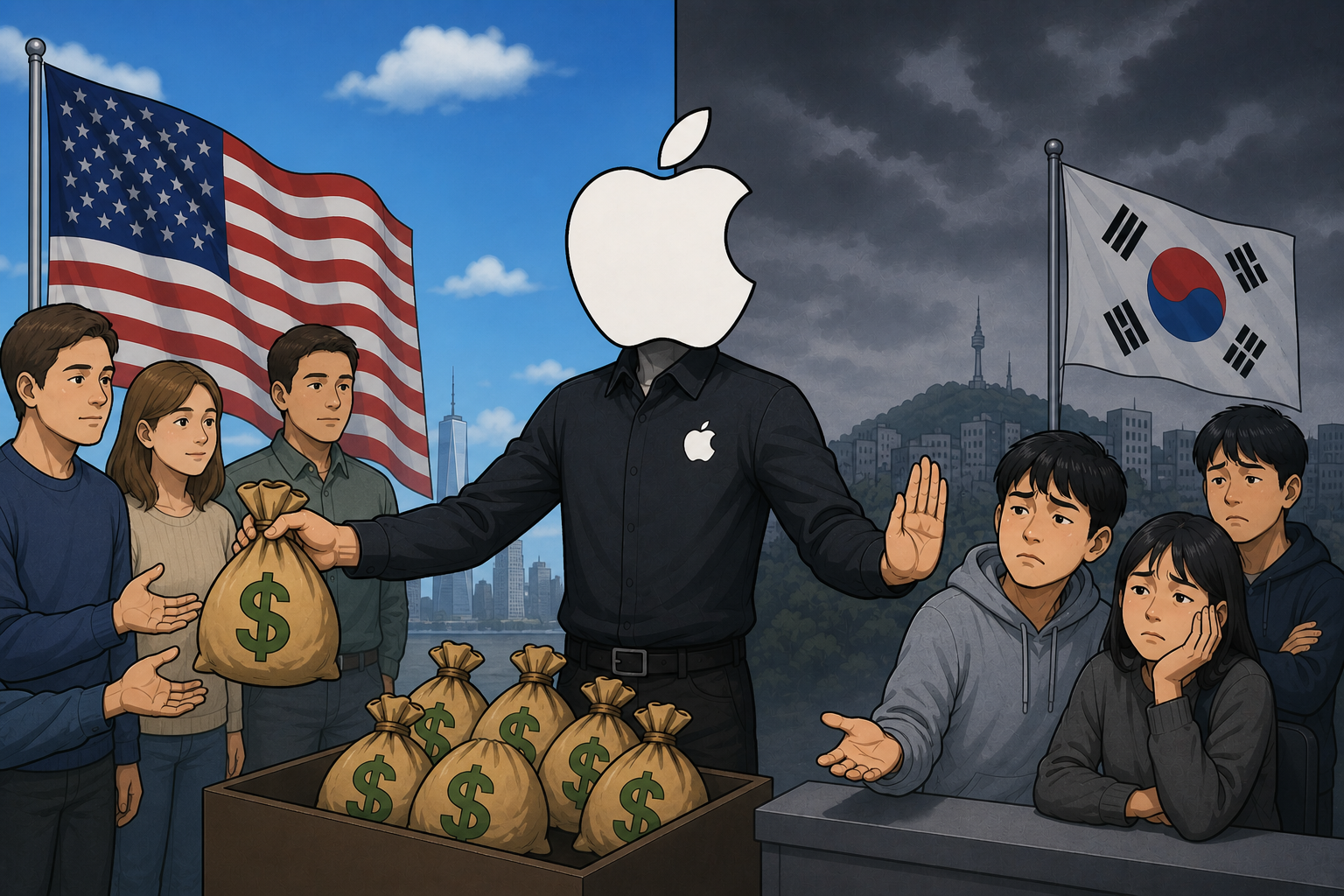
Apple is facing renewed controversy over discrimination against Korean consumers after being ordered to pay a settlement of $250 million (approximately 367 billion won) to U.S. consumers for failing to timely equip its new products, including the iPhone series, with artificial intelligence (AI) features. Compensation of up to 140,000 won per U.S. consumer is expected to be paid, but as the compensation is only being provided to consumers within the United States, equity issues have been raised. In response, the Korea Fair Trade Commission has decided to review the matter, taking into account the situation in the U.S., and to accelerate its investigation.
A Korea Fair Trade Commission official told The Asia Business Daily on the 6th, "Seoul YMCA reported Apple last April, alleging that the core AI features highlighted in Apple's advertisements were not actually implemented and were being delayed, so the commission officially launched an investigation at that time." The official added, "Currently, as the fairness issue regarding Korean consumers could arise, we are closely examining the matter."
According to major IT outlets such as 9to5Mac on the 5th (local time), Apple reached a settlement with shareholders and consumers in a class-action lawsuit related to the delay in introducing its AI service, Apple Intelligence, and the next-generation Siri. Apple did not admit any legal liability or wrongdoing as part of the settlement.
iPhone 15 Pro·16 Series Buyers Eligible for Compensation of up to 140,000 Won

Under the settlement, consumers in the United States who purchased select models of the iPhone 15 series (15 Pro, 15 Pro Max) and the iPhone 16 series (iPhone 16, 16 Pro, 16 Pro Max, 16e) between June 10, 2024, and March 29, 2025, are eligible for compensation. The compensation is $25 (approximately 36,700 won) per device, and the final amount may vary depending on the number of consumers who file claims. The maximum compensation is $95 (about 140,000 won).
The plaintiffs in this lawsuit argued, "Apple deceived investors and consumers through false advertising when there was not even a working prototype."
Apple faced the class-action lawsuit because it failed to properly release major AI features that had been announced. At the Worldwide Developers Conference (WWDC) 2024, Apple introduced Apple Intelligence and announced that key features, including 'personalized Siri,' would be incorporated into iOS 18, the mobile operating system to be released that fall.
However, due to development delays, the AI features available to users were limited to writing tools, emoji generation, and image editing. Some features, such as personalized Siri, have still not been implemented. Personalized Siri is designed to allow the AI model to learn from the user's personal text messages, emails, calendar, and app data, enabling Siri to provide tailored responses to user requests.
While companies like OpenAI and Google rapidly built models and infrastructure for AI services such as large language models (LLMs), Apple was slow to respond in the early AI market. As a result, Apple signed a contract with its competitor Google in January to use the Gemini model for its next-generation AI services. The new AI features incorporating Gemini are expected to be available in the next OS, iOS 27, and will be unveiled at WWDC 2026 next month.
"Delayed AI Feature Launch Is Fraudulent Act," Say Groups in Canada and Korea

As Apple has only reached a settlement with U.S. consumers, controversy over discrimination against global consumers has become inevitable. Apple is also facing a class-action lawsuit in Canada for the same reason, and in Korea, civic groups such as Seoul YMCA have reported Apple's delayed AI feature launch to the Fair Trade Commission, citing violations of labeling and advertising laws and fraudulent acts.
A representative from YMCA said, "When consumers purchase smartphones, they decide based not only on hardware but also on core software features such as AI. If the AI features advertised by Apple do not work properly and have yet to be implemented, there was clearly a price premium on the product. Compensation for false advertising is necessary, and since all consumers worldwide saw the same advertisements and purchased the products, compensation similar to that provided in the U.S. should also be made in Korea."
-

Reporter Lee Myeonghwan lifehwan@asiae.co.kr
-

Reporter Seo Sojeong ssj@asiae.co.kr
-
Edit Kim Boram kbram6457@asiae.co.kr
© The Asia Business Daily(www.asiae.co.kr). All rights reserved.






![[Culture Interview] "Unifying the Fragmented Music Market... Super Fans Are the Next Competitive Edge"](https://cwcontent.asiae.co.kr/asiaresize/304/2026042817051344090_1777363513.jpg)