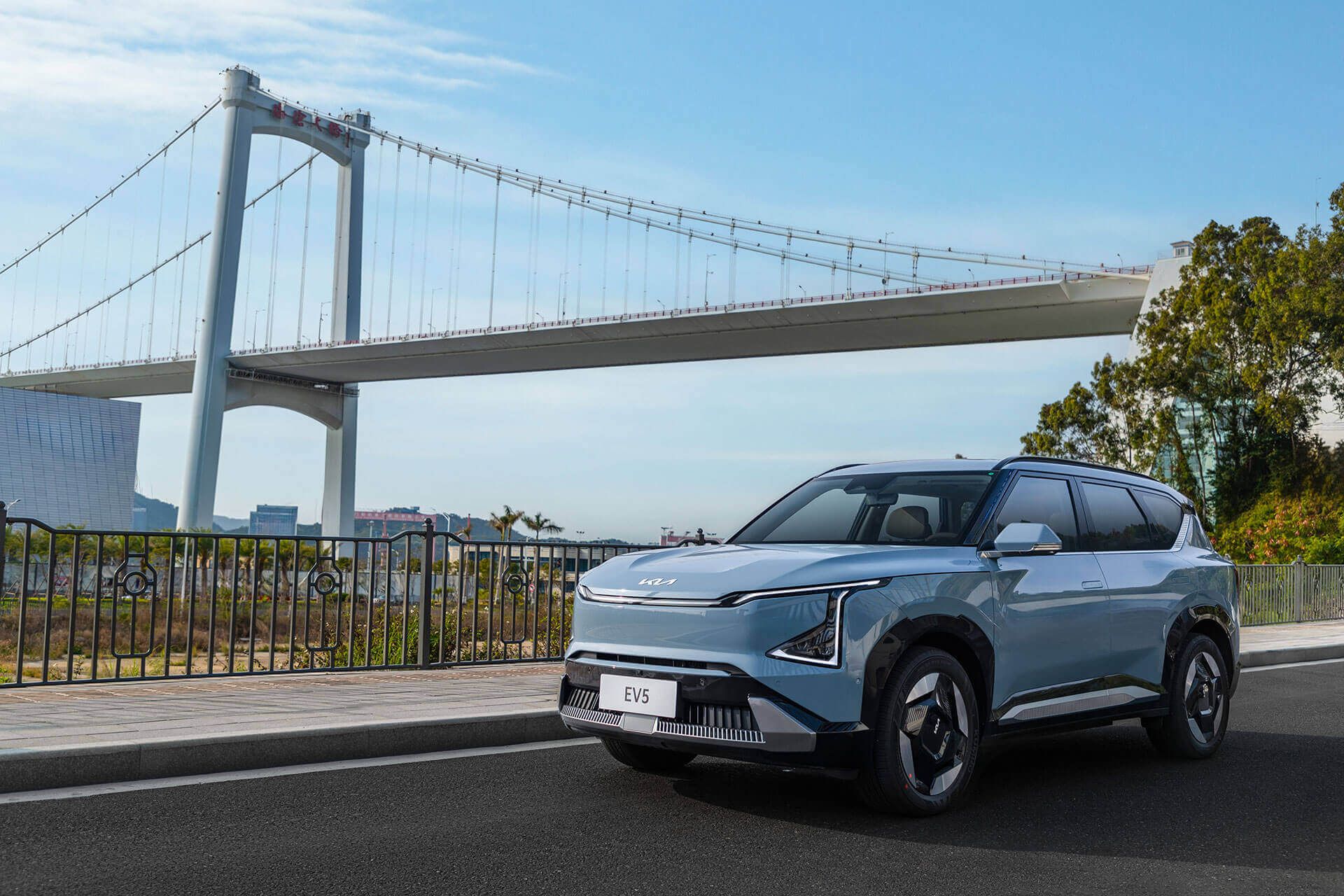
The fifth electric vehicle built on Kia's dedicated EV platform


Loaded with advanced safety and convenience features... Spacious interior secured
Kia has unveiled its fifth electric vehicle built on a dedicated EV platform. This is the EV5, a compact SUV that serves as the core of Kia's electrified lineup.
The EV5 is a key model for Kia, aimed at popularizing electric vehicles, and belongs to the C-segment (compact) SUV category, the largest SUV market globally. Its main competitors include the Kia Sportage, Hyundai Tucson, Toyota RAV4, and Honda CR-V.
To win over consumers against these strong rivals, Kia has equipped the EV5 with a host of advanced safety and convenience features. The body adopts a classic SUV style, and the spacious interior is designed to meet the needs of families.
To assess the EV5's practicality and driving performance as a family car, a test drive was conducted on September 23 in the Hanam and Gapyeong areas of Gyeonggi Province.
First, the exterior design inherits Kia's signature EV design language while delivering a strong presence. The front features Kia's "Digital Tiger Face," emphasizing a refined look. From the side, the angular body lines highlight the classic SUV feel, while the rear's straight-lined taillights give the vehicle a balanced appearance. Although the EV5 is smaller than the Sportage, its boxier design makes it appear larger in person.
The interior space is similar to the Sportage but offers even better space utilization. As a model targeting families, Kia paid special attention to maximizing interior room. The second-row head and legroom are generous. A small table is attached to the back of the front seats, providing a convenient spot for smart devices or for serving snacks to children.
The trunk also offers class-leading cargo space. By pulling the levers on both sides of the trunk, the second-row seats fold down easily. With all rear seats folded, the EV5 provides up to 1,650 liters of cargo capacity. The fully flat floor makes it ideal for camping or car-camping activities.
Stable ride with 'one-pedal drive'
Driving performance also passed the test. The motor output was more than sufficient for daily driving, and the ride quality was comfortable and smooth. Thanks to effective regenerative braking, it was possible to drive using just the accelerator pedal. This "one-pedal drive" reduces sudden stops and starts, resulting in a stable ride.
Kia equipped the EV5 with an 81.4 kWh NCM (nickel, cobalt, manganese) battery. The EV5 can travel 460 km on a single charge. The official energy efficiency is 5.0 km/kWh, but actual driving achieved 6.7 km/kWh.
With fast charging, the battery can be charged to 80% in about 30 minutes. The EV5 also features vehicle-to-load (V2L) capability, allowing users to power electronic devices outdoors. The higher-than-official energy efficiency means lower running costs, which is a significant advantage for families.
Kia has also emphasized safety, especially for families, by equipping the EV5 with cutting-edge safety features. Standard features include acceleration limit assist and pedal misapplication assist, which help prevent accidents if the driver presses the wrong pedal.
Acceleration limit assist, introduced for the first time in a Hyundai Motor Group vehicle, limits acceleration if the pedal is mistakenly pressed while driving under 80 km/h. If the driver confuses the accelerator for the brake, the system detects this and automatically restricts speed. Pedal misapplication assist controls braking if the accelerator is pressed by mistake while the vehicle is stationary.
Higher upfront cost but lower running costs... Strong economic value
What about the price? Many consumers feel it is higher than expected. There were hopes that using CATL's NCM battery from China would significantly lower the price, but the actual launch price did not meet these expectations.
The starting price for the base Long Range Air trim is set at 48.55 million won. With national and local government subsidies, the EV5 can be purchased in the low 40 million won range. In contrast, the comparable Sportage Hybrid starts at 33.46 million won, a difference of about 7 million won. While the initial purchase cost for an EV is higher, the savings on running costs make the overall economic value superior.
In summary, the EV5 does carry a higher upfront cost compared to competing hybrid models in its class. However, considering the lower running costs, the latest electrification technology, family-friendly space, and safety features, it has plenty of appeal as a "first family electric SUV." It remains to be seen how much consumer interest the EV5 will generate in the market.


IndexTabuleiro
- Mini Embraces the Family, Reliable Even on Winding Mountain Roads
- From Machonam to Chadonam
- The Car of Paris Double Gold Medalist Oh Sangwook... Calm Yet Tough Like Him
- GodGodGodSeongbi Electric Vehicle Priced in the 20 Million Won Range?
- Overwhelming Size and Luxurious Interior... The Ultimate State Car
- Chevrolet Colorado, the Authentic American Pickup, Succeeds in Korea
- The New Standard for Family Electric SUVs: EV5
- 200 km/h in Just 10.9 Seconds... Even a World-Class Driver Is Amazed
- Ride Comfort Surpasses Curb Appeal
-

Reporter Woo Sooyoun yesim@asiae.co.kr
-
Edit Choo Myeonghoon chox2mh@asiae.co.kr
© The Asia Business Daily(www.asiae.co.kr). All rights reserved.




![[Report] "A Culinary Destination with a View of Gyeongbokgung"... Kim Dong-sun's High-End Dining Takes Over Gwanghwamun](https://cwcontent.asiae.co.kr/asiaresize/304/2026042114562634571_1776750985.jpg)

![[Gallery Stroll] Red Robe, Black Lines... Danjong Returns with the Face of Wounds](https://cwcontent.asiae.co.kr/asiaresize/304/2026042014183532691_1776662315.jpg)