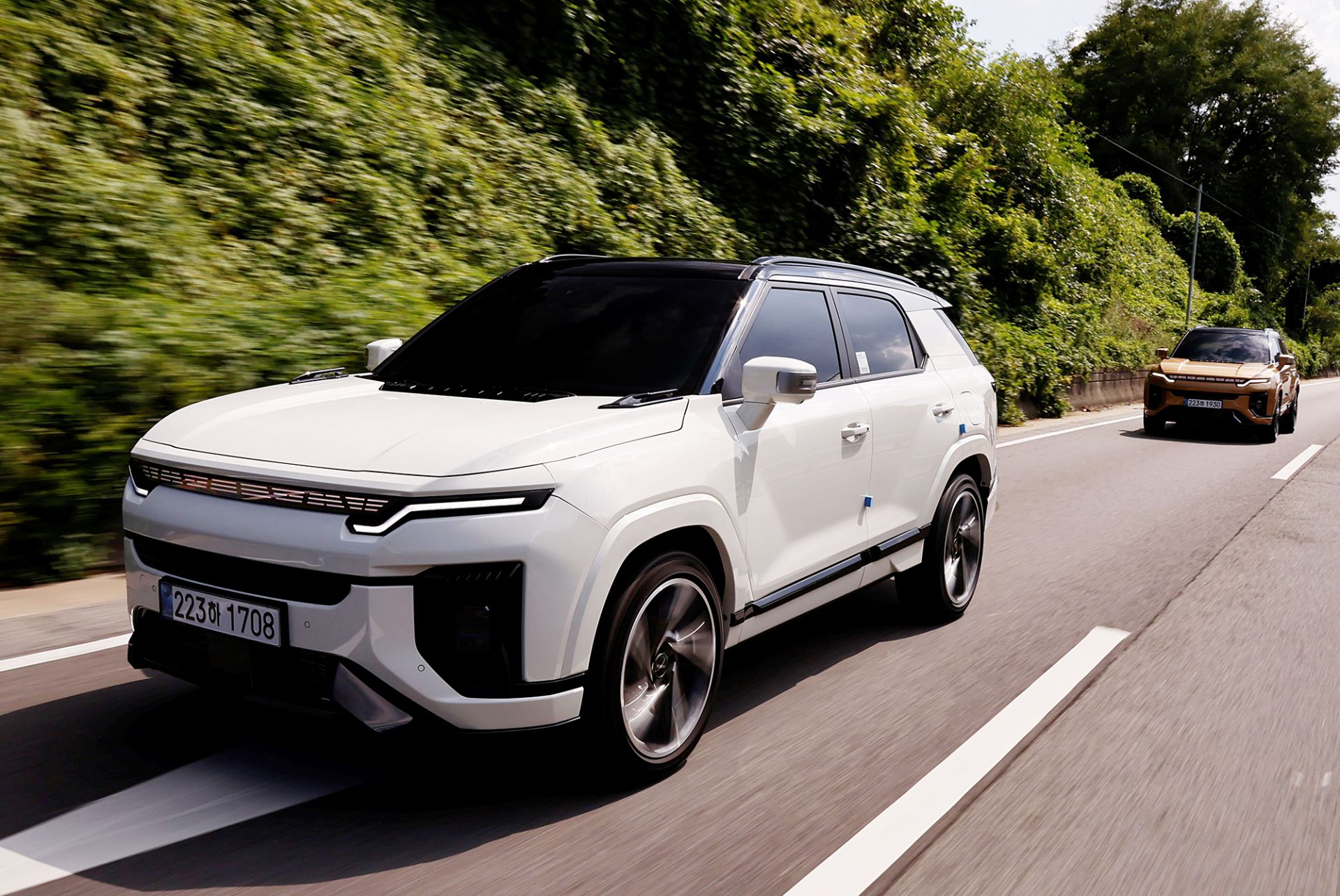
The Actyon, Korea's first coupe-style sports utility vehicle (SUV), has returned in a completely new form, leaving behind its past struggles. Shedding its macho image, it now boasts a sophisticated and urban exterior. While its strengths and weaknesses are clear, its outstanding value for money surpasses them.
Sleeker Without the Muscles: The New KG Mobility Actyon
KG Mobility has expressed its ambition to set a new standard for urban SUVs with the Actyon. Its dimensions are indeed novel, with a length of 4,740mm and a width of 1,910mm. The Actyon is longer than the Hyundai Tucson, a compact SUV, and wider than the Kia Sorento, a midsize SUV. As a coupe-style SUV, its height is 40mm lower than its predecessor, the Torres. The front end is also innovative. The LED daytime running lights, inspired by the Geongon-Gamri patterns from the Korean flag, light up to greet the driver when the doors are opened or closed. The sleek side profile is complemented by 20-inch tires that provide stability. The rear reinterprets the coupe-style design that symbolized previous generations of the Actyon, now featuring horizontal and vertical tail lights at a sharper angle. Instead of the traditional wing-shaped logo, the letters "KGM" are engraved in black chrome.


The interior has also been completely revamped. Sitting in the driver's seat, the first thing you notice is the large panoramic display, which is currently in vogue. The 12.3-inch cluster and 12.3-inch central display are seamlessly connected. The central display is slightly angled toward the driver, rather than being placed in a straight line, making it easier to check the navigation screen. However, the lack of physical buttons means all controls, including the air conditioner, must be operated via the touchscreen, which is a bit inconvenient.
Everything Changed but the Name: Pursuing 'Beautiful Practicality'
The steering wheel is flat at the top and bottom, seemingly designed to prevent the instrument panel from being obscured. In the center, there are shortcut buttons for auto-hold and favorite functions. The cabin space is generous, with ample headroom in both the first and second rows. Even an adult male of around 175cm sitting in the back seat would have enough space to fit two fists between his knees and the seat in front. The seat and interior design aim for an urban look. Both front and rear seats feature suede material on the headrests and shoulder areas, and the ambient lighting is set to a subtle color.


Photo by KG Mobility Actyon
Unlike the macho-oriented Actyon of the past, the new model is optimized for everyday urban driving. It combines an eco-friendly 1.5L turbo gasoline engine with a third-generation Aisin 6-speed automatic transmission, producing a maximum output of 170 horsepower. The maximum torque is 28.6kgf·m. While acceleration performance at launch has improved by 10% compared to the previous engine, the output is still somewhat lacking given the vehicle's size. Nevertheless, it was more than adequate for city driving. The engine noise is minimized, and the use of sound-absorbing Michelin tires is another advantage. Compared to the Torres, which uses the same powertrain, the Actyon offers a quieter and smoother ride. After driving about 60km around Pyeongtaek, Gyeonggi Province, the fuel efficiency was 9.4km per liter, slightly below the official figure of 10.1km per liter.
Advanced semi-autonomous driving assistance systems such as Intelligent Adaptive Cruise Control (IACC) and Intelligent Speed Assist (ISA) operated without any issues. However, the lack of various convenience features is disappointing. For example, there is no memory function for seat angle and other settings, so adjustments must be made each time the driver changes. Features commonly found in recent SUVs, such as a sunroof and head-up display (HUD), are also missing. However, the price makes up for these shortcomings. The two available trims, S7 and S9, are priced at 33.95 million won and 36.49 million won, respectively. Except for seat color and a few other options, most features come as standard, eliminating the need for additional selections. With its strong value for money, the Actyon aims to compete with the Kia Sportage, Sorento, Hyundai Santa Fe, and Tucson.
IndexTabuleiro
- Mini Embraces the Family, Reliable Even on Winding Mountain Roads
- From Machonam to Chadonam
- The Car of Paris Double Gold Medalist Oh Sangwook... Calm Yet Tough Like Him
- GodGodGodSeongbi Electric Vehicle Priced in the 20 Million Won Range?
- Overwhelming Size and Luxurious Interior... The Ultimate State Car
- Chevrolet Colorado, the Authentic American Pickup, Succeeds in Korea
- The New Standard for Family Electric SUVs: EV5
- 200 km/h in Just 10.9 Seconds... Even a World-Class Driver Is Amazed
- Ride Comfort Surpasses Curb Appeal



![[Report] "A Culinary Destination with a View of Gyeongbokgung"... Kim Dong-sun's High-End Dining Takes Over Gwanghwamun](https://cwcontent.asiae.co.kr/asiaresize/304/2026042114562634571_1776750985.jpg)
![[Gallery Stroll] Red Robe, Black Lines... Danjong Returns with the Face of Wounds](https://cwcontent.asiae.co.kr/asiaresize/304/2026042014183532691_1776662315.jpg)