Editor's NoteAccording to consumer price trends released by Statistics Korea, in May, the price of processed foods rose by 4.1% (compared to the same period last year), while bread prices increased by as much as 6.4%. The bread consumer price index reached 138.48, which is a 38.48% increase over the base year of 2020 (100) in just five years. Bread prices have risen even more steeply than tteokbokki and chicken, which are beloved snacks among Koreans. Once a snack enjoyed by everyone, bread has now become something that is difficult to buy without hesitation due to its high price. How did bread prices in Korea end up rising so sharply?
Bread Trends Change With the Times, and So Do Prices... Even as Bread Gets More Expensive, 'Open Run' Culture Changes Bread Consumption
From Gukjin Bread, which cost 500 won in 1999, to bagels that are flying off the shelves in 2025 even with a price tag of 8,500 won?bread prices have continued to rise as the types of bread in vogue have changed according to the tastes of consumers in each era. Consumers have been enthusiastic about new breads, and for those that triggered a syndrome, the younger generation did not hesitate to participate in 'open runs' (lining up before opening) to buy them, even at high prices, thus driving a new consumption culture.
Gukjin Bread in Ttibusil sells 600,000 to 700,000 pieces a day Followed by 'Pinkle Bread,' 'Digimon Bread,' and 'Keroro Bread' Bagels led the trend in the 2000s Prices soared up to 8,500 won depending on the topping type
In the early 2000s, the most popular bread was the mass-produced 'Gukjin Bread' from Samlip Food (now SPC Samlip). Released in 1999, this product came with a sticker (Ttibusil) featuring the popular comedian Kim Gukjin as a character, making it especially popular among children. The launch price was 500 won, and it enjoyed explosive popularity, selling 600,000 to 700,000 pieces per day. It is also famous for reviving Samlip Food, which had been struggling due to the 1997 financial crisis. Building on the success of Gukjin Bread, Samlip released a series of mass-produced breads featuring Ttibusil stickers: 'Pinkle Bread' modeled after the group Fin.K.L in 2000, 'Digimon Bread' in 2001, and 'Keroro Bread' in 2006.
In the 2010s, the traditional German pastry 'Schneeballen' from Rothenburg became popular. Schneeballen is a dessert made by deep-frying round dough and then breaking it with a wooden mallet. First introduced at Shinsegae Department Store in Gangnam in August 2012, Schneeballen quickly gained popularity for the 'fun of breaking it,' achieving daily sales of up to 10 million won. Given the price of 3,500 won per piece, this means nearly 3,000 pieces were sold per day. Nicknamed the 'Gangnam snack' at the time, Schneeballen expanded to about 60 stores in major cities nationwide within a year, with cumulative sales surpassing 20 billion won.
In 2016, 'Taiwanese Giant Castella' swept across the country. It gained attention for its softer and moister texture compared to regular castella, and despite its large size?big enough to share among several people?it was priced at 6,000 to 7,000 won, making it popular as a 'cost-effective dessert.' At the time, Taiwanese castella franchises could be easily found everywhere, including major commercial districts like Itaewon's Gyeongridan-gil and Hongdae, as well as department stores and markets nationwide. However, after a TV expos? labeled it as 'oil-laden castella,' its image plummeted. On top of that, egg prices surged due to the avian influenza (AI) outbreak, leading to a wave of store closures.
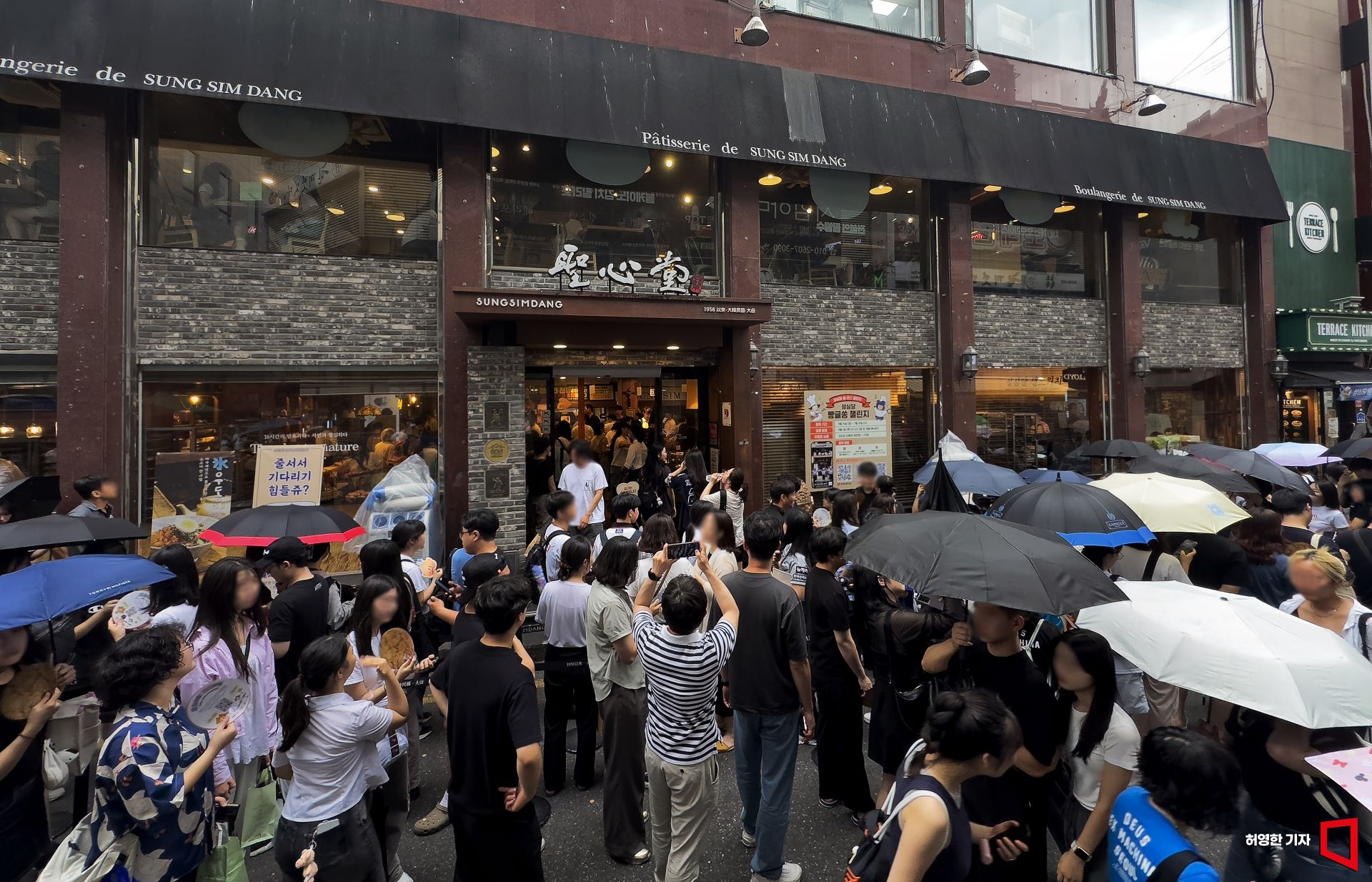
In the 2020s, bagels have been leading trends in the bakery industry. Since the opening of 'London Bagel Museum' in Anguk-dong, Seoul in September 2021, the bagel craze has continued through 2025, especially among young people. This spot, known for its exotic interior and unique bagels, has become a mecca for 'open run' enthusiasts, with long lines forming at every new location in Jamsil, Suwon, Jeju, and more. The basic bagel price starts at 3,800 won, but depending on the topping and type, prices soar up to 8,500 won. Sandwiches sold alongside bagels range from 7,500 to 14,800 won. Franchise bakeries and convenience stores are also joining the bagel craze, releasing related products one after another.
Korean Bread Prices Are Particularly Expensive... Ranked 8th in the World, 'More Expensive Than Major Developed Countries' Salt Bread, Original in Japan 1000 Won, Soars Up to 5000 Won in Korea
Korea ranks eighth in the world for bread prices. The average price of a loaf of bread is in the 4,000 won range, making it more expensive than in major developed countries such as the UK, Canada, and Sweden, where per capita GDP is higher than Korea's.
According to Numbeo, a global country and city statistics comparison site, as of June 11, the price of a 500g loaf of bread in Korea was $3.06 (about 4,200 won), ranking eighth out of 124 countries. Only seven countries had higher bread prices than Korea: Iceland ($4.07), Switzerland ($3.70), the United States ($3.64), Denmark ($3.43), Norway ($3.41), Luxembourg ($3.19), and Costa Rica ($3.14).
In contrast, countries such as Sweden ($3.01), Austria ($2.86), and Canada ($2.71) had lower bread prices than Korea. The cheapest country was Algeria, where a loaf of bread costs $0.16 (about 220 won).
The fact that bread prices in Korea are particularly high compared to other countries is also evident in other bread items besides loaves. At 'Pain Maison,' a Japanese bakery known as the originator of salt bread, a single piece currently sells for 120 yen (about 1,150 won). In Korea, Paris Baguette sells salt bread for 2,800 won, and most large bakery chains price it at around 3,000 won. Especially at popular, individually owned bakeries, the price of salt bread can soar to the high 4,000 won or even the low 5,000 won range.
The same is true for bagels. At 'Ess-a-Bagel,' one of New York's top three bagel shops, a bagel costs $2.05 (about 2,800 won), but at Korean specialty bagel shops, prices are generally around 4,000 won. The average price of a baguette in Paris, France, is 1.19 euros (about 1,800 won), which is much lower than the high 3,000 won range for baguettes in Korea. For pretzels, large German bakery chains sell them for 1.2 euros (about 1,800 won), while in Korea, they are sold for 3,000 to 4,000 won.
Choi Jiwoong, Secretary General of the Korea Bakery Association, explained that the reason why bread prices in Korea are particularly high compared to other countries is that "Korean consumers tend to prefer products with abundant toppings, unlike in the US or Europe." He added, "Bread prices vary depending on what ingredients are used and how much the bread weighs, and this difference in preferences inevitably leads to higher ingredient costs." He also pointed out, "The fact that we rely on imports for key ingredients such as wheat also affects bread prices," and stated, "To address this, we are working with the Ministry of Agriculture, Food and Rural Affairs to hold product review events for new bakery items made with rice flour, among other activities."
Bread prices rise more than tteokbokki chicken... The era of 8,500 won bagels "Cannot attribute solely to raw material cost increase"... Fair Trade Commission remains 'silent'
"We will closely analyze the current status of the domestic bakery market, transaction structure, and factors driving price increases, and develop measures to improve the distribution structure." (April 2024)
It has been over a year since the Fair Trade Commission announced, through its 'Bakery Industry Status Survey' research project, that it would develop regulatory and distribution structure improvement measures. However, the commission has yet to properly identify the causes or present concrete solutions. The Fair Trade Commission did proceed with the research project as planned to investigate the causes of rising bread prices, and the results and measures, originally scheduled for release around October last year, were postponed to the end of the year. As of June 2025, more than a year later, they still have not been made public. A Fair Trade Commission official stated, "The results of the research project are in, but we cannot disclose them," adding, "We are in discussions with the relevant ministries."
Even though the Fair Trade Commission recognized the problem of rising bread prices and launched an investigation, the delay in disclosing specific causes and announcing countermeasures has allowed Korea's notoriously high bread prices to continue rising, increasing the burden on consumers. The term 'breadflation' (bread + inflation) has even been coined.
According to the National Statistical Portal (KOSIS) of Statistics Korea on June 14, last month the bread consumer price index was recorded at 138.48. Compared to the base year of 2020 (100), this means that bread prices have risen by a staggering 38.48% over five years. During the same period, the increase was higher than for other items such as tteokbokki (34.69%), coffee (34.66%), chicken (28.21%), ramen (24.64%), rice cakes (24.18%), and snack foods (18.60%).
The upward trend in bread prices is also evident in the price hikes at franchise bakeries. In February, Paris Baguette of the SPC Group raised the prices of 96 types of bread and 25 types of cakes by an average of 5.9%. Tous Les Jours, operated by CJ Foodville, also raised prices for about 110 types of bread and cakes by an average of about 5% starting March 1. Both companies explained, "The increase in prices of key raw materials and various overhead costs made this decision unavoidable."
The most frequently cited reason by the baking industry for raising bread prices is the increase in prices of major raw materials, such as flour and sugar, which are highly dependent on imports. In the case of flour, about 99% is imported, so when international wheat prices rise, domestic bread prices are directly affected. This is different from countries like France, where the wheat self-sufficiency rate is high.
However, even when raw material prices fall, bread prices do not return to previous levels, which is why it cannot be concluded that the rise in bread prices is solely due to increases in prices of major raw materials such as flour and sugar. After soaring to $419 per ton in May 2022 due to the impact of the war in Ukraine, international wheat futures prices have since declined, falling to $199 per ton as of June 1.
This is why some point to the oligopolistic market dominated by large companies and the complex distribution structure as factors influencing the rise in bread prices. In the domestic bakery market, large corporations have long led price setting and market share, and as products pass through multiple stages from raw material importers to wholesale and retail suppliers, margins accumulate, inevitably resulting in higher final consumer prices.
Because government authorities have not been able to respond quickly to the rapidly rising bread prices, the burden of price increases has fallen entirely on consumers. Office worker Lim Sojung (30) said, "I used to buy bread at my neighborhood bakery quite often, but with prices rising so much in recent years, it's become burdensome to buy as often. Instead, I mainly buy bread at supermarkets. Especially if I go during the clearance sale hours, I can get it cheaper, so I find myself going to the supermarket more often."
IndexThe Secret of Bread Prices
Sellouts, Shortages, and Open Runs... The 'Chronicles of Bread' That Shook Korea