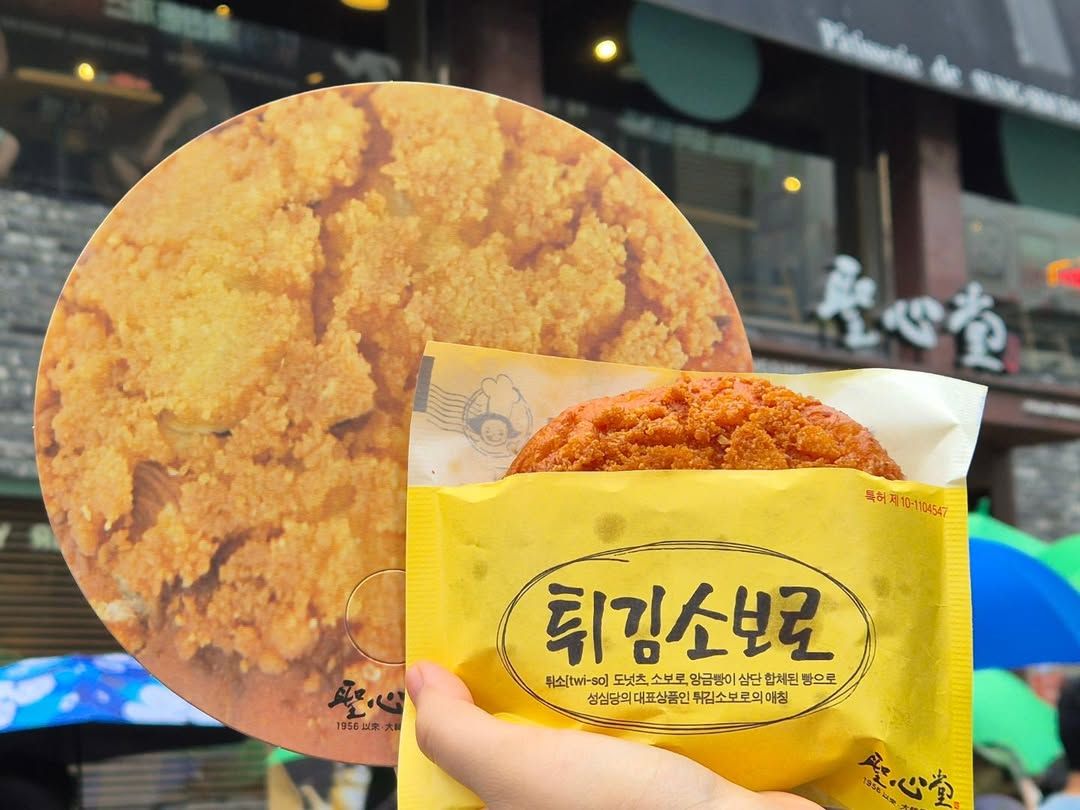
Seongsimdang, Daejeon's iconic bakery, which is on track to surpass 200 billion won in annual sales this year, earns a profit of 500 won for every 2,000-won bread it sells. Compared to the single-digit operating profit margins of major franchise bakeries, and the fact that even well-known local bakeries barely exceed 10%, Seongsimdang is considered highly successful. The company does not spend an unusually large amount on marketing, either. Last year, Seongsimdang's selling and administrative expenses accounted for 21% of its sales, a significant difference from major franchise bakeries, whose ratios often exceed 40%. How did Seongsimdang manage to make consumers line up in front of its stores?

200 Billion Won in Sales Within Reach... Outperforming Franchise Giants

Customers are selecting bread at Seongsimdang, a representative attraction of Daejeon. Photo by Huh Younghan
원본보기 아이콘According to its audit report, Rosso, the operator of Seongsimdang, reported sales of 193.7 billion won last year. This represents a 56% increase compared to 124.3 billion won in 2023. Seongsimdang, which recorded sales of 48.8 billion won in 2020, became the first single bakery brand to surpass 100 billion won in sales in 2023, and at its current growth rate, it is likely to exceed 200 billion won this year.
Seongsimdang's operating profit has also surpassed that of major franchise companies. Last year, its operating profit was 47.8 billion won, a 52% increase from 31.4 billion won the previous year. This is not only higher than the 29.8 billion won (on a separate basis) operating profit of CJ Foodville, which operates bakeries such as Tous Les Jours and various food service businesses, but its operating margin of 25% is also far higher than CJ Foodville's 4% and Paris Croissant's 1%.
‘Twigim Soboro’ 1,700 Won, ‘Pantalong Buchu Bread’ 2,000 Won: ‘Godseongbi’ Value


The origins of Seongsimdang date back to 1956. The late Im Gilsoon and Han Soonduk began by making and selling steamed buns in front of Daejeon Station, using two sacks of flour they received as aid from Daeheung-dong Catholic Church. Nearly 70 years later, Seongsimdang has firmly established itself as Daejeon's representative bakery.
One of the key factors behind its success is its outstanding value for money. Signature items like Twigim Soboro (1,700 won each) and Pantalong Buchu Bread (2,000 won each) have sparked a nationwide "bread pilgrimage" craze, driven by their exclusivity?being sold only in Daejeon?and their reasonable prices.
While seasonal limited-edition cakes are priced higher than regular breads, Seongsimdang still sets their prices lower than other cakes on the market, enhancing their competitiveness. The bakery's "Siru Cake," made with seasonal fruits such as strawberries and mangoes, has consistently generated buzz on social media for its abundant ingredients. In particular, the "Strawberry Siru 2.3kg" cake launched in December last year attracted attention for its appearance, featuring an entire box of strawberries on top. Its price of 49,000 won was compared to hotel cakes that can cost up to 400,000 won, earning it a reputation as a "value-for-money cake." As its popularity soared, the cake was even resold for 140,000 won on secondhand trading sites.
‘Seongsimdang = Daejeon’: Only Available in Daejeon

Visitors lining up to buy bread in front of Seongsimdang main store, a representative attraction of Daejeon. Photo by Younghan Heo
원본보기 아이콘Seongsimdang's strong local identity is another key to its success. The bakery has maintained a policy of not opening stores outside of Daejeon. In 2014, it even declined an offer from the main branch of Lotte Department Store in Jung-gu, Seoul, which offered to provide any location and size desired. This is why "Seongsimdang" is immediately associated with "Daejeon." This approach stands in contrast to other regional bakeries that have expanded nationwide.For example, Samsong Bakery in Daegu, famous for its whole corn bread, entered the franchise business in 2022, and Leesungdang in Gunsan, the oldest bakery in Korea, opened a branch at Lotte Department Store Jamsil in Seoul in 2014.
A positive corporate image also supports Seongsimdang's popularity. Under the management philosophy of "Do what everyone considers good," Seongsimdang donates unsold bread and pastries every day. In addition, it delivers about 30 million won worth of bread each month to social welfare facilities such as nursing homes and orphanages. Recently, the bakery has also attracted attention by providing a "free pass" to skip the waiting line and a 5% discount to customers who present a pregnancy confirmation or a maternity handbook. As business continues to thrive, employee satisfaction is also rising. Seongsimdang distributes 15% of its quarterly operating profit to employees as performance bonuses.
IndexThe Secret of Bread Prices
- Sellouts, Shortages, and Open Runs... The 'Chronicles of Bread' That Shook Korea
- "Expensive, but Still Filling Their Baskets"... London Bagel Earns 80 Billion Won on Word of Mouth Alone
- '1,000 Won Bakeries' Sell 500 Breads a Day: "If You Go at 3 PM, They're Sold Out"
- 2000-Won Bread, 200 Billion-Won Boom...The Secret Behind Seongsimdang's Soaring Sales
- Picked Up a Franchise Cream Bread and Gasped... Why Do Prices Differ by Neighborhood?
- "Is It Really Just Raw Material Costs?"...Other Reasons Behind Korea's Soaring Bread Prices
- "Even a Single Slice Costs 10,000 Won... 'Cake Slices' Now as Expensive as Lunch"
- Salt Bread That Used to Cost 5,000 Won at Bakeries... "Only 2,000 Won at Home"
- "I Want to Try Slow Aging Too"... 'Health Breads' See Explosive Sales Despite Double the Price
-

Reporter Heo Midam damdam@asiae.co.kr
-
Edit Kim Boram kbram6457@asiae.co.kr
© The Asia Business Daily(www.asiae.co.kr). All rights reserved.


![[Report] "A Culinary Destination with a View of Gyeongbokgung"... Kim Dong-sun's High-End Dining Takes Over Gwanghwamun](https://cwcontent.asiae.co.kr/asiaresize/304/2026042114562634571_1776750985.jpg)
![[Gallery Stroll] Red Robe, Black Lines... Danjong Returns with the Face of Wounds](https://cwcontent.asiae.co.kr/asiaresize/304/2026042014183532691_1776662315.jpg)