

Seongan-gil, Cheongju's 'Relatively Bustling Street'
Editor's NoteAre you familiar with the so-called "Nojaem City," meaning a boring city? This term refers to cities that lack things to do, see, or enjoy, making them dull for locals and unappealing for visitors. Since 2019, the nickname "Nojaem City" has been used on social media to describe various cities. What started as a meme has grown into "Fun City Projects" led by local governments in places like Daejeon, Ulsan, Gwangju, and Cheongju. But are these so-called "nojaem" cities truly boring and dull? What makes a city interesting? Let's take a moment to reflect on the places and spaces where we live.
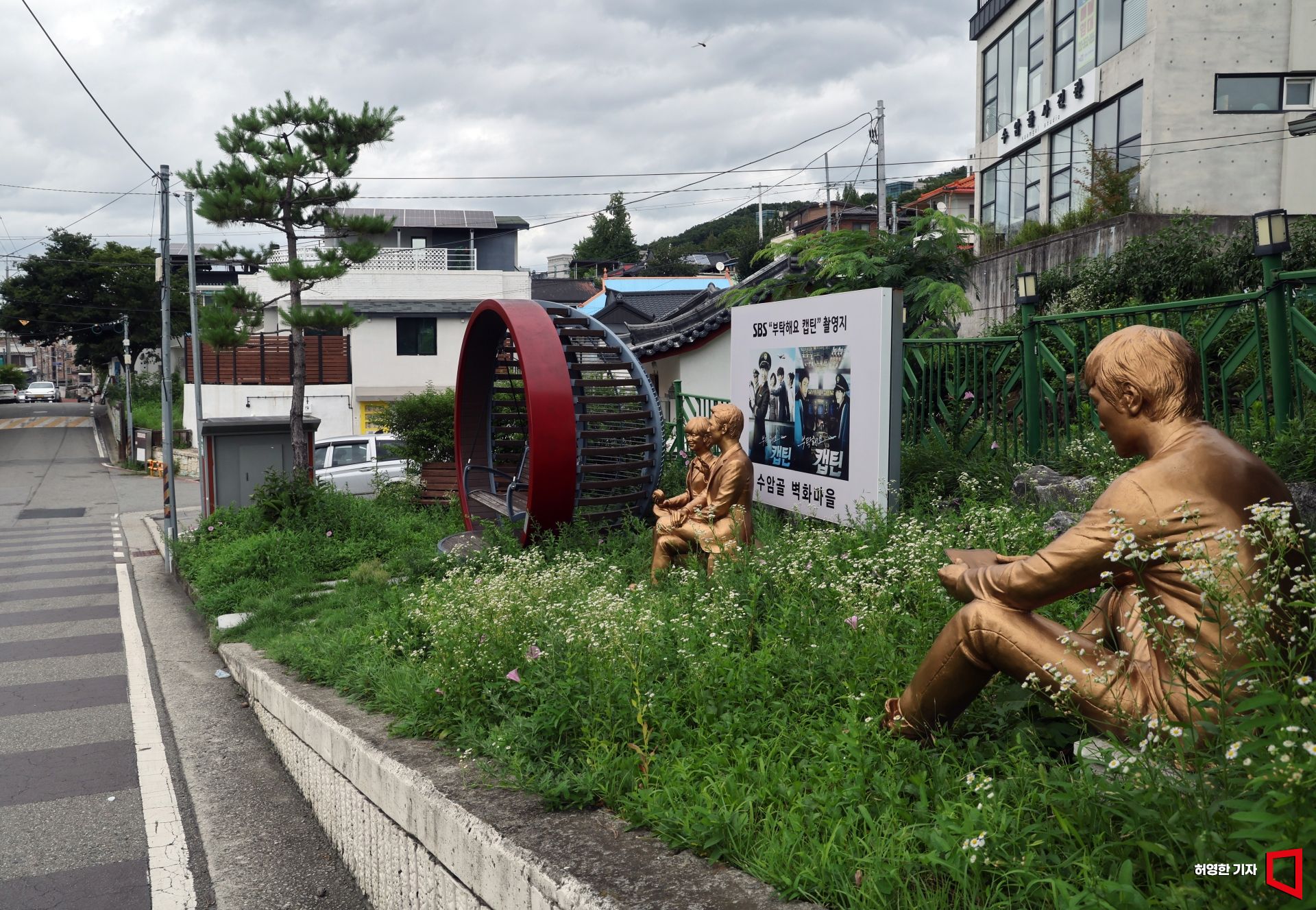
"Even though it looks like this now, back when 'Kim Takgu' was filmed, people used to line up 40 to 50 meters in front of the bakery at the entrance."
Yoon Yeojeong, a Cheongju native in her 60s who serves as the head of Suamgol, reminisced about the heyday of SuamgolLocated in Sangdang-gu, Cheongju as she looked at the mural village houses currently under heavy construction. However, when the reporter visited Suamgol on the morning of the 22nd last month, the only outsiders present were employees and construction workers involved in the local regeneration project. When the sound of drills stopped, silence fell immediately, without even the sound of dogs barking.
Suamgol is a neighborhood where houses built by refugees during the Korean War have been preserved, making it a popular filming location for dramas. Hit dramas from the 2010s, such as "King of Baking, Kim Takgu" (2010) and "Cain and Abel" (2009), both with ratings approaching 50%, were filmed here. With its charming murals, Suamgol was once considered Cheongju's top tourist spot, drawing a steady stream of visitors.
Yoon said, "Actually, when the mural village was created, some residents opposed it because of the noise from tourists, but after much effort, we built the mural village and there was life and the sound of people...," her voice trailing off, filled with regret for the now-quiet village. Lee Gapsun (70), whom the reporter met at the Suamgol Tourist Center, said, "In the past, groups from Vietnam, Japan, China, and other countries would come here by express bus for tours, but now that's just a memory," adding, "These days, foreign tourists only come once in a while."
That day, Suamgol was filled not with the footsteps of tourists but with the deafening noise of construction. The roofs and various parts of the area, unable to withstand the passage of time, are now being rebuilt as part of an urban regeneration project. Houses at risk of collapse are being modernized, new walls are being erected, and murals will be repainted. It's an effort to transform a neighborhood that has been frozen in time since 2010.
Just like Suamgol, which lost its fame... Cheongju's city center faces similar challenges
Cheongju's city center also seemed to have lost its vibrancy, like a deflated balloon. The Culture Factory, a former tobacco manufacturing plant, is now a "hot place" in Cheongju, surrounded by the temporary city hall, the advanced cultural industry complex, a multi-purpose shopping mall, and Dongbu Warehouse. Bae Yunna (19), whom the reporter met here, said, "This is the only place where pop-up stores and events still happen. Five years ago, Seongan-gil was lively, but now it's pretty much dead. Friends who like to go out often head to Dunsan-dong in Daejeon or other nearby, bustling cities." Kim Sunwoo (30) added, "We go on casual dates here, but if we're really going out, we head to Daejeon or Sejong. There aren't even parks, and the city center is really boring."
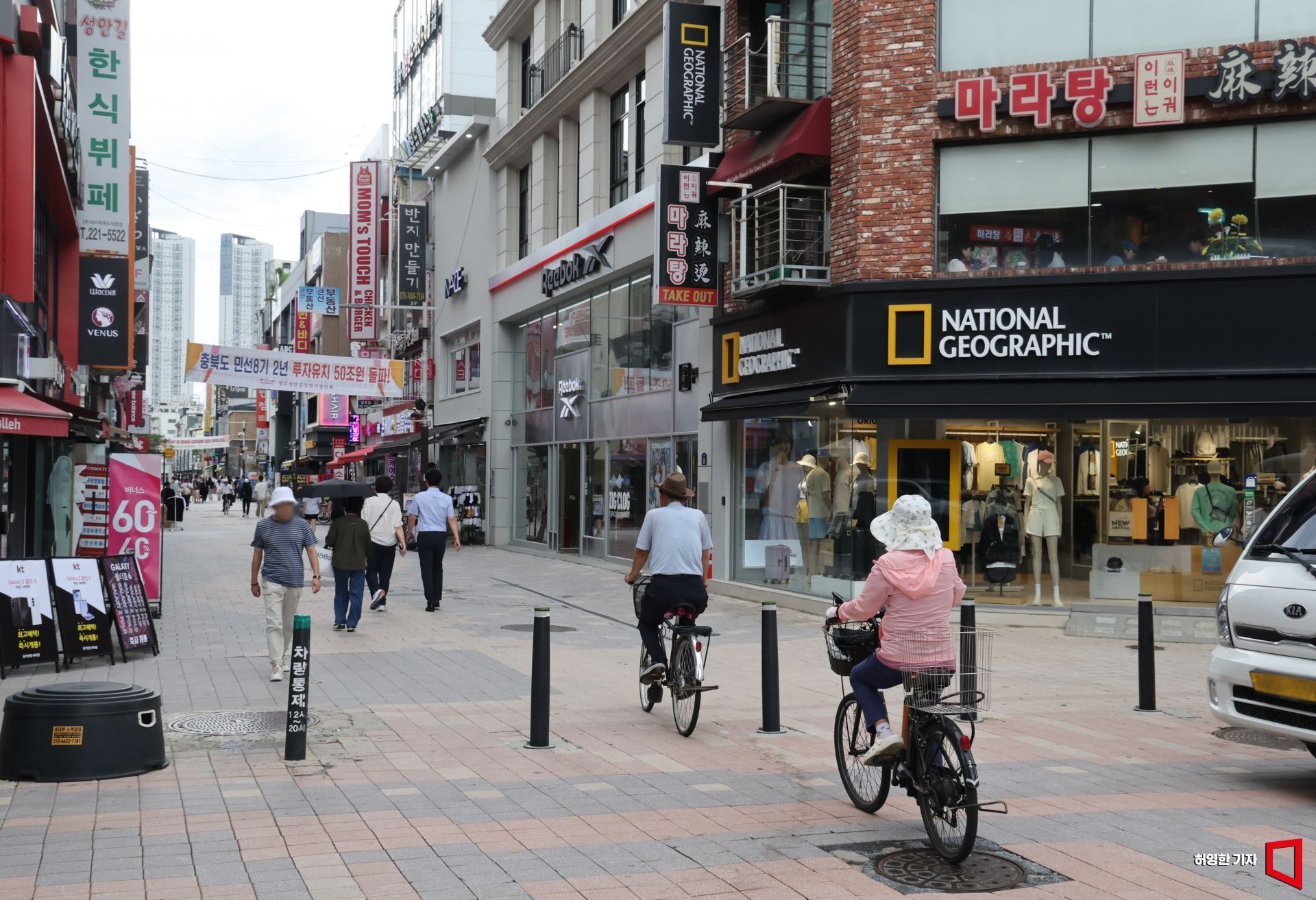
The state of Seongan-gil, once famous for its cafe street, was just as Cheongju residents described. Even considering the 33-degree heat on the day of the reporter's visit, it was difficult to find people walking around. There were many empty buildings in the area. It was common to see an entire building vacant, and on some streets, only one or two stores were open while the rest of the buildings stood empty. According to Korea Real Estate Board's commercial real estate leasing trend survey, the vacancy rate for medium and large-sized shops (buildings with three or more floors and a total floor area exceeding 330 square meters) in Seongan-gil was 33.7% in the second quarter of this year, up 2.6 percentage points from the previous quarter.
Even the commercial districts around universities, usually considered prime locations, were no exception in Cheongju. In front of the main gate of Chungbuk National University, there were Chinese restaurants, stir-fry places, and chicken shops, but aside from these, the area was noticeably empty for a university district. A restaurant named "Jikji Bone Hangover Soup and Gamjatang," inspired by Cheongju's cultural heritage Jikji Simche Yojeol, was the only sign of Cheongju's unique identity.
The Nojaem City meme sparks change... Cheongju is transforming
Recognizing the decline in urban vitality, Cheongju is making efforts to restore everyday fun for its citizens. In fact, Cheongju is home to many famous bakeries, rivaling those in Daejeon. The city noticed the popularity of "Bread Pilgrimage" (bread + pilgrimage) and cafe tours on social media and is holding a Dessert Bakery Festival to promote related businesses.
Leveraging its characteristics as an urban-rural complex, Cheongju is also ahead of other local governments in creating a "camping mecca." The city is planning the largest multi-purpose camping site in the country, scheduled for completion in 2026. In particular, Cheongju has built small performance venues and galleries to make it easier and more affordable for citizens to enjoy performances in their daily lives, and has also established a water leisure experience center where people can enjoy kayaking and paddleboarding.
"Fun is ultimately relative"... Cheongju is a good place to live
While Cheongju dreams of becoming a "fun city," many residents remain skeptical, saying it still doesn't feel that way. Complaints about being "nojaem" arise from comparisons with Seoul, the cultural epicenter, and Cheongju's proximity to Seoul makes such comparisons inevitable.
Jung Hyeongu (26), a Cheongju native and student at Chungbuk National University who is considered a "Cheongjalal" (someone who knows Cheongju well), pointed out that Cheongju is considered boring because, unlike Seoul, it lacks landmarks or icons. He said, "There's no Han River for picnics, not enough art museums like in Seoul, and no defining icons. Because it lacks distinguishing features, people call it a nojaem city." However, he added that the perception of Cheongju as a "nojaem city" came from outsiders, such as people from Seoul who came to work in Cheongju and judged the city from their own perspective.
Some argue that if you don't compare Cheongju to Seoul, the equation "Cheongju = Nojaem City" doesn't hold. Park Chanwoo (26), a student at Chungbuk National University from Buyeo, Chungnam, said, "Still, Cheongju is a good place to live. There are places to hang out like Seongan-gil, and compared to Buyeo, this place is really great." Middle school students from Goesan, Chungbuk, who visited the Culture Factory for a field trip, said, "Is Cheongju really that bad? Goesan can't even be compared to Cheongju," expressing their frustration with the nojaem city perception.
IndexRousseau City
- A Map of South Korea Drawn by ChatGPT... Daejeon is Sung Sim Dang, Gwangju Only Has the Taegeukgi?
- What Is the 'Nojaem City' Meme That Sparked Both Controversy and Buzz on Social Media?
- When You Think of Ulsan, Only "Industrial City" Comes to Mind... "Is This Just a City People Leave After Earning Money?"
- Asked for Sightseeing Recommendations, Even Locals Hesitate... "Gwangju Has History but No Places to Have Fun"
- Cheongju, Still Stuck in the Neighborhood of 'King of Baking, Kim Takgu' for 14 Years... Why?
- Why Is Lee Chanwon Singing in Ulsan? Over 1,100 Local Festivals, But Still 'No Fun'?
- "If Necessary, Have to Go to Busan or Seoul... Cities Debating Complex Shopping Malls"
-

Reporter Yun Seulgi seul97@asiae.co.kr
-
Edit Sung Kiho kihoyeyo@asiae.co.kr
© The Asia Business Daily(www.asiae.co.kr). All rights reserved.


![[Report] "A Culinary Destination with a View of Gyeongbokgung"... Kim Dong-sun's High-End Dining Takes Over Gwanghwamun](https://cwcontent.asiae.co.kr/asiaresize/304/2026042114562634571_1776750985.jpg)

![[Gallery Stroll] Red Robe, Black Lines... Danjong Returns with the Face of Wounds](https://cwcontent.asiae.co.kr/asiaresize/304/2026042014183532691_1776662315.jpg)