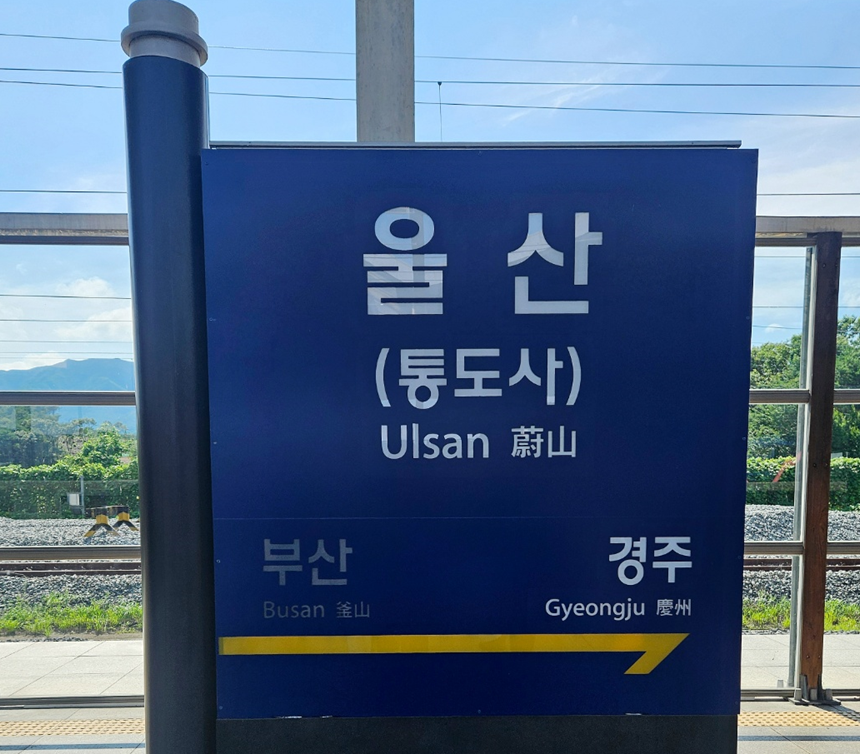
“Korail must be making a lot of money thanks to us (Ulsan). There’s a huge demand for business trips via Ulsan Station.”
On the 19th of last month, Ulsan Station was bustling with people. However, there were more people in summer suits carrying briefcases than those enjoying leisure travel. This is because most visitors to Ulsan come for business rather than tourism. Ulsan residents explained to the reporter that on holidays, many young people prefer to drive an hour to Busan rather than stay in Ulsan. In other words, while people earn money in Ulsan, many spend it outside the city.
An Ulsan city official also lamented to the reporter that Ulsan has become a “city where people earn money and leave.” Despite having good social infrastructure such as jobs, department stores, festivals, and tourist attractions, not many young people choose to stay. Ulsan Metropolitan City Mayor Kim Dukyum even sighed, saying, “Ulsan has become a city where people just stop by to use the restroom and leave.”


“A great place to live, but on weekends... to Seoul”?Ulsan, a city of two sides
Ulsan has long been known as an industrial city, but in fact, it boasts a full range of natural environments, including the sea, rivers, and mountains. The Taehwagang River, which runs through the heart of Ulsan, symbolizes the city’s transformation. During the era when Ulsan was called an industrial city, the river became so polluted by industrial waste that it was nicknamed the “River of Death.” Starting in the mid-1990s, a purification project was launched, and now 7,000 to 8,000 migratory birds visit the river every year, turning it into a “treasure trove of ecological environment.”


Today, with places to rest, stay, and enjoy, Ulsan is highly regarded by both locals and visitors. Along the riverbank, there are not only Starbucks but also numerous cafes and restaurants, big and small. On this day, the park along the Taehwagang walking trail was bustling with citizens strolling in groups or lying on benches soaking up the sun.
Lee Bokji (63), a lifelong Ulsan resident sitting on a bench in the sun, said, “Look at the Taehwagang, isn’t it beautiful? It’s also great for cycling.” When asked about Ulsan’s industrial city image, Lee replied, “That factory image is long gone. Ulsan is such a great place to live.”
However, some said it’s hard to appeal to outsiders with Ulsan’s natural beauty. Kim (68), who has been a taxi driver in Ulsan for 30 years since moving here during the manufacturing boom, listed off tourist spots like Daewangam, Amethyst Cave, Ganjeolgot, Taehwagang, and Jangsaengpo. He added, “The city keeps broadcasting and promoting these places to the point of brainwashing, so I know them all, but many tourists still say there’s nothing to see in Ulsan.” He recalled, “One tourist, who liked former President Park Geunhye, came to Ulsan because she had visited, but complained that there was nothing here but bamboo.”
For young people in Ulsan, the fun is in Seoul, Busan, and Daegu... Is it because of Nojaem?


Citizens met in Ulsan also explained that the city is less lively than nearby cities like Busan, Daegu, and Gyeongju. On days they plan to have fun, they leave Ulsan altogether. Hong Jungwoo (32), met in Seongnam-dong, said, “When my friends and I plan a day out, we usually go elsewhere. In Ulsan, we just meet up for a simple get-together. Compared to Busan or Daegu, the vibe here is much duller. Ulsan’s downtown is small and quiet, while Busan’s Gwangalli is crowded and lively.”
Kim Hyunchan (36), who runs “Siz Coffee” on Gongnidan-gil, pointed out that the lack of young people is a weakness for Ulsan. Kim said, “Trendy pubs from Seoul are starting to open here, and with higher incomes, many high-quality dining franchises are coming in. It’s a decent city for nightlife. But with so few universities, there aren’t many young people, and there’s a lack of cultural benefits to attract them.”
The small number of universities is also seen as a factor in the city’s lack of youthful energy. Currently, the only universities in Ulsan are University of Ulsan and Ulsan National Institute of Science and Technology (UNIST). On this day, the reporter visited several busy spots in Ulsan, including the Shipbuilding and Marine Festival, Ulsan City Hall, Gongnidan-gil, Ulsan Station, and Seongnam-dong, but young people in their 20s were rarely seen.
The alley business districts that could attract young people also seemed lifeless. It’s a 20-minute walk from Ulsan City Hall to the old downtown area, Gonguptap. The roads were busy with cars, but what stood out most along the way were vacant stores with “For Rent” banners. Entire buildings were sometimes empty. Even foot traffic to Gongnidan-gil, a cafe street near Gonguptap, was sparse. Although so-called “hip” Instagrammable cafes have started to open on Gongnidan-gil, there are fewer than ten, making it hard to call it a true “-dan-gil” (trendy street). A nearby high school student didn’t even know where Gongnidan-gil was when asked by the reporter.
As business districts decline, PC rooms and karaoke bars?popular hangouts for Gen Z?are also closing down. Kim (15), who visited the bustling Seongnam-dong with friends, was wandering the streets with a map app open. He said, “After school, I came to Seongnam-dong to find a PC room, but so many have closed down lately that I have to search on my phone and try several places just to find one.” In reality, the Seongnam-dong district looked like a typical old downtown Rodeo Street, but with every other store vacant or for rent, it didn’t feel lively at all.
Ulsan, wedged between Busan and Gyeongju... Stuck with the “industrial city” image

A standing signboard on the platform of Ulsan Station. "Ulsan (Tongdosa)" is located between Busan and Gyeongju. Photo by Yoon Seulgi
원본보기 아이콘There’s a saying about the plight of the second child: with attention focused on the eldest and the youngest, the one in the middle feels left out. Because of its ambiguous position, the second child can feel invisible in the family. Ulsan is like that. To the north is Gyeongju, to the south is Busan. Gyeongju is known as a “historic city,” while Busan has claimed the “tourist city” image.
In fact, Ulsan is a region with a rich history dating back to the prehistoric era, as seen in the Bangudae Petroglyphs, and has great tourism potential thanks to its natural scenery. However, because it failed to secure a defining keyword, Ulsan is still overwhelmingly seen as an “industrial city.” While industry built Ulsan, in an era where fun is a key aspect of urban competitiveness, the industrial image is now holding the city back.

The old downtown street in front of Ulsan City Hall. Ulsan is a city where leading domestic companies such as Hyundai Heavy Industries, Hyundai Motor, Hyundai Mobis, SK, Mobis, S-Oil, and Korea Zinc are gathered, and it is also a wealthy metropolitan city with the highest per capita Gross Regional Domestic Product (GRDP) in the country. However, on weekends, Ulsan suffers from the outflow of consumption as people leave for Seoul or nearby cities.
원본보기 아이콘Ulsan citizens also agreed that the “Nojaem City” stigma is largely due to Ulsan’s background as an industrial city. The monotonous look of concrete buildings and factory chimneys led to the perception of dullness, and as a result, outsiders have not been curious about Ulsan for decades.
Experts also diagnosed that this image has contributed to Ulsan being branded as a boring city. Yoo Youngjun, professor at Ulsan University Graduate School of Policy, said, “Even in textbooks, we learn that Ulsan is an industrial city, and there’s an image that all it has are industrial complexes. Tourism based on industry is inherently not fun, so there are limits.” An Ulsan city official added, “Ulsan’s image has always been that of an industrial city. And being sandwiched between Gyeongju and Busan means we get even less attention.”
Citizens say, “Give us small, everyday fun”?The key to Ulsan’s leap as a “Fun City”
Ulsan is now busy trying to become a “Fun City.” Plans are underway to build a world-class performance venue and a canoe slalom stadium on the Taehwagang, as well as a large-scale resort to inject new energy into the city. Ulsan City is also pushing to build a K-pop Academy by 2028 to nurture K-pop talent. With so few universities and little inflow of people in their 20s, this is seen as a policy to attract more young people to the city.
However, what citizens really want is not grand or flashy buildings, but everyday fun they can enjoy in their daily lives. Lee (30s), who visited Seongnam-dong with her baby, said, “I go to places like Taehwagang with my family, but you can’t go there every day. There aren’t enough places to go, and I feel the lack.” Hwang Yebin (18), a high school student who attended the Shipbuilding and Marine Festival, also said, “Honestly, there’s not much to do in Ulsan. In Samsan-dong, you go to a karaoke bar, then a cafe, and that’s it.” She added, “I wish there were more diverse events to enjoy, and more spectacular things to see, like today’s fireworks.”
IndexRousseau City
- A Map of South Korea Drawn by ChatGPT... Daejeon is Sung Sim Dang, Gwangju Only Has the Taegeukgi?
- What Is the 'Nojaem City' Meme That Sparked Both Controversy and Buzz on Social Media?
- When You Think of Ulsan, Only "Industrial City" Comes to Mind... "Is This Just a City People Leave After Earning Money?"
- Asked for Sightseeing Recommendations, Even Locals Hesitate... "Gwangju Has History but No Places to Have Fun"
- Cheongju, Still Stuck in the Neighborhood of 'King of Baking, Kim Takgu' for 14 Years... Why?
- Why Is Lee Chanwon Singing in Ulsan? Over 1,100 Local Festivals, But Still 'No Fun'?
- "If Necessary, Have to Go to Busan or Seoul... Cities Debating Complex Shopping Malls"
-

Reporter Yun Seulgi seul97@asiae.co.kr
-
Edit Hong Jayeon hongzaa@asiae.co.kr
© The Asia Business Daily(www.asiae.co.kr). All rights reserved.


![[Report] "A Culinary Destination with a View of Gyeongbokgung"... Kim Dong-sun's High-End Dining Takes Over Gwanghwamun](https://cwcontent.asiae.co.kr/asiaresize/304/2026042114562634571_1776750985.jpg)

![[Gallery Stroll] Red Robe, Black Lines... Danjong Returns with the Face of Wounds](https://cwcontent.asiae.co.kr/asiaresize/304/2026042014183532691_1776662315.jpg)