[Namsan Stroll]The Grammar of Life for the Second Act
Beyond "Slow Aging": Well-Aging as Life's Turning Point
Pausing the Pursuit of Success, Embracing Maturity
![[Namsan Stroll]The Grammar of Life for the Second Act](http://www.asiae.co.kr/news/img_view.htm?img=2025091211395130686_1757644791.jpg)
Recently, the publishing industry has been flooded with reinterpretations of classics titled "Read at Fifty." Why fifty, rather than thirty or forty? While one demographic reason is that this is the last analog generation to prefer books, there is a more significant reason. Fifty is not a prelude to exit, but rather a turning point for the second act of life. For a while, the dominant keywords in our society were "slow aging" and "anti-aging"—management strategies aimed at delaying aging and holding on to biological time.
However, what is truly needed after fifty is not the technique to slow down aging, but the ability to make the transition to "well-aging," which changes the meaning of life. If slow aging is a kind of "management" that resists the passage of time, well-aging is an "interpretation" that accepts it.
Dante wrote in "The Divine Comedy," "In the middle of the journey of our life, I found myself in a dark wood, for I had lost the right path." The forest is both the point of losing direction and the turning point of awakening from wandering. This is a time when the old formula for success starts to crumble and external applause grows faint. What is needed now is not the stamina to run faster, nor the stem cells to reclaim youth, but the discernment to know what to hold on to and what to let go. The ability to run is a skill, but knowing when to stop is wisdom.
American social scientist Arthur Brooks explains this transition to the second act of life using the intelligence theory of psychologist Raymond Cattell. The achievements of youth are driven by "fluid intelligence," which is based on analytical thinking, reasoning, and innovative speed. After middle age, the density of maturity increases through "crystallized intelligence," integrating accumulated knowledge and experience. Charles Darwin reached his peak at fifty with "On the Origin of Species," but even after that, he continued to compete with his younger self, refusing to accept the decline of fluid intelligence and living his second act as an extension of his prime. On the other hand, composer Johann Sebastian Bach entered the era of crystallized intelligence by nurturing students and synthesizing a lifetime of knowledge.
In the latter half of life, another formula for meaning, "maturity," is needed in addition to success. Confucius left this as a concise timeline of life: At fifteen, he aspired to learning; at thirty, he stood on his own; at forty, he established unwavering standards immune to external temptation; at fifty, he understood the mandate of heaven; at sixty, his ear was attuned; and at seventy, he could follow his heart without overstepping the bounds. The "mandate of heaven" one realizes at fifty is not a command for greater success. It is discernment—knowing what not to do, rather than what more to do. It is about setting internal standards instead of relying on external evaluation, and awakening to the density of life rather than its speed or scale—a true turning point.
Not long ago, I was impressed by a scene from a friend's sixtieth birthday play. He carefully held up a cracked white porcelain piece and said, "The crack in the baekja means 'Back自'—a return to oneself. It is not a wound, but a passage for light and air." In Japanese kintsugi, broken pieces are joined with gold to complete the work. Life is no different.
A crack is not simply a flaw; it can become gold that reflects new meaning. Perhaps the second act of life is the time to shift the axis of meaning from success to maturity, and to redesign the standards and significance of life. The latter half of life is less a race to climb another peak, and more a transitional phase to decide what to leave behind. That thought suddenly occurs to me.
Light and air pass through the cracks. Will you leave the fissure simply as a scar, or see it as a new channel for meaningful accumulation? Not higher, faster, or farther, but deeper, stronger, and more meaningful. That may be the true grammar of life’s second act.
Hot Picks Today
 "Six Months After 'Mom's Touch Troublesome Woma...
- Popcorn Container Craze at Theaters Sparks Sell-Out Frenzy, Emerges as New Reven...
- "With This Certificate, Even Those in Their 60s Can Get Hired and Earn 3.69 Mill...
- When His Father Suddenly Collapsed Before His Eyes... 13-Year-Old Son Preserves ...
- Female Game Caster Makes Bold Move After Criticism Over "Short Skirt" on Broadca...
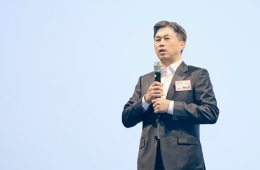
Kim Seonghoe, Director of CEO Leadership Institute
© The Asia Business Daily(www.asiae.co.kr). All rights reserved.



!["They Said It Was 'Delicious' Milk... Is the 'List of Fake Milk Products in Korea' for Real? [Matjal X-File]"](https://cwcontent.asiae.co.kr/asiaresize/307/2023072413274517286_1690172865.jpg)