Hanyang University and Gyeongsang National University Achieve World’s Highest Efficiency in Blue OLEDs
Achieving World’s Highest Performance with Solution Processing Technology
A joint research team led by Professor Taehee Han from the Department of Materials Science and Engineering at Hanyang University and Professor Yunhee Kim from the Department of Chemistry at Gyeongsang National University has achieved the world’s highest efficiency in blue solution-processed organic light-emitting diodes (OLEDs), which have long been considered the greatest challenge in next-generation displays.

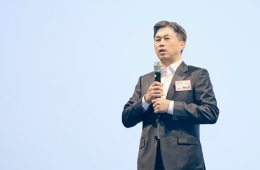
Taehee Han (left), Professor of the Department of Materials Science and Engineering at Hanyang University, and Yunhee Kim, Professor of the Department of Chemistry at Gyeongsang National University. Hanyang University
View original imageDue to their high-energy characteristics, achieving high efficiency in blue OLEDs has proven difficult, and hyperfluorescence has emerged as a promising alternative. However, even hyperfluorescent materials have faced challenges in realizing high-efficiency blue devices, due to issues such as material aggregation and interfacial energy loss during solution processing.
According to Hanyang University on April 15, the research team, for the first time in the world, combined a polymer sensitization-based hybrid emission layer design with a self-organizing interface technology in the blue emission spectrum. In particular, by combining a proprietary polymer sensitizer with a blue monomolecular emitter, they suppressed material aggregation, and by introducing a novel self-organizing interfacial layer, they minimized photon loss at the interface.
As a result, the team successfully developed a high color purity blue hyperfluorescent OLED device with an external quantum efficiency (EQE) exceeding 30% and a full width at half maximum (FWHM) of approximately 18 nm. This represents the highest efficiency ever reported for a polymer-based OLED, demonstrating exceptional performance even with solution processing rather than vacuum deposition.
Solution processing technology offers lower production costs and enables large-area, continuous manufacturing compared to conventional methods, making it a key technology for next-generation form factors such as ultra-high-resolution VR/AR (virtual reality/augmented reality) wearable devices, foldable displays, and garment-type healthcare devices. This research is considered a significant breakthrough in overcoming the persistent efficiency issues of blue light sources, substantially lowering the barrier to commercialization of next-generation displays.
Professor Taehee Han stated, "By applying a polymer sensitizer to blue hyperfluorescent OLEDs for the first time, we have demonstrated that polymers not only act as simple emitters but also simultaneously enhance morphological stability and mediate charge transport. This achievement highlights the potential for next-generation display platforms that allow large-area printing processes."
Hot Picks Today
 "With This Certificate, Even Those in Their 60s...
- Popcorn Container Craze at Theaters Sparks Sell-Out Frenzy, Emerges as New Reven...
- 'Security Controversy' LG Uplus, USIM Replacement Rate at 4%...Civic Groups Say ...
- Passed Through Just Before Hormuz Re-closure... 1 Million Barrels of Crude Oil H...
- "Quit Office Job to Earn Over 200 Million Won a Year"… Chinese Woman in Her 30s...
Meanwhile, this research was supported by the Excellent Young Researcher Program and the University Basic Research Laboratory Support Program (G-LAMP) of the National Research Foundation of Korea under the Ministry of Science and ICT. The results were published in the international journal Science Advances on April 10.
© The Asia Business Daily(www.asiae.co.kr). All rights reserved.



!["They Said It Was 'Delicious' Milk... Is the 'List of Fake Milk Products in Korea' for Real? [Matjal X-File]"](https://cwcontent.asiae.co.kr/asiaresize/307/2023072413274517286_1690172865.jpg)