 What Happens When AI Is Applied to Education... You’ll Know If You Let It Handle Descriptive Grading](https://cwcontent.asiae.co.kr/asiaresize/306/2026041315094623791_1776060586.jpg)
Education
[AI Revolution](195) What Happens When AI Is Applied to Education... You’ll Know If You Let It Handle Descriptive Grading
"Technology can accelerate learning." On April 19, in an interview with The Asia Business Daily, Cho Hyungoo, CEO of edtech startup CT, emphasized, "Artificial intelligence (AI) will expand the realm of learning." He predicted that educational programs could be transformed not only to support teachers' work but also to foster students' critical thinking abilities. CEO Cho founded CT in 2012, drawing on his experience as an elementary school teacher. In his class, there were students with a wide range of backgrounds and abilities, including North Korean defectors and students with disabilities, making it challenging to cater to each student's needs. Motivated by a desire to solve such problems in public education through technology, he decided to start a business. The journey was not easy from the start, as he needed a developer to co-found the company. While attending KAIST (Korea Advanced Institute of Science and Technology), Cho searched for someone interested in developing educatio
-
"What Is Annual Leave? We Go to Work Even When Sick"... The Reality for Kindergarten Teachers Is Harsher Than Satire

-
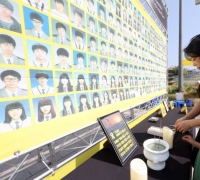
Teachers' Groups Mark 12th Anniversary of Sewol Ferry Disaster: "A Safer Educational Environment Needed"
- "First Time in a Korean School..." Seoul Office of Education to Provide Educational Support for Parents of Students from Immigrant Backgrounds
-
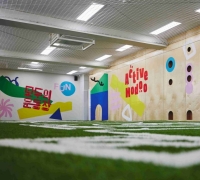
ChildFund Korea and Nike Korea Create Indoor Playground at Gangdong Elementary School in Seoul
-
Baehwa Women's University-Commissioned Jongno-gu Children's Meal Center Conducts Kitchen Staff Training for Food Poisoning Prevention
-
Seoul Metropolitan Office of Education to Support Cancellation of Ji Haebok's Dismissal and Reinstatement
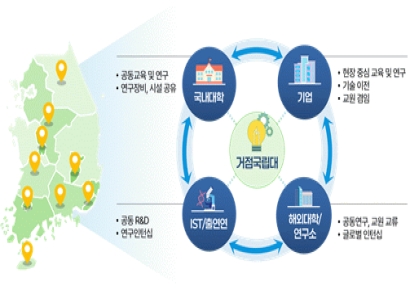
"Creating 10 Seoul National Universities": Intensive Support for 3 Flagship National Universities... To Be Developed as Regional Industry-Academia Hubs
The government will select three flagship national universities this year as a priority to implement the national agenda of "creating 10 Seoul National Universities," and will cultivate them as hubs for local industries, academia, and research institutes. Instead of supporting all nine flagship national universities at once as initially planned, the government has decided to accelerate the project by focusing on selection and concentration. The three universities will receive package support in the fields of "growth engine," which highlights each university's unique characteristics to serve as a hub for education and research in their regions, and "artificial intelligence (AI)." The additional budget allocated for this is expected to be around 100 billion won per university. On April 15, Minister of Education Choi Kyojin announced the "Plan for Training Local Talent Linked to Growth Engines" at the Government Complex Sejong. The plan aims to foster outstanding talent required by compa
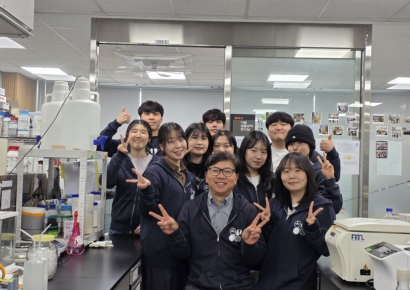
Kookmin University's Yongchul Park Selected for Core Research Program under Basic Research Project
Professor Yongchul Park from the Department of Convergence Bioengineering at Kookmin University has been selected for the 2026 Core Research (Type C) program under the Basic Research Project led by the Ministry of Science and ICT and supported by the National Research Foundation of Korea. The title of the project is "Development of a Genetic Tool Kit for the Food Yeast Candida utilis for Precision Fermentation and Its Application in Food Ingredient Production." The Basic Research Project is a government-led initiative aimed at strengthening creative and challenging basic research and fostering outstanding researchers to enhance future capabilities in science and technology. Among its various categories, the 'Core Research' field is designed to support highly creative individual research, cultivate excellent basic research skills, and provide a foundation for researchers to become leaders in their fields. Eligible applicants include faculty members in science and engineering at universi
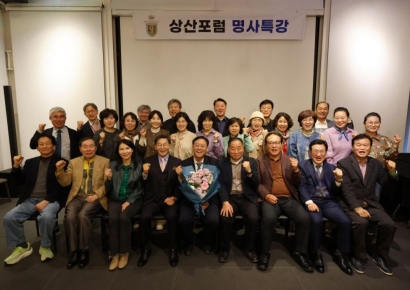
Professor Kim Daejong of Sejong University Presents Economic Strategies at Sangsan Forum
On April 9, Professor Kim Daejong of Sejong University delivered a special lecture at the Sangju Sangsan Forum, held at the Forcs Building in Gangnam District, where he presented strategies for survival for individuals and companies in the Korean economic environment. He emphasized, "We must become wealthy in Korea and live a life that contributes to society." He began his lecture by describing wealth accumulation not merely as personal success, but as a value closely connected to social responsibility. Professor Kim suggested that the most realistic way to become wealthy in Korea is through apartment subscription lotteries. In particular, he explained that apartments sold south of the Han River have the potential for significant asset appreciation over the long term. Taking into account the characteristics of the apartment subscription point system, he emphasized, "Children can open a subscription savings account from the age of one, and from the age of fifteen, one point is awarded e
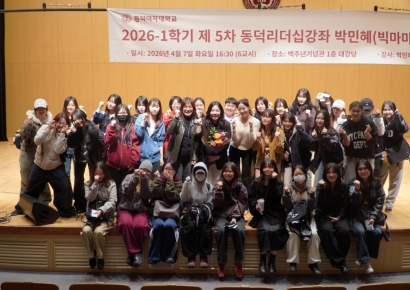
Min Hye Park of Big Mama Delivers Special Lecture at Dongduk Women's University
Dongduk Women's University held a special lecture on April 7 at the 100th Anniversary Hall, inviting Min Hye Park, a singer from the group Big Mama and a professor in the Department of Practical Music at Hanyang University. This special lecture was organized as the fifth session of the "Dongduk Leadership Lecture" series, planned by Dongduk Women's University ARETE College of Liberal Arts. This program is a liberal arts initiative that invites prominent figures from various fields and notable alumni to provide students with diverse experiences and insights. In particular, Professor Park is an alumna who graduated from Dongduk Women's University's Department of Practical Music, creating a meaningful opportunity to connect with her juniors. The lecture was held under the theme "From Big Mama to Mama." Professor Park candidly shared her journey of growth as a singer and the pivotal choices she faced at life’s turning points, resonating deeply with the students. She emphasized, "Life truly
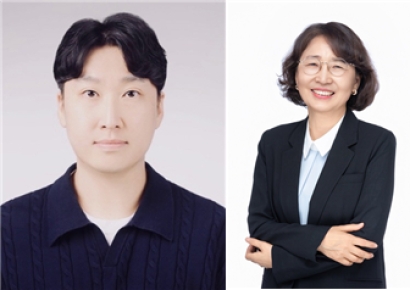
Hanyang University and Gyeongsang National University Achieve World’s Highest Efficiency in Blue OLEDs
A joint research team led by Professor Taehee Han from the Department of Materials Science and Engineering at Hanyang University and Professor Yunhee Kim from the Department of Chemistry at Gyeongsang National University has achieved the world’s highest efficiency in blue solution-processed organic light-emitting diodes (OLEDs), which have long been considered the greatest challenge in next-generation displays. Due to their high-energy characteristics, achieving high efficiency in blue OLEDs has proven difficult, and hyperfluorescence has emerged as a promising alternative. However, even hyperfluorescent materials have faced challenges in realizing high-efficiency blue devices, due to issues such as material aggregation and interfacial energy loss during solution processing. According to Hanyang University on April 15, the research team, for the first time in the world, combined a polymer sensitization-based hybrid emission layer design with a self-organizing interface technology in th
Ministry of Education to Ensure Timely Supply of Braille Textbooks... Guaranteeing Educational Rights for Visually Impaired Students
The Ministry of Education has announced plans to supply braille textbooks for visually impaired students before the start of each semester, aiming to guarantee their right to education to the fullest extent. On April 15, the Ministry of Education stated that it would sign a Memorandum of Understanding (MOU) for "Ensuring the Right to Learn for Visually Impaired Students and Timely Supply of Braille Textbooks" at Seoul School for the Blind, together with the Korea Textbook Association and 81 major textbook publishers. This agreement was established to bridge educational gaps for students with disabilities and to guarantee their substantive right to education. Despite the efforts of the National Institute of Special Education and publishers, the time-intensive process of producing braille textbooks has made it difficult to distribute them by the start of the semester. As a result, on March 31, the National Assembly passed a partial amendment to the Elementary and Secondary Education Act
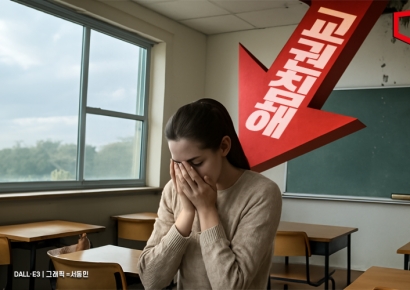
Weapons in the Classroom... Teacher Groups Call for Measures to Protect Educators
Following a series of teacher assault incidents occurring on school premises, teacher organizations are calling for measures to protect educators. According to the Korean Federation of Teachers' Associations (KFTA) on April 14, the number of injury and assault cases involving teachers has been increasing every year: 106 cases in 2020, 231 in 2021, 347 in 2022, 488 in 2023, 502 in 2024, and 328 during the first semester of 2025. The KFTA stated, "Based on the number of school days, an average of four teachers per day are subjected to assault or injury." Recently, incidents of injury and assault against teachers have continued to occur at schools. On April 13, at a high school in Gyeryong, South Chungcheong Province, a student wielded a pre-prepared weapon in the principal's office, resulting in a teacher sustaining injuries to the back and neck and being transported to the hospital. On March 31, at a middle school in Gwangju, Gyeonggi Province, a student assaulted a female teacher, caus
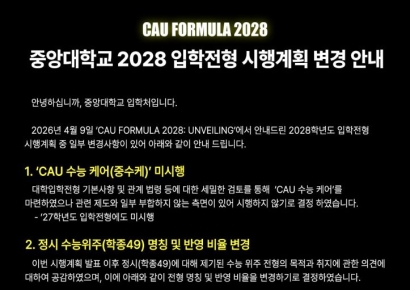
Chung-Ang University Withdraws 'Early Admission Kidnapping Relief'... Ministry of Education Cites Legal Violation
Chung-Ang University planned to introduce a new admissions process for the 2028 College Scholastic Ability Test (CSAT) that would exclude applicants from the early admission list if they received higher-than-expected CSAT scores?but has since withdrawn the plan. On April 13, Chung-Ang University announced on its Admissions Office website, "After a thorough review of university admissions guidelines and related laws, we had prepared the 'CAU CSAT Care' program. However, because certain aspects do not align with the current admissions system and some regulations, we have decided not to implement it." On April 9, the university had introduced the 'CAU (Chung-Ang University) CSAT Care' system at an admissions briefing session for students and parents. Under this system, if a student who applied for early admission scored higher than expected on the CSAT, they would be removed from the early admission list, allowing them to apply for regular admissions at other universities. Under the curr
![[Reporter’s Notebook] Preventing the Collapse of the Tower of Babel in Coding](https://cwcontent.asiae.co.kr/asiaresize/303/2026032309273285889_1774225653.jpg)
![[The Collapsed Coding Wall]⑤Will Vibe Coding Take Away Jobs?... "High-Level Developers Will Be in the Spotlight"](https://cwcontent.asiae.co.kr/asiaresize/303/2026032513575190214_1774414671.jpg)


![Before the US and China Make Their Move, Korea Must Seize the Niche... The Key to Korean Cooking Robots Is 'K-Recipe' [Heukbaek Cooking Robot]⑤](https://cwcontent.asiae.co.kr/asiaresize/303/2026040216221111819_1775114531.png)
In the News

- Kwak Nohjung: "Tectonic Shift in Semiconductor Industry... Building Competitiveness Through Mutual Trust With Partners"
- Iran War and High Oil Prices Drive Oil Industry to Look Beyond the Middle East
- They Said It Was 'Delicious' Milk... Is the 'List of Fake Milk Products in Korea' for Real?
- "With This Certificate, Even Those in Their 60s Can Get Hired and Earn 3.69 Million Won a Month"... Retirees Are Flocking
- "Moms Touch Unruly Woman" Video Spreads... Assaulted Employee and Smashed Register After 'Cola Refill' Refusal
- "If the Hormuz Blockade Continues, We Won't Be Able to Eat 'This' Anymore"... Japan in Turmoil