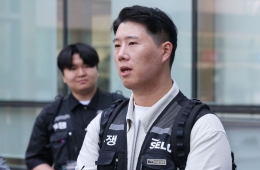
Lee Donghoon: "If We Voted Right Now, It Would Be 11:5—Jung Wonoh Faces Major Crisis" [Current Affairs Show]
Ha Heongi: "Currently, Daegu Is a Battleground"
Lee Donghoon: "Attention on the People Power Party’s 'Jang Donghyuk Risk'"
Ha Heongi: "Park Minshik–Han Donghoon Unification Impossible"
■ Broadcast: The Asia Business Daily "So Jongseop's Current Affairs Show" (Mon-Fri, 4–5 PM)
■ Host: So Jongseop, Political Specialist ■ Director: Park Sumin, PD
■ Guests: Lee Donghun, Chief Spokesperson of the Reform New Party, Ha Heongi, former Standing Deputy Spokesperson of the Democratic Party of Korea (May 14)
※ When quoting content from this article, please be sure to cite "So Jongseop's Current Affairs Show."
So Jongseop: Hello, everyone. This is So Jongseop's Current Affairs Show. Candidate registration will take place from the 14th to the 15th. Official election campaigning will run from the 21st until midnight on June 2. In other words, the countdown for the June 3 election has truly begun. As candidate registration begins, we are seeing a flood of polls—some of which are showing very tight races.
Ha Heongi: Historically, as elections enter the final stage, the conservative vote consolidates in Yeongnam. However, overall, Democratic Party candidates currently still seem to have the upper hand. Daegu is the only area that's truly competitive—it’s almost a dead heat there, in our view. While Daegu has always been a challenge, and the Yeongnam region is certainly tougher than other areas, we use terms like "slight disadvantage" or "narrow lead." Right now, it looks like a slight but close lead for us, with Daegu in particular being highly competitive.
If voting happened right now, it would likely be around 11 to 5
Lee Donghun: After about a year of the Lee Jaemyung administration, there is a sense of a midterm evaluation. Although President Lee Jaemyung is credited in some polls with doing well, it’s also true that the public feels a need for a degree of judgment and checks on power. The People Power Party leadership has boxed itself in with the insurrection narrative and chaotic nominations, leading to predictions that it could go as far as a 15 to 1 result. Conservatives have been holding back, seeing little reason to vote for the ruling party or the opposition. But the case for a special prosecutor to dismiss the indictment has now provided justification. I think Busan, Ulsan, Gyeongnam, and Daegu are once again becoming battlegrounds. So if the vote were held now, the outcome would probably be about 11 to 5.
So Jongseop: How long do you think the conservative consolidation in the Yeongnam region will last?
Lee Donghun: In places like Ulsan, it seems the region has largely shifted. Busan is also very competitive now. The question is whether that trend will reach the Seoul metropolitan area. I think the Democratic Party made some arrogant nomination choices. In Busan, Ulsan, and Gyeongnam as well as in the capital region, I wonder whether the Democratic Party has ever fielded such weak candidates for metropolitan mayor. Just consider Seoul—it’s not about the personal qualities of each candidate, but looking at the overall competitiveness and appeal to moderates, I can't recall a time when the party’s Seoul, Incheon, and Gyeonggi candidates have been this weak.
The People Power Party's 'Jang Donghyuk' could be the final variable
Ha Heongi: The nominations were decided through primaries, so it wasn’t just the party leadership’s decision. The only place where the race hasn’t narrowed is Incheon. Incheon has just kept widening, like a calm lake. It’s likely because it is the region with the highest electoral competitiveness among metropolitan mayors.

Jang Donghyuk, Standing Election Committee Chair of the People Power Party, is speaking at the Central Election Committee held at the National Assembly on the 15th. Photo by Kim Hyunmin
View original imageLee Donghun: On the opposition side, I think Jang Donghyuk, the party chair, could be a last-minute variable. He’s been moving back and forth in the Yeongnam region, and after the local elections, people are talking about his “dream of extending his political life.” His confidence has grown. Some say, "Even if only to avoid seeing Jang Donghyuk, I'll vote for so-and-so, or go back to supporting the Democratic Party." There's still time to see what Jang Donghyuk will ultimately do after the elections, and depending on his decision, the People Power Party could either gain or lose ground.
So Jongseop: People Power Party lawmaker Kim Jaeseop recently exposed past allegations concerning Democratic Party candidate Jung Wonoh. The incident in question dates back to October 1995. How do you assess this?
Ha Heongi: During our party’s primary, lawmaker Kim Jaeseop had already raised this issue, so it was already in the public domain. I believe it also came up during the district mayoral race. To be clear, assault is wrong, regardless of the circumstances. Jung Wonoh apologized for his actions. Kim Jaeseop is citing the Yangcheon District Council’s transcript, but that’s just the unilateral statement of one council member. Even if inappropriate comments are made in the National Assembly or local councils, and regardless of media or public backlash, everything is recorded verbatim. Portraying that as some kind of historically verified evidence is, in my view, inappropriate. It remains the assertion of a single council member.
Debate in the public sphere should be based on court rulings; lawmaker Kim Jaeseop’s claims are closer to a smear campaign
On the other hand, when something has gone through national investigative and judicial processes, we should rely on the Supreme Court ruling as the factual basis for evaluation. I’m not saying Supreme Court judgments always capture the entire truth, but when debating facts in the public domain, there needs to be substantiation, and court rulings are the appropriate standard. In light of this, the reference cited by lawmaker Kim Jaeseop is difficult to treat as fact, so I don't believe it will have a major impact on the outcome; in fact, it is closer to a smear campaign.

People Power Party lawmaker Jae-seop Kim held a press conference at the National Assembly Communication Office on the 13th, revealing information related to the assault record of Seoul mayoral candidate Woon-oh Jung of the Democratic Party of Korea. Photo by Yonhap News
View original imageLee Donghun: The court ruling is probably correct. The transcript is just a council member’s claim. When you read through the council member’s statements, you can piece together a certain picture, although the details may not be in the ruling. For example, there was talk about a woman staying out overnight. The issue is that the 5·18 Democratization Movement was cited as an excuse for the fight that ensued. You can't really say the fight was because of 5·18; there were likely multiple factors. We can only speculate, since we don’t know the full circumstances.
The fact that there was an incident involving habitual violence may resonate with voters because candidate Jung’s background is that of the "386 generation" student activist. This kind of negative campaigning may lead voters to question, "Is this person really fit to be mayor of Seoul?" I think this attack could have a significant impact.
Awareness of the 'Jung Wonoh assault case' is important—likely to hurt the candidate
Ha Heongi: The recording of the victim released by the People Power Party does not support lawmaker Kim Jaeseop’s claims. As for the 5·18 issue, I can accept that criticism. There are also allegations that violence was committed against the responding police officers, but it’s unlikely that the police would have been debating 5·18 with him. So, regarding the 5·18 aspect, I can't say for sure. According to the investigation at the time, it appears to have been a political disagreement. More importantly, the victim’s recording does not mention bar employees at all. The People Power Party is making assertions that are not substantiated. If these claims remain unproven, then under the Public Official Election Act, this constitutes the public dissemination of false information for the purpose of electing or defeating a candidate.
Lee Donghun: The claim is not made without any basis. There existed a transcript from 1995, and the council member would not have fabricated the secretary’s statement for no reason. When someone makes specific allegations, it means there were rumors at the time, and the council member raised the matter after hearing them. There are always hidden stories not covered in court rulings or media reports. When the council member reported it to the district mayor, the mayor apologized, which is also recorded in the transcript. So, it's not entirely groundless. After nearly 30 years, it’s not easy to clarify what really happened, and I don’t think that’s what matters. What’s important is how voters interpret and respond to the incident.
Ha Heongi: Anyone is free to think and imagine as they wish, but when it comes to legal and investigative proof, we need to rely on tangible evidence. Even if political factions differ, most people don’t know who that council member was, their standards, or the context of their statements. Placing too much social trust in an individual’s statement, rather than official documents, undermines the integrity of our public discourse.
So Jongseop: Some say candidate Jung Wonoh is being overly passive in his response to various issues.

Democratic Party of Korea candidate for Seoul Mayor, Jung Won-oh, is attending the 80th anniversary event of the Seoul Nursing Association held on the 15th at the DDP Art Hall in Jung-gu, Seoul. Photo by Yonhap News
View original imageHa Heongi: I partially agree. He does seem to have difficulty articulating his thoughts. For example, when asked which area of Seoul would change immediately if he were elected mayor, he struggles to give a prompt answer. He doesn’t seem like a naturally eloquent speaker, and strategically, when it comes to the assault issue, he should simply acknowledge the wrongdoing and move on. Continuing to argue about it puts him at a disadvantage. He should admit his fault and quickly return to presenting his vision for Seoul and focusing on his main campaign. The campaign team needs to review their approach.
As competitiveness continues to erode, campaign review is needed—Jung Wonoh is at risk
After being mentioned by President Lee Jaemyung on social media, candidate Jung Wonoh received a boost, but since then, his campaign has failed to further increase his support or broaden his appeal. Instead, his approval rating has steadily declined. This is both a campaign and candidate issue. Looking at the overall trend, the electoral landscape hasn’t fundamentally changed, but as the candidate’s competitiveness keeps eroding, a serious campaign review is needed.
So Jongseop: As a product, candidate Jung Wonoh could be considered a so-called "new release," right?
Lee Donghun: Compared to Gyeonggi Province, Seoul is a relatively favorable base for the People Power Party. But the appeal of a "new release" has a shelf life. Just because someone is new doesn’t mean they are automatically preferred. While someone who rises to become the ruling party’s Seoul mayoral candidate is obviously highly capable, voters are realizing there are quite a few shortcomings as well. Ultimately, this is a matter of perception. That’s just how elections work; campaigns and promotions are about appealing to voters. But the current situation is clearly a crisis point for candidate Jung Wonoh—a possible turning point in his campaign.
So Jongseop: Let’s turn to North Jeolla Province. As Governor Kim Kwanyoung is running as an independent, the Democratic Party of Korea is on high alert.
Ha Heongi: He is mounting a serious challenge, which suggests the party needs to reflect on whether its nominations and judgment were appropriate. Regarding the sentiments in Honam, the party leadership and our team should reflect on whether we thoroughly considered the nomination process, candidate assessment, and public sentiment in Honam. Nominations are the party’s most important responsibility. The People Power Party is also suffering from chaotic nominations and is being shunned by its own supporters. In our case, we need serious reflection on this issue as well.
Lee Donghun: Within Jeonbuk, there’s a sense among voters that Governor Kim Kwanyoung was unfairly treated, that Representative Jeong Cheongrae targeted him to install his own people. Voters see this as excessive, and with Kim Kwanyoung being the incumbent governor, there is a perception that the New Lee Jaemyung faction is quietly supporting him. This trend seems to be emerging.
Kim Kwanyoung’s independent run highlights need for nomination management reflection within the Democratic Party of Korea
Ha Heongi: If you look at the process of Kim Kwanyoung’s expulsion, it actually proceeded rapidly. Videos relating to cash envelopes emerged, and the party’s ethics committee requested an explanation. When that wasn’t provided, he was expelled. But at the local level, there is a perception that the process was unfair, that the issue of the cash envelopes was just an excuse, and that this was really about factional strife and power struggles. Proper nomination management should be done transparently so that everyone accepts the outcome. The party needs reflection on this point.
So Jongseop: In the Busan Buk-gap district, a poll found that even if People Power Party candidate Park Minsik and independent candidate Han Donghun unite, their combined support would only be 1.3 or 1.4, not 2.0.
Ha Heongi: I think unification is impossible. Their interests are too different and their bases are distinct. In the last parliamentary election, we saw a merger between defectors from the Democratic Party of Korea and the People Power Party, resulting in the Reform New Party and the New Democratic Party. People thought a merger of rational progressives and rational conservatives would create a larger bloc, but it actually backfired. That’s because when you force together bases with different ideologies, both sides lose supporters.
People may ask, "How are the People Power Party and Han Donghun any different, since they were once in the same party?" Han Donghun was expelled because it was impossible for him to remain, and it was done in a very heavy-handed, undemocratic way—despite the party forum incident. When parties seek to reunite with someone they expelled, they need a new rationale.
From Park Minsik’s perspective, he would want Han Donghun to step down; Han Donghun, on the other hand, wants the People Power Party to step aside so he can survive. But neither can accept that. If they were to discuss unification, it would involve polls or other methods, but it’s not easy. Based on what I’ve heard from Han Donghun’s camp, they never actually considered unification. While they leave the door open rhetorically, their basic stance is that unification is off the table.
The People Power Party seems to be investing more effort in sidelining Han Donghun than supporting Hajungwoo
Another factor is the internal structure of the People Power Party. If Hajungwoo wins in Busan Buk-gap, it’s status quo, since it was originally a Democratic Party seat. But if former party leader Han Donghun wins, it could shake up the party. If Han returns with a National Assembly badge and claims to rebuild the conservative bloc, he could threaten the current mainstream. The establishment doesn’t step aside voluntarily. That’s why it seems the party is investing more resources in sidelining Han Donghun than in supporting Hajungwoo. For Han Donghun to win, he’ll need to do it on his own merits, but given the voter composition there, it’s extremely difficult.
So Jongseop: In a three-way race, isn’t candidate Hajungwoo in a favorable position?
※Click the video to watch the full discussion
Lee Donghun: The electoral structure favors Hajungwoo, and it can’t realistically be overturned. In a three-way race where unification doesn’t occur, the only way to win—like former leader Lee Junseok’s Dongtan model—is with a 4:4:2 split. You’d need to keep Hajungwoo under 40%, Park Minsik under 20%, and win with somewhere in the 40% range. But Park Minsik is much stronger than the People Power Party candidate in Dongtan was. He’s run four times in this district, and with the local elections coinciding, all party organizations will be mobilized. Both People Power Party and Democratic Party organizations will be active. I doubt Park Minsik can be kept under 20%, and it will also be hard to keep Hajungwoo under 40%.
Han Donghun is a very unusual figure—all factions in the opposition dislike him. People talk about Jang Donghyuk, but it’s not just him. Figures like Ahn Cheolsoo and Oh Sehoon, as well as prominent names in the ruling camp, and even at Sunday’s campaign office opening, lawmaker Na Kyungwon was visibly upset. Han’s camp refers to it as "Han-phobia," but it’s not fear—it’s aversion. It makes me wonder how someone like him manages to stay in politics. He is sustained by a passionate fan base, but it’s remarkable how he’s managed to alienate so many. For these reasons, his path is difficult.
Dongtan and Buk-gap have different voter structures, making Park Minsik–Han Donghun unification difficult
Ha Heongi: Dongtan and Buk-gap have different voter compositions. Dongtan is basically a stronghold for the Democratic Party, with little incentive to vote conservative. If there’s one conservative candidate and one People Power Party candidate, you can reduce the People Power Party candidate to under 10%, making it essentially a one-on-one contest. Buk-gap, on the other hand, is not a Democratic Party stronghold; it’s fundamentally conservative, and lawmaker Jeon Jaesu only won due to his personal competitiveness. The incentive for conservative voting is much stronger in Buk-gap than in Dongtan. So, trying to apply the Dongtan model to Buk-gap will not work for Han Donghun or his team—it will fail.
So Jongseop: Thank you both for your insights.
Hot Picks Today
!["Heading for 2 Million Won": The Company the Securities Industry Says Not to Doubt [Weekend Money]](https://cwcontent.asiae.co.kr/asiaresize/93/2025061015355092669_1749537351.jpg) "Heading for 2 Million Won": The Company the Securities Industry Says Not to Doubt [Weekend Money]
"Heading for 2 Million Won": The Company the Securities Industry Says Not to Doubt [Weekend Money]
- "Anyone Who Visited the Room Salon, Come Forward"… Gangnam Police Station Launches Full Staff Investigation After New Scandal
- "Can't Even Turn On a Fan? How Will They Endure the Heat?"... Massive Blackout Hits the Philippines Amid Scorching Heat
- "Drink Three Cups of Coffee and Stay Up All Night Before the Test"... Manual of Insurance Planner Who Collected 1 Billion Won in Payouts
- Did Samsung and SK hynix Rise Too Much?... Foreign Assets Grow Despite Selling [Weekend Money]
Lee Donghun & Ha Heongi: Thank you.
![Lee Donghoon: "If We Voted Right Now, It Would Be 11:5—Jung Wonoh Faces Major Crisis" [Current Affairs Show]](http://www.asiae.co.kr/news/img_view.htm?img=2026051514493165024_1778824170.jpg)
© The Asia Business Daily(www.asiae.co.kr). All rights reserved.