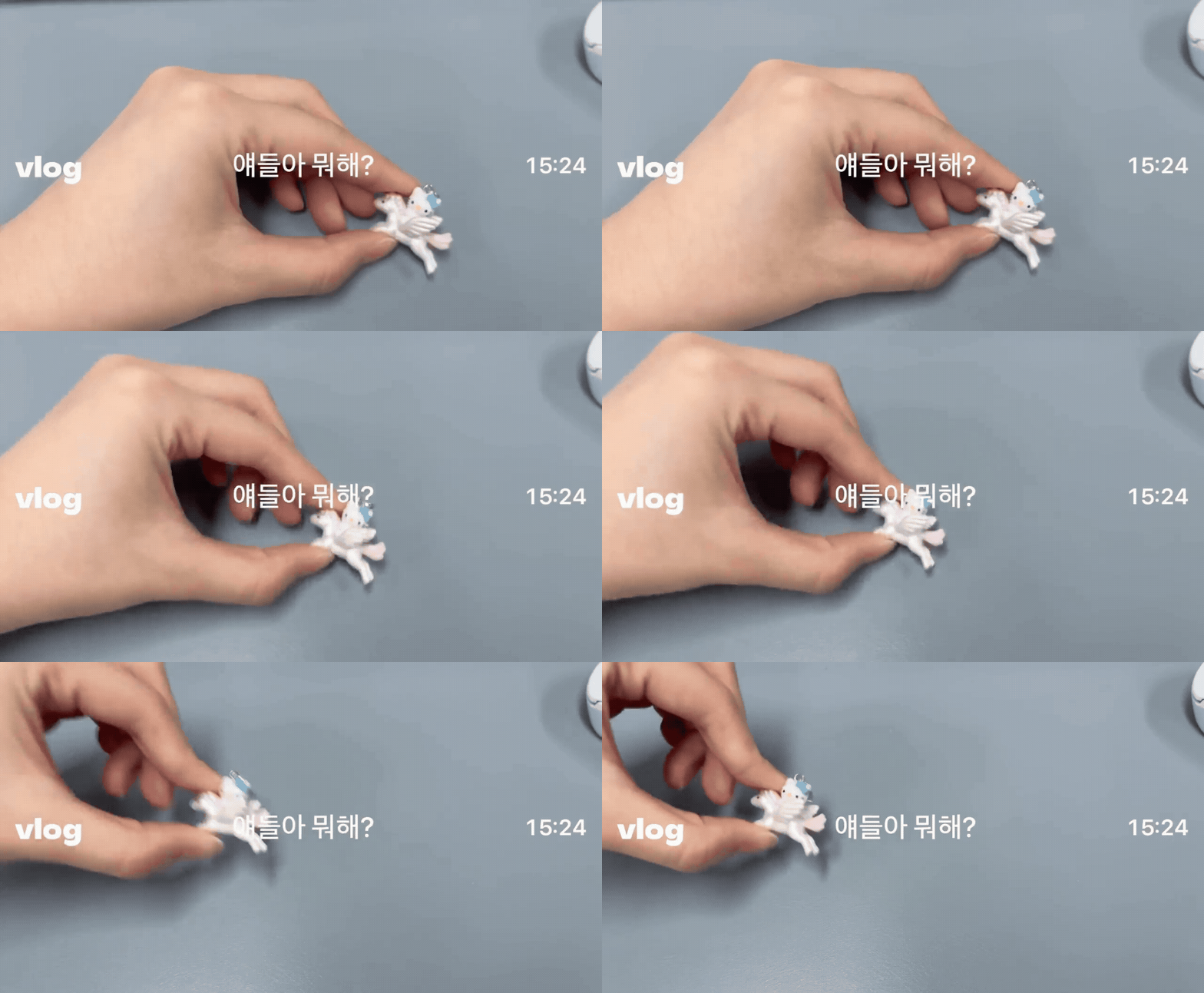


Song Sieun (23), a student in the vocal music department at Kyung Hee University, habitually opens the Setlog app whenever she has free time between classes. Song said, "These days, if you don't use Setlog on campus, it feels like you don't have any close friends," adding, "Even though nothing special is happening, the process of stacking up two-second videos with friends feels like creating content itself."
Setlog, which was released less than six months ago, is rapidly spreading across college campuses nationwide. The app works by notifying users every hour to record and share a two-second video, and it has recently climbed high in popularity rankings on both the Apple App Store and Google Play Store, gaining significant traction among people in their 20s and 30s. The Asia Business Daily interviewed 15 college students from across the country to hear their detailed reviews and examine what draws them to this "short record" trend.

The core of the Setlog craze lies in the fact that "you don't have to put on a show." Whereas conventional social networking services (SNS) focus on polished photos and edited videos, leading to fatigue, Setlog emphasizes raw, unprocessed moments. Stored photos cannot be used; users must shoot in real time. Editing features are also limited. This is why users say, "There's no pressure to upload, even if you look sleepy in the classroom."
Cho Hyunwoo (26), a student in the Human AI Engineering department at Sangmyung University, said, "Because you can't revise or edit, you end up sharing your real, everyday self during breaks or while commuting." Kim Hyunwoo (25), a media and communication major at Chung-Ang University, also commented, "It's fun to see people’s real daily lives," and added, "It feels like you’re hanging out together, even without directly messaging one another."

Experts analyze that the popularity of Setlog is connected to the video-centered communication culture that solidified after the COVID-19 pandemic. Kim Siwol, a professor in the Department of Consumer Studies at Konkuk University, explained, "Generation Z (born in the mid-1990s to early 2000s) is accustomed to maintaining relationships through video in non-face-to-face environments," and added, "Instead of elaborate self-presentation, they reduce the cost of maintaining relationships by simply sharing what they’re doing right now."
The fact that it is a low-stimulation SNS is also a major draw. While Instagram has become a platform for flaunting travel, fashion, or self-development, Setlog is closer to simply letting daily life flow by without any specific purpose. The feature that automatically strings together all two-second videos filmed during the day into a single vlog further fuels users’ desire to document their lives. By sharing their daily routines in real time, users essentially create a diary.
Shim (20), a student in the Korean traditional music department at Seoul National University, said, "It’s comfortable because there’s no pressure to reply," adding, "Being able to casually see what everyone is up to makes it less burdensome." Park Sugyeong (24), a Korean language and literature major at Konkuk University, also said, "It feels like I’m living together with friends who are far away or studying abroad."
Setlog is evolving beyond a record-keeping app into a new form of relationship platform. Recently, among college students, the so-called "Setlog group dating" culture is spreading, in which six men and six women create anonymous chat rooms, share each other’s daily lives for several days, and then meet in person. On platforms like Everytime, Instagram, and X (formerly Twitter), posts such as "Looking for people to film Setlog with" and "Seeking a Setlog room for class of ‘26" are appearing one after another. Lee (22), a psychology major at Jeonbuk National University, commented, "With traditional blind dates, you only had a few photos to go by, but with Setlog, you can naturally get a sense of someone’s lifestyle and vibe. Meeting in person after seeing their daily life makes things less awkward."

However, some analysts point out that it is uncertain whether this craze will last in the long term. Trends among college students today tend to be consumed and disappear quickly in short cycles. In fact, viral hits like "Dubai Chewy Cookie" or "Shanghai Butter Rice Cake" that spread through SNS quickly faded after a short-lived boom.
Choi Chul, a professor in the Department of Consumer Economics at Sookmyung Women’s University, analyzed, "As a culture of rapidly consuming dopamine-driven content takes hold, the trend cycle itself is becoming shorter," and added, "If the novelty of Setlog fades, the rate at which users leave could accelerate."
Some are also concerned that it could lead to another form of fatigue. Lee Youngae, a professor in the Department of Consumer Studies at Inha University, said, "Even if it starts out as light and free communication, it could eventually lead to pressure to constantly show what you’re doing," adding, "We need to be cautious so that the real-time sharing culture doesn’t become another form of compulsive self-validation."
-

Reporter Park Hosu lake@asiae.co.kr
-

Reporter Oh Jieun joy@asiae.co.kr
-
Edit Kim Boram kbram6457@asiae.co.kr
© The Asia Business Daily(www.asiae.co.kr). All rights reserved.
!["Please Help Us": How Much Do Those Bowing 90 Degrees These Days Actually Earn? [Data Pick]](https://cwcontent.asiae.co.kr/asiaresize/323/2026052010120870131_1779239528.png)