[2026 Future Business Forum] "K-Space Has Sufficient Potential... Must Target Niche Markets"
There have been suggestions that for Korean companies to achieve tangible results in the era of space exploration, continuous rocket launch attempts and full-scale government support are essential. While the United States, led by SpaceX and Rocket Lab, is dominating the space market, it is assessed that there are still opportunities for Korean companies, as latecomers, to secure competitiveness by targeting niche markets.
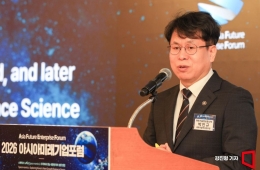
Shim Sooyeon, Vice President of Perigee Aerospace, stated at the "2026 Asia Future Business Forum" held at Lotte Hotel in Sogong-dong, Seoul, on May 13, "A goal such as launching satellites for just a few thousand dollars per kilogram, like SpaceX, may be difficult to achieve immediately. However, access to space is a multifaceted mission that requires launching rockets quickly, at a low cost, to the desired orbit and at the desired time." She pointed out that there is sufficient room for Korean companies to make their presence felt in the global market.
Vice President Shim added, "Currently, the only companies that regularly launch commercial service rockets in the space market are SpaceX and Rocket Lab in the United States," and predicted, "In this supplier-dominated market, there are still plenty of unmet needs. In terms of payload, the small and medium-sized market will likely be the first opportunity to capture." She also mentioned that, geographically, it would be advantageous to build partnerships by sharing space exploration missions with regions such as Southeast Asia and the Middle East.

On the 13th, a panel discussion titled "Growth Opportunities in K-Space Opened by New Face Companies" was held at the 2026 Asia Future Business Forum at Lotte Hotel in Sogong-dong. May 13, 2026 Photo by Yongjun Cho
View original imageVice President Shim emphasized, "However, all of this is premised on Korean companies providing reliable launch services," and added, "If the government acts as the 'first customer' and takes the lead in reliability certification, it can help domestic private launch vehicle companies strengthen their presence in both domestic and overseas markets."
At the panel discussion held under the theme "Growth Opportunities for K-Space Opened by New Space Companies," Vice President Shim was joined by Kim Ieul, CEO of Satrec Initiative; Kim Sujong, CEO of Innospace; and Lee Jaeho, CEO of the Institute of Unmanned Exploration. These leaders of Korea's private space exploration sector all agreed that for the country's space industry to grow, a spirit of challenge that is not afraid of launch failures and strategies targeting niche markets are necessary.
Kim Sujong, CEO of Innospace, said, "For private launch vehicle companies to be self-sustaining and maintain commercial viability, they must be selected by customers or government agencies that have multiple satellite launch plans." He emphasized, "Even if a rocket launch fails, it is important to demonstrate, like SpaceX or Rocket Lab, the willingness to keep attempting launches until success is achieved." He pointed out that it is crucial for the market to recognize a company as one that is determined to create success stories through continuous launch attempts and possesses strong service capabilities.

On the 13th, a panel discussion was held on the theme of "Growth Opportunities for K-Space Opened by New Face Companies" at the 2026 Asia Future Business Forum held at Lotte Hotel in Sogong-dong. 2026.5.13 Photo by Yongjun Cho
View original imageKim Ieul, CEO of Satrec Initiative, commented, "Recently, with the rise of national prioritization and regional hegemony, 'space sovereignty' has become a very important factor. However, the gap between countries with abundant resources and those without is widening." He explained that the background to considering a business model of leasing satellite usage rights, rather than simply selling satellites, also stems from this gap in space exploration demand and capabilities.
He stressed, "It is more important to know what the customer wants and what problems they want to solve than simply knowing what we are good at." He added, "In a New Space era dominated by a giant like SpaceX, Korean companies need to position themselves in niche markets that the giants cannot serve in order to find opportunities and achieve results."
Hot Picks Today
 Even with High Oil Price Relief Payment, Additional 300,000 Won Per Person to Be Provided... Applications Open from the 18th in This Region
- "Invested 95% in Hynix and Reached 10 Billion Won"... Japanese Investor's Proof Post Goes Viral
- "Did He Think This Was a Chauffeur Service?"... Drunk Driving in Tesla with Autopilot Activated
- "You Don't Need to Go to the Gym": The Best Exercises for Lowering Hypertension
- "That Thing Wakes Up Every Night" ... Suspicious Object Covers Rural Village
Lee Jaeho, CEO of the Institute of Unmanned Exploration, said, "While it is important for Korea to internalize and localize launch vehicle and satellite technologies, in the future, as the unit cost of launch vehicle logistics decreases, the market will further expand to areas such as lunar exploration." He analyzed that Korean companies could also find opportunities in the unmanned rover market for planetary and lunar exploration.
© The Asia Business Daily(www.asiae.co.kr). All rights reserved.