Wi Sung-lac: "No Grounds to Conclude Namu Attack Was by Drone...Cannot Speculate on Perpetrator"
"Reviewing International Cooperation for Navigation in Hormuz...Considering Possibility of a Military Role Step by Step"
"Iranian Ambassador's Visit Was a Consultation, Not a Summons"
"Transfer of Wartime Operational Control Must Not Weaken Combined Defense"
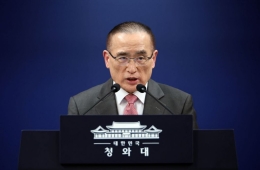
On May 13, National Security Advisor Wi Sung-lac stated regarding the attack on the HMM Namu vessel in the Strait of Hormuz, "We do not have sufficient grounds to definitively say it was a drone. If it was not a drone, it could have been a missile." He emphasized that both the attack method and the perpetrator require further investigation, and therefore, it is necessary to be cautious about identifying a specific country or attributing the attack to a particular means.

At a meeting hosted by the Korea News Editors’ Association at the Seoul Press Center that day, Advisor Wi was asked about the UAE’s characterization of the Namu incident as a "drone attack." He responded, "It's not that we are refraining from specifying the attack method out of consideration for the UAE or any other country." He continued, "We must make judgments based on the inspection and investigation results up to this point, and further investigations are necessary. If it was not a drone, then what could it have been? It could have been a missile; various possibilities remain open. There is not enough information at this stage to determine whether the attack was conducted by a drone or by something else."
He also refrained from identifying who was responsible for the attack. Advisor Wi said, "Even if there are circumstances or suspicions, we cannot, as a matter of national policy, single out a specific country for blame. Just as one cannot accuse someone without solid evidence in legal matters, this holds even more true in inter-state relations." He added, "It is customary not to make premature conclusions or assumptions. We intend to respond in a way that is both reasonable and consistent with established practice."
"First Investigation of Namu Completed...Additional and Detailed Investigations Needed"
Regarding the investigation into the Namu incident, Advisor Wi stated that the initial investigation has been completed, but further detailed investigations are necessary. As for when the additional findings would be announced, he said, "This is a significant issue, so I cannot specify a date," adding, "Depending on the outcome, various follow-up measures will have to be considered, but it is difficult to say anything definitive at this stage."
The investigation is currently being conducted solely by Korea. Advisor Wi explained, "We have considered a number of options, but for now, we are conducting the investigation independently. If necessary, we may cooperate with other countries during the process, but at this point, we are not expanding our plans."
Regarding the Iranian ambassador's visit to the Ministry of Foreign Affairs, he clarified that it was a "consultation," not a "summons." Advisor Wi said, "A summons, a simple visit, and a consultation are all different. The circumstances on that day did not constitute a summons, because the perpetrator of the attack had not been identified." He explained that a summons might have implied that a specific party had been identified, but since that was not the case, the visit was to consult. "We explained that 'an attack occurred, someone attacked, but there are several possible perpetrators.' The Iranian side also did not assume that they were being singled out, so the discussion was conducted with various possibilities in mind," he added.
On Hormuz Cooperation: "Considering the Possibility of a Military Role"

Regarding international cooperation for the freedom of navigation in the Strait of Hormuz, Advisor Wi did not rule out the possibility of Korea playing a military role. He stated, "We are reviewing several proposals for collaborating with the international community to ensure free and safe passage through the Strait of Hormuz. We are discussing what contributions we can make, but nothing has been decided yet."
He added, "Since the review is ongoing, it is difficult to comment on the specifics, but a military role at various levels is possible." He continued, "We are reviewing several stages, from lower-level roles upward, to see how far we can go."
Wi also explained that during the initial response there had been discussions about whether to convene a National Security Council (NSC) working-level coordination meeting. "At first, when it was described as an attack, we considered holding a meeting, but as it was later suggested that it might not have been an attack, there was a lot of discussion. Even if an NSC meeting is not convened, many of the same people as an NSC meeting engage in extensive consultations," he said.
On ROK-U.S. Intelligence Sharing: "Some Restrictions...No Overall Issues in Cooperation"

Regarding intelligence sharing between Korea and the United States, Advisor Wi acknowledged there are some restrictions but said that there are no significant issues in overall cooperation. "It is an established practice not to comment on matters related to intelligence," he prefaced, "but I cannot deny that there are some restrictions in certain areas of information sharing. However, there have been no major changes in overall intelligence sharing between Korea and the United States, including information on North Korea and other matters. There are known restrictions in some areas, and we are working to resolve those," he said.
On the transfer of wartime operational control, Advisor Wi stressed that maintaining the combined defense capabilities and deterrence of the ROK-U.S. alliance is a fundamental premise. "The discussion on wartime operational control is based on a major premise: combined defense capability between Korea and the United States must not be compromised. At a minimum, it must remain the same or be enhanced." He said, "Weakening our military strength or deterrence is not an option, and the discussion on transferring operational control is based on maintaining and advancing combined defense capabilities." Regarding possible changes to operational plans, he said, "There may be some adjustments to detailed operational plans, but I do not expect any fundamental shifts in the overall framework."
As for the essence of the transfer of operational control, he described it as a matter of which party has the right to command operations during wartime. "Currently, the Commander of the Combined Forces Command holds that authority, and the plan is to transfer it to the Korean military. The structure in which the United States supports, cooperates, and responds together will remain unchanged," he explained. He further commented, "Over time, there may be subtle changes to the structure, but there will be no major changes."
Regarding the timing and conditions for the transfer, Advisor Wi said adjustments are ongoing between Korea and the United States. "It is difficult to say that what the United States says will be the final decision; we are in the process of coordinating our positions. I believe there are not significant differences in conditions and timeline." He added, "The military details must be discussed first, and then a political consensus must be reached for a conclusion to be drawn."
"CPTPP Accession Under Review, Korea-Mexico FTA Negotiations Resume...Second Year of Practical Diplomacy Begins in Earnest"
Meanwhile, in his earlier keynote remarks, Advisor Wi evaluated that the Lee Jaemyung administration, in its first year, promptly restored summit diplomacy and stabilized relations with major neighboring countries.
For the second year of foreign policy and national security, he presented as priorities the review of joining the Comprehensive and Progressive Agreement for Trans-Pacific Partnership (CPTPP), resumption of Korea-Mexico Free Trade Agreement (FTA) negotiations, progress in negotiations to improve the Korea-India Comprehensive Economic Partnership Agreement (CEPA), and strengthening core mineral and energy supply chains.
Hot Picks Today
 Even with High Oil Price Relief Payment, Additional 300,000 Won Per Person to Be Provided... Applications Open from the 18th in This Region
- "Invested 95% in Hynix and Reached 10 Billion Won"... Japanese Investor's Proof Post Goes Viral
- Seoul Real Estate Formula Collapses: "Just Follow Gangnam" Is Now a Thing of the Past [Home-Tech]
- "You Don't Need to Go to the Gym": The Best Exercises for Lowering Hypertension
- "That Thing Wakes Up Every Night" ... Suspicious Object Covers Rural Village
Regarding the Middle East conflict, he stated that through direct government assistance, approximately 1,500 Korean nationals have been evacuated or repatriated. He also explained that, to ensure the safety of 26 Korean vessels and 160 crew members stranded inside the Strait of Hormuz, a constant communication system with shipping companies and seafarers is being maintained.
© The Asia Business Daily(www.asiae.co.kr). All rights reserved.