Samsung Electronics Labor Talks End in Final Breakdown... Will the General Strike on the 21st Become a Reality?
Differences Over Abolishing and Clarifying the Performance Bonus Cap Remain Unresolved
Attention Focused on Possible Invocation of Government's "Emergency Adjustment Authority"
The labor and management at Samsung Electronics failed to overcome their differences regarding the performance-based bonus system during the second post-adjustment meeting at the Central Labor Relations Commission, ultimately declaring the breakdown of negotiations. Despite two days of talks, the union's demands for institutionalizing the performance bonus and removing the upper limit were not accepted. As a result, the largest strike in the company's history, scheduled for the 21st, is now at risk of becoming a reality.

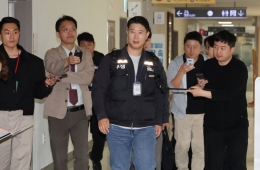
Choi Seungho, Chairperson of the Samsung Electronics Branch of the Super Large Enterprise Labor Union, attended the post-adjustment meeting held on the 11th at the Central Labor Relations Commission, Conference Room 1, Government Sejong Complex. Photo by Yonhap News
View original imageSamsung Electronics labor and management held post-adjustment meetings at the Central Labor Relations Commission in the Government Sejong Complex for two days starting on the 11th, as part of efforts to conclude the 2026 wage agreement. However, discussions ended without an agreement around 3 a.m. on the 13th.
Choi Seungho, Chairperson of the Super Large Enterprise Labor Union, stated after the negotiations, "The gap between labor and management could not be narrowed, so we requested a mediation proposal and waited for nearly 12 hours. However, the proposal actually regressed," adding, "We are officially declaring the final breakdown of the post-adjustment process." He explained that "the mediation proposal maintained the upper limit (50%) for performance-based bonuses and kept the existing excess profit incentive (OPI) system unchanged."
Choi further revealed that as of now, 41,000 people have expressed their intention to participate in the planned strike on the 21st, and the number is expected to exceed 50,000. He made it clear that the union intends to push ahead with the strike in accordance with legal procedures.
The Central Labor Relations Commission ended the process without presenting a mediation proposal due to the significant gap between the two sides. The commission stated, "We supported the negotiations by presenting various alternatives based on the positions of both labor and management, but the gap was too wide. Since the union requested to end the post-adjustment process, we decided to close the proceedings without presenting a mediation proposal."
However, the commission left the door open for further dialogue, stating that additional support could be provided at any time if both sides jointly request it.
Industry observers believe that if the strike actually takes place, the damages could exceed 40 trillion won, dealing a severe blow to the national economy, including disruptions to the semiconductor supply chain. As a result, there is cautious discussion in some circles about the possibility of the government invoking its "emergency adjustment authority," which would forcibly suspend industrial action and order mediation. The emergency adjustment authority is an exceptional measure that has not been exercised for over 20 years since the 2005 airline pilots' strike.
Hot Picks Today
!["Those Who Hesitated at 3,000 Still Haven't Bought" 7 Trillion-Won Asset Manager Says "Opportunities Remain" [Investment Strategies of the Wealthy] ⑦](https://cwcontent.asiae.co.kr/asiaresize/93/2026050715101553735_1778134216.jpg) "Those Who Hesitated at 3,000 Still Haven't Bought" 7 Trillion-Won Asset Manager Says "Opportunities Remain" [Investment Strategies of the Wealthy] ⑦
"Those Who Hesitated at 3,000 Still Haven't Bought" 7 Trillion-Won Asset Manager Says "Opportunities Remain" [Investment Strategies of the Wealthy] ⑦
- "Not Just Olive Young"... Word-of-Mouth Drives Foreigners to Pharmacies, Spending Surges 156%
- "SK hynix Could Reach 2.8 Million Won; Why Securities Firms Are Confident That the Main Chapter of AI Has Not Even Begun Yet [Click eStock]"
- "Don't Come to Work from Tomorrow": Two Million Face Unemployment Crisis...Iran Shaken by War Shock
- "Why Are My Child's Grades Like This?" Surge in Overprotected, Isolated, and Reclusive University Students [University Students in Crisis] ⑧
The company has filed for an injunction, claiming that the industrial action announced by the union is illegal, while the union plans to focus on legal countermeasures and preparations for the strike.
© The Asia Business Daily(www.asiae.co.kr). All rights reserved.