KRIBB Unveils Ultra-Precise Sensor for Atomic-Level Analysis of Protein-Drug Binding
A cutting-edge sensor technology capable of precisely determining the binding state of proteins and drugs at the atomic level has been developed. For a drug to have the desired therapeutic effect in the human body, it must bind accurately to its specific target protein. However, it is challenging to precisely analyze the binding state of low-molecular-weight drugs with similar structures, as the differences upon binding to proteins are extremely subtle. This newly developed technology is expected to contribute to drug discovery by enabling the rapid and accurate selection of highly effective drug candidates from among numerous potential compounds.

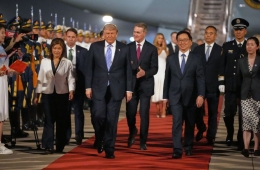
Members of the joint research team are gathered for a commemorative photo. Korea Research Institute of Bioscience and Biotechnology
View original imageOn May 12, the Korea Research Institute of Bioscience and Biotechnology (KRIBB) announced that a joint research team, including Dr. Ji Seungwook, Dr. Jeong Kibaek, Dr. Hwang Seongbo, and Dr. Kim Jinsik from the Artificial Intelligence (AI) Biopharmaceutical Research Center, has developed an 'ultra-precise nanopore sensor' technology capable of identifying and analyzing the binding state between proteins and drugs at the molecular level.
A nanopore is a gap just a few nanometers (nm, one-billionth of a meter) in size, and it is characterized by subtle changes in electrical signals when proteins pass through or stay within it.
Focusing on the fact that the binding state of proteins and drugs can be determined by precisely analyzing the electrical signals generated in the nanopore, the joint research team developed an ultra-precise nanopore sensor technology and conducted experiments targeting 'BRD4 (Bromodomain-containing protein 4),' a major target for anticancer drug development. BRD4 is known as a key protein involved in the development of various diseases, including cancer, and in regulating gene expression.
The experiments were conducted by analyzing multiple drugs that bind to BRD4 using nanopore technology. It was confirmed that each drug produced a distinct electrical signal pattern depending on its type.
Notably, the joint research team successfully distinguished between drugs that were extremely similar, with a mass difference of only 2.5 Da (Dalton). Considering that conventional nanopore-based protein analysis technology could only differentiate differences of 88 to 116 Da, this represents a dramatic improvement—enabling ultra-high-resolution analysis with dozens of times greater precision.
An important feature of the ultra-precise nanopore sensor is its ability to identify even the most subtle structural differences in drug binding. This overcomes the limitations of previous technologies, which could only detect differences when there were significant changes in protein structure.
The joint research team also developed a multiparameter analysis method that simultaneously analyzes various characteristics—such as the positional changes and movements of target proteins within the ultra-precise nanopore sensor, as well as current signal patterns.
Through this, they established unique electrical fingerprints for each drug-protein binding event, enabling rapid, single-molecule-level analysis with only minute sample quantities and without the need for fluorescent labels.
The research team anticipates that, if this technology is implemented in the field, it will enable much faster and more accurate selection of optimal compounds from tens of thousands of drug candidates, thereby shortening the drug development timeline and improving efficiency.
Dr. Ji Seungwook stated, "The ultra-precise nanopore sensor technology developed by our team is significant because it can determine the binding state of proteins and drugs with world-class resolution," adding, "This technology will not only accelerate the discovery of highly effective new drugs but also serve as a platform technology expandable to precision medicine and disease diagnostics."
Hot Picks Today
 Even with High Oil Price Relief Payment, Additional 300,000 Won Per Person to Be Provided... Applications Open from the 18th in This Region
- "Invested 95% in Hynix and Reached 10 Billion Won"... Japanese Investor's Proof Post Goes Viral
- "Why Is the Korean Stock Market Surging?"... Even Italy Is Astonished by the KOSPI Rally
- "Jensen Huang Also Heads to China" Joins Trump’s Visit at the Last Minute
- "That Thing Wakes Up Every Night" ... Suspicious Object Covers Rural Village
This research was supported by KRIBB's major projects and the Ministry of Science and ICT's Individual Basic Research Program. The results were recently published online in the global scientific journal 'ACS Nano.'
© The Asia Business Daily(www.asiae.co.kr). All rights reserved.