Choi Tae-won: "We Need to Copy Nvidia's Strategy... The Formula for AI Success Is Speed, Scale, and Security" (Comprehensive)
Special Lecture at Korea-China Parliamentary Alliance Policy Seminar
Lack of Infrastructure in South Korea... Highlights Need for Investment
Proposes 'Economic Integration' with Japan
Choi Tae-won, Chairman of the Korea Chamber of Commerce and Industry and Chairman of SK Group, proposed large-scale investments in AI data center infrastructure and Korea-Japan economic integration as strategic responses for South Korea amid the US-China competition for AI technology supremacy. He presented "speed, scale, and security" as the formula for success in the AI era and emphasized, "We need to copy Nvidia's strategy."
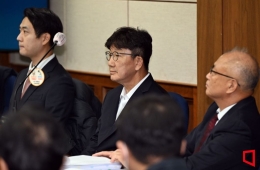
On April 28, Chairman Choi delivered a special lecture titled "Growth Strategies for South Korea amid the US-China AI Technology Hegemony Competition" at the first policy seminar of the Korea-China Parliamentary Alliance in 2026, held at the National Assembly Members' Office Building.
Kim Tae-nyeon, a member of the Democratic Party and president of the Korea-China Parliamentary Alliance, stated, "AI is demanding significant changes not only in industry and the economy but also in everyday life, and the global trade environment is changing in unprecedented ways." He added, "This is now a national competition. Collaboration among businesses, the government, and the National Assembly is extremely important at this time."

Choi Tae-won, Chairman of the Korea Chamber of Commerce and Industry and SK Group, is giving a lecture on the topic of "Growth Strategy for South Korea Amid the U.S.-China AI Technology Hegemony Competition" at the Korea-China Parliamentary League Policy Seminar held at the National Assembly Members’ Office Building on the 28th. Photo by Kim Hyun-min
View original imageChairman Choi identified capital and electricity for data centers, graphics processing units (GPUs), and memory chips as bottlenecks in the AI competition. He stressed, "How each country utilizes these bottlenecks is key to their AI growth strategy."
He likened AI data centers to "factories producing intelligence," not merely storage facilities, and pointed out the lack of infrastructure in South Korea. Chairman Choi explained, "Less than 5% of domestic data centers can be used as AI data centers," and added, "To overcome this, we need to invest about $50 billion to build 1 gigawatt (GW) of capacity."
He also addressed the issue of electricity. "A nuclear power plant produces about 1 GW, but in reality, you need a margin of 1.2 to 1.3 GW to operate an AI data center stably," he said. "South Korea, with more than a 30% electricity reserve rate, could add 50 GW more, but the problem lies in low transmission efficiency." He continued, "China has already surpassed the United States in electricity production and is expected to increase production at a faster rate."
He emphasized the need for a system that allows electricity to be properly used where it is generated. Chairman Choi pointed to distributed power generation as a good example, suggesting, "If a particular industry uses a lot of electricity, it might be better to create an environment that supports that."
Chairman Choi highlighted speed, scale, and security as the key strategies for success in the era of AI technology supremacy. He said, "Even if it is imperfect, it needs to be developed quickly to attract people, and at least a minimal scale must be secured. First, we need to copy Nvidia's strategy."

Kim Tae-nyeon, chairman of the Korea-China Parliamentary Friendship League and member of the Democratic Party of Korea, is giving a greeting speech at the Korea-China Parliamentary Friendship League policy seminar held at the National Assembly Members' Office Building on the 28th. Photo by Kim Hyun-min
View original imageHe also suggested that an economic integration alliance with Japan, at the level of full economic integration, could serve as an excellent response strategy amid US-China hegemony competition. Chairman Choi emphasized, "If we integrate with Japan, the size of our gross domestic product (GDP) will increase to $6 trillion," and added, "We should move beyond simple cooperation and pursue economic integration with Japan, which is in a similar position to us."
In response to a question from Democratic Party lawmaker Choi Minhee about specific measures for Korea-Japan economic integration, he explained, "If we share power lines with Japan, we could purchase additional electricity, or if there is a surplus, we could send it. This is common abroad," and continued, "Even just creating synergy in energy would reduce costs and could be leveraged for investment and other purposes, resulting in integration benefits."
When asked by People Power Party lawmaker Cho Bae-sook to suggest ways for the National Assembly to legislate in the AI era, Chairman Choi emphasized, "Lawmakers need to visit the field and see it as players themselves." He continued, "This is not like the days when global markets were governed by rules under the World Trade Organization (WTO) regime. Someday, we will have to fight as 'fighters.' If we only run away or shy away from being hit, we cannot succeed. Lawmakers need to be present in the global arena."
Hot Picks Today
 "Forged IDs Easily Bypass Convenience Stores, B...
- "Pay for the Postpartum Care Center with My Card"... Grandparents Open Their Wal...
- "Skipping Diamond Rings... Gen Z in the US Opts for Finger Tattoos"
- Oh Sehoon in a Red Jumper: "I Will Be the Magpie's Share to Stop the Lee Adminis...
- Back After 3 Years and 5 Months with a 'Shark Nose Surgery'... Hyundai Unveils T...
The Korea-China Parliamentary Alliance, which hosted the seminar, is a bipartisan parliamentary diplomacy platform with 145 lawmakers from both ruling and opposition parties, continuing policy discussions across diverse fields such as the economy, foreign affairs, and advanced industries.
© The Asia Business Daily(www.asiae.co.kr). All rights reserved.