President Lee Highlights "Doubling Korea-India Trade with Queen Heo Hwang-ok Legend"…Expansion of CEPA Reform and Shipbuilding Cooperation
President Lee attends Korea-India Business Forum
"Current scale is still insufficient compared to India's economy"
Three key directions proposed: expanding trade and investment cooperation, strengthening advanced industry collaboration, and broadening cultural and people-to-people exchanges
"Shipbuilding cooperation to mark a new starting point for bilateral industrial partnership"
Twenty MOUs signed between Korean and Indian companies
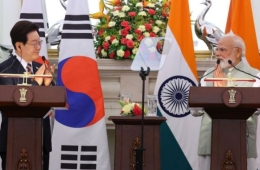
President Lee Jae-myung, currently on a state visit to India, attended the Korea-India Business Forum on the 20th (local time), where he stated, "We must harness India's dynamism as a new sail and more than double the current scale of trade." He outlined three key directions for qualitative advancement in bilateral economic cooperation: ▲ expanding trade and investment cooperation, ▲ strengthening collaboration in advanced industries, and ▲ broadening cultural and people-to-people exchanges. Marking the first state visit by a Korean president to India in eight years, the forum saw enterprises from both countries sign 20 memoranda of understanding (MOUs) for private sector cooperation in areas such as shipbuilding, digital industries, and energy.

During his congratulatory remarks at the forum held at Bharat Mandapam Convention Centre in New Delhi, President Lee said, "The current scale of bilateral trade is still insufficient compared to the vast size of India's economy," but added, "This also indicates significant room for future growth, cooperation, and investment." He emphasized the need to swiftly advance negotiations to improve the Korea-India Comprehensive Economic Partnership Agreement (CEPA), thereby establishing a more stable institutional foundation for business cooperation between the two nations. The leaders of both countries also agreed on the need to resume CEPA improvement talks and expand trade during their summit earlier that day.
President Lee also highlighted cooperation in advanced industries as a central pillar of bilateral relations. He said, "If India's world-class capabilities in artificial intelligence (AI) and software are combined with Korea's manufacturing competitiveness in semiconductors, batteries, automobiles, and shipbuilding, the two countries can create tremendous synergy." He further stated, "In particular, collaborating in the shipbuilding sector will mark a new starting point for industrial cooperation between Korea and India." He added, "I hope that, starting with today's signing of an MOU to promote the establishment of a shipyard, we will be able to expand cooperation into many more areas."
He also stressed the importance of cultural and people-to-people exchanges. President Lee said, "Sustainable cooperation ultimately begins with trust," and added, "If economic cooperation is the ship we are sailing together, cultural exchange is the engine that propels it forward." Referring to K-pop, K-dramas, K-food, K-beauty, and K-games, he noted, "The people of Korea and India are communicating more actively and sharing a deeper friendship than ever before."
On this day, President Lee also expanded on the roots of Korea-India relations by referencing a historical connection from 2,000 years ago. He mentioned the relationship between Queen Heo Hwang-ok and Kim Suro as described in Samguk Yusa, as well as the 'Pasa Stone Pagoda' that Queen Heo is said to have brought by ship to the Korean Peninsula. He said, "The Pasa Stone Pagoda symbolizes humanity's unyielding will to overcome risks and uncertainties and to pave new paths." He continued, "If we had given up on sailing out of fear of the waves, our connection might never have begun. Going forward, I hope we will continue to expand the scope of our exchanges and build even more Pasa Stone Pagodas together."
President Lee also reiterated future cooperation between the two countries by mentioning India's 'Viksit Bharat (Developed India) 2047' initiative, the Indian spirit of innovation known as 'jugaad,' and Korea's values of solidarity and cooperation. He said, "India's jugaad spirit is the power of innovation that finds creative solutions even under constraints, and Korea's Daedong spirit represents the value of achieving shared prosperity through solidarity and collaboration." He emphasized, "If these two spirits are linked together, Korea-India cooperation will withstand any wave."

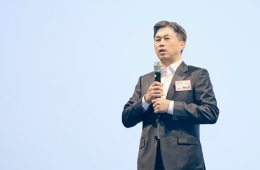
At the forum, tangible outcomes of cooperation between companies from both nations were also presented. Ryu Jin, Chairman of the Korea Enterprises Federation, said in his opening remarks, "Today's Korea-India Business Forum is a venue where we confirmed the future and new possibilities of our cooperation," adding, "Sixteen companies from Korea and India signed 20 MOUs, outlining a blueprint for joint growth." Chairman Ryu identified advanced manufacturing, digital and AI, and the cultural industry as core pillars of future cooperation, stressing, "Now, what matters most is execution."
Piyush Goyal, India's Minister of Commerce and Industry, welcomed the state visit as "the start of a new journey, a new chapter." He stated the goal of increasing bilateral trade volume, currently around 27 billion dollars, to 50 billion dollars by 2030, and remarked, "Korea and India are not competitors but partners advancing together into the global market." He also expressed a commitment to easing trade barriers, expanding market access, and building a more balanced economic partnership.
Hot Picks Today
 "Six Months After 'Mom's Touch Troublesome Woma...
- Popcorn Container Craze at Theaters Sparks Sell-Out Frenzy, Emerges as New Reven...
- "With This Certificate, Even Those in Their 60s Can Get Hired and Earn 3.69 Mill...
- When His Father Suddenly Collapsed Before His Eyes... 13-Year-Old Son Preserves ...
- Female Game Caster Makes Bold Move After Criticism Over "Short Skirt" on Broadca...
Minister Goyal noted that President Lee's visit coincides with an auspicious day in India symbolizing 'endless prosperity.' He said, "This visit will mark the starting point of unending success and prosperity." Highlighting the achievements of Korean companies expanding into India, he added, "India is an oasis of stability amid global uncertainty."
© The Asia Business Daily(www.asiae.co.kr). All rights reserved.

!["They Said It Was 'Delicious' Milk... Is the 'List of Fake Milk Products in Korea' for Real? [Matjal X-File]"](https://cwcontent.asiae.co.kr/asiaresize/307/2023072413274517286_1690172865.jpg)