"Even If the Exchange Rate Exceeds 1,500 Won, No Financial Crisis Looms... Escape the Fears of the Past" [Issue Interview]
Heejin Kim, Head of Shinhan Bank S&T Center Interview
"No Dollar Shortage... Pace and Magnitude Matter More Than the Level"
Closely Monitoring Capital Inflows and Outflows... Equity Markets Have Become Especially Influential
"Er
"Even when the won-dollar exchange rate rises sharply, concerns about a dollar shortage have not emerged over the past four to five years. While lingering fears remain in the market due to past experiences, the mechanism has fundamentally changed. Now, each country is launching massive investments for survival, and governments are supporting them with fiscal spending, so it is dangerous to simply assume that the exchange rate will continue to climb indefinitely."
Heejin Kim, Head of the Solution & Trading (S&T) Center at Shinhan Bank, gave this assessment of the current foreign exchange market situation in an interview with The Asia Business Daily on April 17. Since 2023, she has been leading Shinhan Bank's dealing room, the S&T Center, overseeing foreign exchange (FX) and derivatives trading. Kim is a seasoned field expert with extensive market experience ranging from risk management to corporate FX operations.
No Liquidity Crisis Even if Exchange Rate Rises... 'Pace of Change' Matters More Than the Level

Kim Heejin, Head of S&T Center at Shinhan Bank, is giving an interview to The Asia Business Daily. Photo by Yoon Dongju
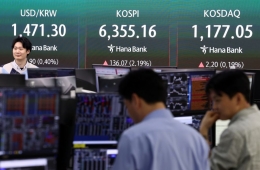
View original imageKim pointed out that regarding the sharp fluctuations in the won-dollar exchange rate since the Middle East conflict erupted at the end of February, "What is concerning is not the level itself, but rather the speed and range of volatility." She explained, "What the government worries about is volatility, especially the short-term pace of the exchange rate. If it moves sharply in one direction, there is always a significant reversal, and unnecessary noise can arise during that process."
She viewed the situation where the won-dollar exchange rate swings widely in the short term depending on negotiations between the U.S. and Iran as especially fatal for companies. Kim said, "Companies move like living organisms 24 hours a day, but when exchange rate volatility increases, they are unable to respond. Even making business investment plans or signing contracts itself can become burdensome."
Kim also emphasized that the old formula—believing a financial crisis would erupt if the exchange rate exceeded 1,500 won—is no longer valid. "If there's a problem with dollar liquidity, an immediate spread appears in the FX swap market (where dollars are bought and sold)," she said. "But since the initial shock of COVID-19 in 2020, we have not observed such phenomena in the past four to five years, even as the exchange rate has risen."
Kim added, "During the COVID-19 period, the United States released a large amount of dollars, and domestic companies have deposited considerable amounts of dollars in banks. So-called 'Seohak Ants' (Korean retail investors investing abroad) also hold a significant volume of dollar deposits. The lingering fear and vigilance from the past foreign exchange crisis and the 2008 global financial crisis, when the won weakened, still remain, so everyone gets anxious when the exchange rate rises. However, the current FX swap market is extremely stable."
FX Dealers Also Watch Nasdaq and KOSPI... "Capital Flows Driven Ultimately by Equities"
Kim assessed that the sharp selloff of domestic stocks by foreign investors in February and March also contributed to increasing exchange rate volatility. "Korean stocks showed overwhelming gains over the past year, so it appears foreign investors realized profits, and the shock from the war also played a role in prompting this. Naturally, this partially contributed to a further weakening of the won," she analyzed.
She also noted that since the selloff has subsided this month, it is important to monitor at what point the balance between foreign investors' purchases of Korean securities and domestic investors' overseas investment will stabilize to gauge the future direction of the exchange rate. "Currently, the outflow of domestic capital overseas has temporarily slowed due to the shock of the war, but considering Korea's low-growth, low-interest-rate environment and the enthusiasm for investing in U.S. stocks leading technological innovation, this trend is unlikely to be short-lived," Kim said. "The possibility that this will continue to create structural pressure for a weaker won in the future cannot be ruled out."
As the correlation between domestic and international equity investment trends and the exchange rate grows, market participants are also sensing change. Kim said, "These days, both bond managers and FX traders have to keep an eye on both domestic and foreign stocks. The flow of capital in and out—that is, the balance of capital flows—has a decisive impact on exchange rates, and equities are the primary indicator."
Era of Investment for Survival..."Government Unlikely to Let the Exchange Rate Rise Indiscriminately"

Heejin Kim, Head of S&T Center at Shinhan Bank, is being interviewed by The Asia Business Daily. Photo by Dongju Yoon
View original imageWith international oil prices surpassing 100 dollars per barrel due to the aftermath of war, some pessimists are suggesting that the won-dollar exchange rate could soar to the 2,000 won range. However, Kim dismissed this as "an extremely dangerous assumption."
She said, "According to traditional economics, it is only natural that international oil prices have risen significantly and, as a result, the exchange rate would also rise. But now we have entered an era of massive investment for survival, with governments supporting it through fiscal policies. Governments may continue efforts to stabilize exchange rates and interest rates to manage fiscal soundness and reduce the burden on companies," Kim explained. She added that given the government's strong commitment to fiscal policy and market intervention, it is unlikely that the exchange rate, prices, or interest rates will spiral out of control purely according to market logic.
Kim commented, "If the 10-year government bond yield rises above 1%, the Japanese government has continued to purchase government bonds to lower yields under its Yield Curve Control (YCC) policy, and both the U.S. and Korean governments could implement similar measures. As fiscal expansion increases the possibility of rising exchange rates and interest rates, and as the government's pressure to stabilize them continues, a balance point is likely to be found between these opposing forces."
Kim stressed, "As the pace of market change accelerates, it has become extremely difficult to make decisions. It is very challenging to respond to what will happen three or four years from now based on the logic that prevailed 10 or 20 years ago. Most people still only pay attention to economic indicators and market movements, but we must broaden our perspective to include fiscal and political factors." She emphasized, "In particular, it is necessary to watch where government finances are heading, the direction of industries, and the political situation surrounding fiscal policy."
WGBI Inclusion, 24-Hour Opening of FX Market..."Opportunity to Boost the Won's Competitiveness"
Kim also discussed the need for fundamental measures to enhance the value of the won for exchange rate stability. She assessed that the international standing of the won has improved significantly compared to the past.
"Until now, the won had remained an NDF (non-deliverable forward) currency, so from a foreign investor's perspective, settlement convenience and transparency were not much different from currencies like the Vietnamese dong or the Indonesian rupiah. However, as the government moves toward a fully open market for the won through initiatives like the opening of the night market and inclusion in the World Government Bond Index (WGBI), the trading environment has changed considerably compared to a decade ago," Kim said.
Hot Picks Today
!["Disclosed Without Prior Consultation"... U.S. Lodged Simultaneous Protests Over Jeong Dongyoung's Remarks Last Month [Yang Nakgyu's Defence Club]](https://cwcontent.asiae.co.kr/asiaresize/93/2026042109031833675_1776729798.jpg) "Disclosed Without Prior Consultation"... U.S. ...
"Disclosed Without Prior Consultation"... U.S. ...
- Individual Investors Net Buy 140.3 Billion Won in a Month... KOSPI Surges While ...
- "Even If the Exchange Rate Exceeds 1,500 Won, No Financial Crisis Looms... Escap...
- KOSPI Hits All-Time High, Driven by Foreign Investors and Institutions
- Couple Secretly Making Love on Mountain Summit... Broadcast Live on the Internet
Kim views the 24-hour opening of the FX market, scheduled for July, as an opportunity to strengthen the won's competitiveness. She said, "If the industrial competitiveness and fiscal soundness of the Korean economy are maintained, there will be more foreign investors including won-denominated stocks and bonds in their portfolios. Rather than remain isolated by clinging to outdated mechanisms, we should use openness to raise the status of the won and prevent negative side effects."
© The Asia Business Daily(www.asiae.co.kr). All rights reserved.


!["They Said It Was 'Delicious' Milk... Is the 'List of Fake Milk Products in Korea' for Real? [Matjal X-File]"](https://cwcontent.asiae.co.kr/asiaresize/307/2023072413274517286_1690172865.jpg)