[New York Diary] What Has the U.S. Gained From the Iran War...
Iranian Regime Remains in Power...
Nuclear Negotiations Uncertain
Strait of Hormuz Still Closed

Just days before the ceasefire is set to end, the second round of talks between the United States and Iran is at risk of falling through. Even if the talks are dramatically held and a deal is reached, it appears that the United States will gain nothing from this war.
U.S. President Donald Trump put forth several goals for the war: preventing Iran from acquiring nuclear weapons, effecting regime change in Iran, and reopening the Strait of Hormuz. Now, more than six weeks after the war began, it is worth asking how many of these objectives President Trump has achieved.
As the second round of talks approaches, the Strait of Hormuz remains closed. While the United States began a counter-blockade in Iranian waters at 10 a.m. Eastern Time on the 13th to increase pressure on Iran, the fact remains that the strait is still shut. Before the Iran war, an average of about 138 vessels passed through the Strait of Hormuz each day. Now, not a single ship is able to move freely through the strait.
It is reported that Iran is demanding control over the Strait of Hormuz in the negotiations. Some countries have even paid tolls to pass through the strait. Even if the strait is reopened, the fact that Iran has demonstrated it can use the Strait of Hormuz as leverage means that the risk to energy transport in the region will not disappear.
President Trump also claims that regime change has been achieved in Iran, but this is not true. After the death of Ayatollah Seyyed Ali Khamenei, Iran decided on his son, Mojtaba Khamenei, as his successor. It is an open secret that the Islamic Revolutionary Guard Corps (IRGC) played a significant role in the process of Mojtaba's selection.
On the surface, the Speaker of the Iranian Parliament—considered a moderate in Iran—is leading the negotiation team, but military forces in Iran still wield significant influence over major political decisions. This is evident from how Iranian media outlets representing the military and hardliners criticized the Speaker after he declared the reopening of the Strait of Hormuz on social media, accusing him of providing political justification to President Trump.
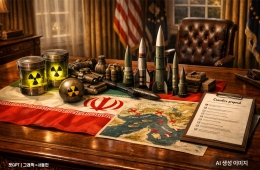
There is also no certainty regarding the nuclear negotiations. According to the New York Times and other sources, the Trump administration proposed a 20-year ban on Iran's uranium enrichment during the first round of talks. In response, Iran reportedly countered with a five-year limit. This led to criticism within the United States that the administration had stepped back from its original position of demanding a permanent ban on enrichment.
In this context, the United States appears to have made its red line on the nuclear negotiations clear during the coordination for the second round of talks. This is because President Trump, in a recent comment to the White House press corps, suggested that the second round of talks would be held and stated that Iran's uranium enrichment period would, in effect, be permanent. However, given the current atmosphere, not only does a successful negotiation seem unlikely, but even the holding of the talks is uncertain.
Hot Picks Today
 "With This Certificate, Even Those in Their 60s...
- Popcorn Container Craze at Theaters Sparks Sell-Out Frenzy, Emerges as New Reven...
- "Bear Destroyed My Rolls-Royce"... US Car Owners Who Claimed $200,000 Insurance ...
- Female Game Caster Makes Bold Move After Criticism Over "Short Skirt" on Broadca...
- "Quit Office Job to Earn Over 200 Million Won a Year"… Chinese Woman in Her 30s...
Meanwhile, the U.S. Navy has announced the seizure of an Iranian vessel. Should the United States' strategy be understood as pursuing both negotiations and military threats simultaneously? It remains doubtful whether Iran will trust the United States and proceed smoothly with negotiations. If the United States has failed to achieve its goals in this war, the best course of action would be to bring the conflict to a swift conclusion.
© The Asia Business Daily(www.asiae.co.kr). All rights reserved.



!["They Said It Was 'Delicious' Milk... Is the 'List of Fake Milk Products in Korea' for Real? [Matjal X-File]"](https://cwcontent.asiae.co.kr/asiaresize/307/2023072413274517286_1690172865.jpg)