[Economic Insight] A Period of National Prosperity... President Lee Jaemyung's Remarkable Good Fortune
![[Economic Insight] A Period of National Prosperity... President Lee Jaemyung's Remarkable Good Fortune](http://www.asiae.co.kr/news/img_view.htm?img=2024052714233685591_1716787416.jpg)
This is a period of national prosperity. The semiconductor supercycle has unexpectedly coincided with a boom in the defense industry. Thanks to the influence of popular culture such as K-pop and K-dramas, Korea's image has improved worldwide, resulting in major successes for K-beauty and K-food. In the first quarter of this year, the number of foreign tourists visiting Korea reached 4.76 million, marking an all-time high for the same period.
President Lee Jaemyung pledged to usher in the era of a KOSPI index at 5,000 during his term, but less than a year after taking office, the KOSPI index not only surpassed 5,000 but also crossed the 6,000 mark. While there were efforts such as introducing separate taxation on dividend income, imposing severe penalties for stock price manipulation, and amending the Commercial Act, it would have been difficult to achieve this without the coincidental external factors of the semiconductor supercycle, the artificial intelligence (AI) boom, and the defense industry boom.
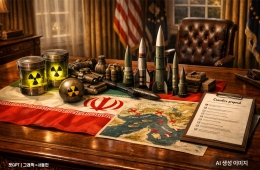
The KOSPI index has been on an upward trend since the second half of last year, and in January and February of this year, it soared so rapidly that it even broke through the 6,000 level. There was concern that such a rapid rise might trigger a sharp correction, and then the United States-Iran war broke out. As the saying goes, "it rains when you are already wet," and the war led to a correction in the KOSPI index. However, just a month and a half after the correction, on April 15, it again surpassed the 6,000 level. Foreign investors posted a record net sale of 43.888 trillion won worth of stocks in the KOSPI market in March this year, and another net sale of 19.319 trillion won in February. Nevertheless, the KOSPI index managed to hold above the 5,000 mark and rebounded afterward.
The International Monetary Fund (IMF) released its World Economic Outlook (subtitle: The World Economy in the Shadow of War) report on April 14, which downgraded the growth forecasts for major countries such as the United States, the United Kingdom, the Eurozone, and China by 0.1 to 0.5 percentage points each for this year, but kept Korea's growth forecast unchanged at 1.9%. While the U.S.-Iran war poses a downside risk to the economy, the 26.2 trillion won supplementary budget utilizing excess tax revenue is expected to offset this impact.
The government announced this supplementary budget, projecting the amount of excess tax revenue this year at 25.2 trillion won, a figure that, as the government stated, was calculated conservatively. Due to the semiconductor supercycle, both corporate tax and earned income tax are expected to rise sharply, and the stock market boom is likely to result in a surge in securities transaction tax revenue, leading to forecasts that excess tax revenue will exceed at least 35 trillion won this year.
Countries around the world are facing concerns about stagflation, where economic downturn and soaring inflation occur simultaneously due to the United States-Iran war. Central banks are faced with uncomfortable choices: whether to worsen the economic outlook by raising interest rates to control inflation, or to accept the risk of rising inflation expectations. The UK think tank Oxford Economics predicted that the European Central Bank (ECB), given its hawkish stance and relatively low base rates, would raise rates twice this year by 0.25 percentage points each. In contrast, the U.S. Federal Reserve is still expected to cut rates by 0.25 percentage points each in June and September.
Korea, thanks to exceptional excess tax revenue, is able to make relatively easier choices. If tax revenues exceed initial forecasts, the Bank of Korea can maintain its policy rate, and the government can implement a second supplementary budget to counter downward economic pressures. In the United States and European countries, excessive government debt combined with the need to increase defense spending makes it difficult to use fiscal measures to support the economy, but Korea is an exception.
Hot Picks Today
 "Six Months After 'Mom's Touch Troublesome Woma...
- Popcorn Container Craze at Theaters Sparks Sell-Out Frenzy, Emerges as New Reven...
- "With This Certificate, Even Those in Their 60s Can Get Hired and Earn 3.69 Mill...
- Kang Hoon-sik Urges Enhanced Effectiveness of Mandatory Employment for People wi...
- Female Game Caster Makes Bold Move After Criticism Over "Short Skirt" on Broadca...
President Lee Jaemyung not only demonstrates impressive leadership in state affairs, but is also a remarkably lucky president, with the nation's fortune on his side.
© The Asia Business Daily(www.asiae.co.kr). All rights reserved.


!["They Said It Was 'Delicious' Milk... Is the 'List of Fake Milk Products in Korea' for Real? [Matjal X-File]"](https://cwcontent.asiae.co.kr/asiaresize/307/2023072413274517286_1690172865.jpg)