[Market ING]KOSPI Returns to 6,000: Will It Break Through Its Previous High?
Weekly KOSPI Projected Range: 5,700–6,400 Points
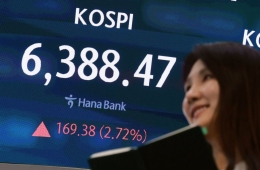
Driven by expectations for an end to the war, the KOSPI has regained the 6,000-point level. The market is now watching to see whether the KOSPI will surpass its previous high and set a new all-time record this week. However, given that geopolitical uncertainties remain, it is important to note that volatility could increase depending on the situation.

Last week, the KOSPI rose by 5.68%, while the KOSDAQ climbed by 6.99%. Jeongeun Lim, a researcher at KB Securities, explained, "U.S. President Donald Trump hinted at the possibility of a second round of negotiations to end the war, which somewhat eased geopolitical uncertainty stemming from the Middle East. The S&P 500 and Nasdaq in the United States both hit record highs." She continued, "Variables related to the war appear to be gradually peaking. Last week, the KOSPI and KOSDAQ returns were 5.68% and 6.99%, respectively, nearly returning to pre-war levels as expectations for an end to the conflict, along with earnings and order momentum, were reflected."
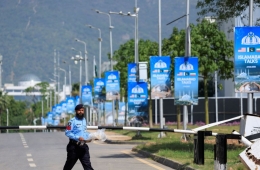
However, as Iran closed the Strait of Hormuz just one day after reopening it, the market is expected to remain subject to Middle East-driven geopolitical uncertainty this week. Previously, Iran’s Islamic Revolutionary Guard Corps (IRGC) announced that the Strait of Hormuz was closed from the evening of the 18th (local time), and that it would not be reopened unless the United States lifts its maritime blockade on Iran.
Jongmin Kim, a researcher at Samsung Securities, said, "Following the breakdown of the initial negotiations, the Iranian situation is likely to lead to a tense tug-of-war, and for the time being, both optimism and disappointment could create noise in the market. However, the market has already developed resilience, and investors are now looking at the next phase beyond the war. Even if the market ahead is as bumpy as an unpaved road, the opportunity cost of hesitating to invest is currently too high."
Although uncertainty in the Middle East persists, the market’s focus is expected to shift more toward corporate earnings. Sangjun Lee, a researcher at NH Investment & Securities, said, "The trend of the market’s attention moving from the war to corporate results will likely continue. This week, SK hynix is scheduled to announce its earnings. Considering that Samsung Electronics recently reported results that significantly beat consensus estimates thanks to a strong rise in memory prices, there is a high probability that SK hynix will also post a first-quarter earnings surprise this year." Currently, the consensus for SK hynix’s first-quarter results stands at KRW 48 trillion in revenue and KRW 32.9 trillion in operating profit. Lee added, "Following Samsung Electronics’ earnings release, the KOSPI’s earnings forecast was revised upward, but the 12-month forward price-to-earnings ratio (PER) actually declined to 8.2 times even after regaining the 6,000-point level. Both earnings and valuation are now creating momentum for the stock price." NH Investment & Securities suggested a KOSPI forecast range of 5,700 to 6,400 points for this week.
Jinhyuk Kang, a researcher at Shinhan Investment & Securities, also noted, "As the recent rebound in the market has been led by U.S. big tech, there are expectations for the performance of the AI value chain, including semiconductors and power. It’s important to watch whether earnings estimates for major memory companies such as SK hynix and SanDisk will be revised upward." He added, "With the KOSPI approaching its previous high and preparing for an all-time high rally, there is a possibility that leading stocks will come into focus."
Key events scheduled for this week include Korea’s export figures for April 1-20 and U.S. March retail sales on the 21st, as well as the confirmation hearing for Kevin Warsh, nominee for Chair of the U.S. Federal Reserve. On the 23rd, the U.S. S&P Global Manufacturing and Services PMI for April will be released.
Kyungmin Lee, a researcher at Daishin Securities, said, "U.S. retail sales for March are expected to increase by 1.2% month-on-month (February: 0.6%), but due to rising energy prices, retail sales excluding autos and gasoline are likely to grow by only 0.2%, slowing from February’s 0.5%. The key will be how well real retail sales hold up. Since the Consumer Price Index (CPI) is not showing signs of energy price increases spreading to other items, if real retail sales remain robust, concerns about U.S. stagflation will likely ease quickly."
Korea’s export results, to be released on the 21st, are also drawing attention. Lee added, "The correlation between daily average export amounts and the KOSPI is over 0.7. If the daily average export volume as of the 20th hits a new all-time high, it will boost the KOSPI’s upward momentum. As of the 10th, the export growth rate was 36.7%, with both total and semiconductor exports reaching record amounts."
Hot Picks Today
 Applied Just for Skin Soothing...Study Finds It...
- "Only the Top 1% Winning Big in Stocks Smile... '300 Million Won Splurges' or '1...
- "Paying More Than the Listed Price?"... Academies Caught in the Act of Illicit T...
- "If You Pay, I'll Close the Case"... Former Korea Customs SJPO Who Took 145 Mill...
- "Please Launch It in Korea!" After All the Hype... This Coffee Finally Arrives i...
Corporate earnings releases will also continue. In the United States, Tesla, Lam Research, IBM, AT&T, and Boeing will announce results on the 22nd, while Intel will report on the 23rd. In Korea, Samsung Biologics will announce first-quarter results on the 22nd, and SK hynix and KB Financial Group will do so on the 23rd.
© The Asia Business Daily(www.asiae.co.kr). All rights reserved.





![Is This a Boom or a Recession? Queues for Both Luxury and Bargain Goods [K-Shaped Consumption Era]](https://cwcontent.asiae.co.kr/asiaresize/307/2026042114133834494_1776748418.png)