US and Iran Likely to Hold Second Ceasefire Talks in Pakistan on the 20th
Significant Differences Remain Over Nuclear Materials
Will the Two Sides Narrow Their Disagreements?
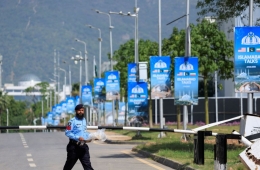
The second round of ceasefire talks between the United States and Iran is expected to take place on the 20th (local time) in Islamabad, Pakistan. As significant differences remain on key issues such as nuclear materials, attention is focused on whether the two sides can narrow their disagreements.

According to the Wall Street Journal (WSJ) on the 17th (local time), a senior official from the Trump Administration stated that there is a high likelihood the talks between the two countries will be held in Pakistan on the 20th. The official explained that the U.S. negotiation team is on standby to attend the meeting. Iranian officials also told CNN that their delegation would arrive in Islamabad on the 19th and that the talks are expected to take place on the 20th. Although neither government has officially announced the date, both sides have informally identified the 20th as the most likely day for the talks.
President Donald Trump previously stated in an interview with Bloomberg that "most of the major issues have been resolved." However, since disagreements remain on critical issues such as halting uranium enrichment and Iran’s abandonment of its nuclear program, there is keen interest in how both sides will seek common ground during the second round of talks.
In particular, whether Iran will transfer its enriched uranium is expected to be a central issue. President Trump has claimed that Iran has agreed to give up its "nuclear dust"—that is, enriched uranium—and hand it over to the United States, but Iran has denied this. Esmail Baghaei, spokesperson for Iran’s Ministry of Foreign Affairs, said in an interview with state-run IRIB that "Iran’s enriched uranium will not be transferred anywhere."
Hot Picks Today
 "Even Luxury Cars Drive Off Without Paying"... ...
- "Only the Top 1% Winning Big in Stocks Smile... '300 Million Won Splurges' or '1...
- Applied Just for Skin Soothing...Study Finds It Suppresses Antibiotic Resistance
- "Is the Starting Salary Really 4 Million Won?"... Surprise as Navy Salary and Sa...
- “Nothing Left to Protect” as Japan Drops Its “Peace State” Banner... Lifts B...
The United States and Iran previously failed to reach an agreement in the first round of talks after being unable to bridge differences over uranium enrichment. According to U.S. media, the United States stepped back from its original position of a complete ban on uranium enrichment and proposed a 20-year suspension instead. However, Iran counter-offered with a five-year suspension, which led to the breakdown of the negotiations.
© The Asia Business Daily(www.asiae.co.kr). All rights reserved.




![Is This a Boom or a Recession? Queues for Both Luxury and Bargain Goods [K-Shaped Consumption Era]](https://cwcontent.asiae.co.kr/asiaresize/307/2026042114133834494_1776748418.png)